Wide Open. Gear

The Best Gimbals Under $500

Under $500 a gimbal choice stops being about payload and starts being about what comes in the box - tracking, a fill light, or neither.

By Stephen V.Last updated How we pick

Under $500 the gimbal to buy is the DJI RS 4 — a 3 kg tested payload, automated axis locks and 360 degrees per second of rotation on all three axes, which means it balances a full-frame body with a fast zoom attached and still folds down without a wrestling match. It is for anyone whose camera is heavier than a kit zoom. The budget pick is the Hohem iSteady MT2 Kit, the cheapest gimbal here — and the one that includes the most: a magnetic AI tracker module and a magnetic CCT/RGB fill light come in the box, which on a DJI you buy separately or do without.

All four gimbals below carried a live price under $500 when our price layer last ran, on November 24, 2026, and the table prints each one’s current number with that date under it. The most expensive reads under three quarters of the ceiling, so this band has real headroom rather than sitting a few dollars inside it.

Our main gimbal roundup ranks on one thing: payload, because a gimbal that cannot carry your camera is not a gimbal. That ordering puts the DJI RS 4 Pro at the top, and it is the right answer to the question “which gimbal is best.”

Inside a $500 ceiling, the question changes, and this is the whole reason for this page. The RS 4 Pro is out of the band, and what is left are four stabilizers whose published payloads run from 1 kg to 3 kg — a range in which most mirrorless setups fit on most of them. Once payload stops being the deciding factor, what comes in the box does. Two of these four include a subject-tracking system and a usable fill light. Two do not, and sell tracking as a separate module. That difference is worth more in practice than 1 kg of headroom you will never use, and it is what we ranked on.

Before you buy anything here, weigh your actual rig — body, lens, and whatever is bolted to it. Gimbal payload figures are the one specification where being optimistic costs you money, because an overloaded gimbal does not fail gracefully; the motors fight, the horizon drifts and the battery empties. Our gimbal vs in-body stabilization explainer is also worth two minutes first, because for some kinds of shooting the answer is that you do not need one of these at all.

How this is funded: we earn a commission if you buy through our links, at no extra cost to you. It never changes which product we recommend, and we’ll tell you plainly when to skip one. Full disclosure.

Quick picks

Ranked on published specs and buyer fit. Select a row to jump to the full write-up. We have not tested these products — here is exactly what we do instead.

#ProductBest forPrice
1
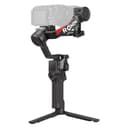
DJI RS 4

DJI RS 4

The full-size RS, and the one to buy if your camera is a full-frame body with a real zoom on the front. Its 3 kg tested payload is 50% more than the Mini's, which is the difference between balancing comfortably and balancing right at the edge. You pay for that in weight - about 1,066 g before the grip - so this is a gimbal for planned shoots rather than all-day carry. One thing to know first: DJI has since shipped the RS 5, the newer full-size generation, and it is the one to buy if you want current. It carries the same 3 kg tested payload in a heavier head - about 1,193 g with plates - and charges in roughly an hour where this one takes 2.5. DJI still lists the RS 4 alongside it as the cheaper route into that payload class, which is why it keeps this slot.

Best overall
$369.00 · View on Amazon

$469.0021% off

Price as of November 24, 2026. #ad How we’re funded

2
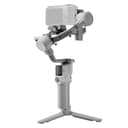
DJI RS 4 Mini

DJI RS 4 Mini

The gimbal most people buying their first one should get. At about 890 g it is light enough that you will actually carry it, and its 2 kg tested payload covers the mirrorless-plus-small-prime kit almost everyone in our camera guides owns. Automated axis locks mean it folds and unfolds without a three-minute ritual, which is the single biggest reason gimbals end up in a closet.

Best for small mirrorless
$259.00 · View on Amazon

$369.0030% off

Price as of November 24, 2026. #ad How we’re funded

3
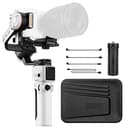
Zhiyun Crane M3S

Zhiyun Crane M3S

The lightest camera gimbal here at 705 g, and the only one with a usable light built into the head - a bi-color panel Zhiyun rates at 1,000 lux. For a solo creator shooting handheld in a hotel room or a cafe that removes a whole second piece of gear from the bag. The trade is payload: 1 kg is a compact mirrorless with a pancake or small prime, and not much more.

Best built-in light
$239.00 · View on Amazon

$299.0020% off

Price as of November 24, 2026. #ad How we’re funded

4
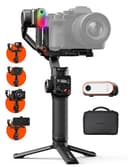
Hohem iSteady MT2 Kit

Hohem iSteady MT2 Kit

The value pick, and the one that includes the extras the others charge for: a magnetic AI tracker that follows you around the frame, and a magnetic fill light with CCT and RGB modes, both in the box. Hohem is a smaller name than DJI or Zhiyun and the app is rougher, but 1.2 kg of payload at 653 g, with tracking included, is a lot of gimbal for the money.

Budget pick
$199.00 · View on Amazon

$229.0013% off

Price as of November 24, 2026. #ad How we’re funded

The picks in full

#1Best overall

DJI RS 4

The full-size RS, and the one to buy if your camera is a full-frame body with a real zoom on the front. Its 3 kg tested payload is 50% more than the Mini's, which is the difference between balancing comfortably and balancing right at the edge. You pay for that in weight - about 1,066 g before the grip - so this is a gimbal for planned shoots rather than all-day carry. One thing to know first: DJI has since shipped the RS 5, the newer full-size generation, and it is the one to buy if you want current. It carries the same 3 kg tested payload in a heavier head - about 1,193 g with plates - and charges in roughly an hour where this one takes 2.5. DJI still lists the RS 4 alongside it as the cheaper route into that payload class, which is why it keeps this slot.

Strengths

  • 3 kg tested payload handles a full-frame body with a 24-70mm f/2.8
  • 360-degrees-per-second maximum controlled rotation on all three axes
  • Continuous 360-degree pan for whip-around and orbit moves

Trade-offs

  • Roughly 1,066 g before the grip and plates - noticeably more to hold up
  • Published charge time is about 2.5 hours, the slowest of the DJI gimbals here
Tested payload3 kg (6.6 lb)
WeightApprox. 1,066 g gimbal; grip approx. 203 g, plates 98 g
BatteryUp to 12 h stationary (DJI figure; less in active use)
ChargingApprox. 2.5 h with an 18W PD charger
Max rotation360 degrees/s on pan, tilt and roll

Specifications read from the manufacturer listing, on October 9, 2026.

#2Best for small mirrorless

DJI RS 4 Mini

The gimbal most people buying their first one should get. At about 890 g it is light enough that you will actually carry it, and its 2 kg tested payload covers the mirrorless-plus-small-prime kit almost everyone in our camera guides owns. Automated axis locks mean it folds and unfolds without a three-minute ritual, which is the single biggest reason gimbals end up in a closet.

Strengths

  • Automated axis locks - fold it, pull it out, shoot, with no manual latches
  • About 890 g, the lightest DJI gimbal that still handles a real camera
  • DJI publishes 13 hours of stationary runtime and roughly a 1h50m recharge

Trade-offs

  • 2 kg tested payload rules out a full-frame body with a fast 24-70mm zoom
  • Subject tracking needs the separate Intelligent Tracking Module, sold on its own
Tested payload0.4-2 kg (0.88-4.4 lb)
WeightApprox. 890 g (gimbal, excluding tripod and quick-release plate)
BatteryUp to 13 h stationary (DJI figure; less in active use)
ChargingApprox. 1 h 50 min with a 30W charger
Axis locksAutomated
TrackingDJI RS Intelligent Tracking Module (19 g, magnetic) sold separately

Specifications read from the manufacturer listing, on October 9, 2026.

#3Best built-in light

Zhiyun Crane M3S

The lightest camera gimbal here at 705 g, and the only one with a usable light built into the head - a bi-color panel Zhiyun rates at 1,000 lux. For a solo creator shooting handheld in a hotel room or a cafe that removes a whole second piece of gear from the bag. The trade is payload: 1 kg is a compact mirrorless with a pancake or small prime, and not much more.

Strengths

  • 705 g - the lightest camera gimbal in this guide by a clear margin
  • Built-in bi-color 2700-5500K fill light rated at 1,000 lux
  • Handles a phone or an action camera as well as a compact mirrorless body

Trade-offs

  • 1 kg payload is the tightest here - a fast zoom will overload it
  • 7.5-hour rated runtime is about half what the DJI gimbals publish
Max payload1 kg
Weight705 g
Battery7.5 h (Zhiyun lab figure); PD charge in approx. 2 h
Fill lightBuilt-in bi-color 2700-5500K, 1,000 lux
Screen1.22-inch color touchscreen
Mechanical range360-degree pan, 305-degree tilt, 314-degree roll

Specifications read from the manufacturer listing, on October 9, 2026.

#4Budget pick

Hohem iSteady MT2 Kit

The value pick, and the one that includes the extras the others charge for: a magnetic AI tracker that follows you around the frame, and a magnetic fill light with CCT and RGB modes, both in the box. Hohem is a smaller name than DJI or Zhiyun and the app is rougher, but 1.2 kg of payload at 653 g, with tracking included, is a lot of gimbal for the money.

Strengths

  • AI tracker and a magnetic CCT/RGB fill light are both included, not add-ons
  • 653 g carrying 1.2 kg - a better payload-to-weight ratio than the Zhiyun
  • Hohem rates the 2,600 mAh battery at up to 17 h, or 6-8 h with AI tracking running

Trade-offs

  • App and firmware are less polished than DJI's Ronin ecosystem
  • Published charge time is about 3 hours, the longest in this guide
Max payload1.2 kg
Weight653 g
Battery2,600 mAh; up to 17 h, 6-8 h with AI tracking
ChargingApprox. 3 h
IncludedMagnetic AI tracker module and magnetic CCT/RGB fill light
Mechanical range360-degree pan, 290-degree tilt, 200-degree roll

Specifications read from the manufacturer listing, on October 9, 2026.

How we ranked these

1. Published payload against real rigs. DJI publishes a tested payload, Zhiyun and Hohem publish a maximum. We quote whichever each manufacturer actually publishes, with the wording, because “tested payload 3 kg” and “max payload 1 kg” are not the same kind of claim. Then we say what rig that number realistically covers.

2. What is included versus sold separately. This is the axis that reorders this band. The Hohem ships with an AI tracker module and a fill light; the Zhiyun has a fill light built into the body; DJI’s RS Intelligent Tracking Module is a 19 g magnetic accessory you buy on top. If you shoot alone and need the camera to follow you, that is a real cost difference.

3. Weight of the gimbal itself, because you carry it as well as the camera. The spread here runs from 653 g to roughly 1,066 g for the gimbal body, and after twenty minutes one-handed that is not a small difference.

4. Battery, read with the condition attached. Every figure on this page is a manufacturer figure measured stationary or in a lab, not in active use. We print the condition next to the number — Hohem’s 17 hours drops to 6-8 hours with AI tracking running, by Hohem’s own reckoning, and that is the honest way to compare.

5. Setup friction. Automated axis locks sound like a detail until you have balanced a gimbal in a car park. DJI has them on both its picks here.

We have not tested these gimbals — here is exactly what we do instead — and every figure is the manufacturer’s own published specification with the date we read it. No scores, because a score would imply a measurement we did not take.

The DJI pair: payload and setup speed

The RS 4 is the pick if your camera is heavy. A 3 kg tested payload comfortably covers a full-frame body with a 24-70mm f/2.8 or a 70-180mm attached, which is the setup most people actually struggle to balance. It rotates at up to 360 degrees per second on pan, tilt and roll, DJI rates the battery at up to 12 hours stationary, and it charges in about 2.5 hours from an 18W PD charger. The gimbal body is roughly 1,066 g, plus about 203 g for the grip and 98 g for the plates.

The RS 4 Mini is the pick if it is not. DJI publishes a tested payload of 0.4-2 kg, which is an APS-C or full-frame body with a small prime or a kit zoom — and note the lower bound of 0.4 kg, which is the number people miss: a gimbal this capable can be under-loaded as well as over-loaded. At roughly 890 g excluding the tripod and plate, and up to 13 hours stationary, it is the lighter thing to carry all day.

Both have automated axis locks, which is the single biggest quality-of-life difference between a modern gimbal and a cheap one. What both also have is an extra purchase: subject tracking needs the DJI RS Intelligent Tracking Module, a 19 g magnetic add-on sold separately. If following yourself around a room is the reason you want a gimbal, factor that in before comparing prices with the two below.

The two that include what DJI sells separately

The Zhiyun Crane M3S has a bi-color fill light built into the body — 2700K to 5500K at a published 1,000 lux — plus a 1.22-inch color touchscreen for changing settings without a phone. Its maximum payload is 1 kg, so this is a compact-mirrorless gimbal rather than a full-frame-with-a-zoom one. It weighs 705 g, Zhiyun quotes 7.5 hours of battery as a lab figure, and it charges over USB-C PD in roughly two hours. Its mechanical range is the widest here: 360 degrees pan, 305 tilt, 314 roll.

For a one-person run-and-gun setup — a small body, a prime, and a face that needs a little light on it in a dim venue — having the light on the gimbal rather than in a bag is a genuine advantage, and it is why this is the pick despite the lowest payload on the page.

The Hohem iSteady MT2 Kit is the budget pick and the value outlier. It is the cheapest gimbal here, and it ships with the two things that cost extra elsewhere: a magnetic AI tracker module that follows a subject without a phone in the loop, and a magnetic CCT/RGB fill light. Payload is 1.2 kg, the gimbal is 653 g — the lightest on this page — and Hohem rates the 2,600 mAh battery at up to 17 hours, falling to 6-8 hours with AI tracking active, which is the figure that matters if tracking is why you bought it. It charges in about three hours.

Read the payload honestly: 1.2 kg is a mirrorless body and a light lens, not a full-frame body with an f/2.8 zoom. Within that limit, it is the most capable thing you can buy at this price and the reason it sits on our main gimbal roundup as well.

What $500 does not buy

A cinema-camera payload. The DJI RS 4 Pro publishes a 4.5 kg tested payload, a built-in image transmitter with roughly 200 m of range, and a -20 to 45 degrees C operating range. It is roughly double this ceiling and it is the right tool for paid work with a rigged camera and someone watching a monitor. Nothing in this band is a substitute.

Wireless video out. None of these four transmits a monitoring feed. If a second person needs to see the frame, that is a feature of the tier above.

An excuse not to balance it. A gimbal is only as good as the balance you set, and no price point changes that. Automated axis locks speed up the process; they do not do it for you. Budget fifteen minutes the first time, and remember that changing lens means balancing again — which is itself an argument for a one-lens kit on gimbal days. Our video lens roundup leans toward exactly that.

Stabilization you cannot get any other way. Worth saying last because it saves some people $200. If your body has in-body stabilization and your lens has optical stabilization, slow walking shots may already look good enough, and a gimbal is a large object to carry for a marginal gain. The gimbal vs IBIS explainer lays out which kinds of movement actually need one.
Frequently asked questions

What is the best gimbal under $500?

The DJI RS 4. DJI publishes a tested payload of 3 kg, which covers a full-frame body with a fast standard or telephoto zoom attached, and it has automated axis locks plus up to 360 degrees per second of rotation on all three axes. The gimbal body is about 1,066 g and DJI rates the battery at up to 12 hours stationary.

What gimbal should I buy if I shoot alone?

The Hohem iSteady MT2 Kit, if your rig is under its 1.2 kg payload. It is the cheapest gimbal in this roundup and it includes a magnetic AI tracker module and a magnetic fill light in the box - on DJI's RS 4 and RS 4 Mini, subject tracking means buying the separate RS Intelligent Tracking Module. Hohem rates the battery at up to 17 hours, dropping to 6-8 with AI tracking running.

How much payload do I need in a gimbal?

Weigh your body, your heaviest lens and anything bolted on, then buy above that number rather than at it. In this band the published figures run from 1 kg (Zhiyun Crane M3S) through 1.2 kg (Hohem iSteady MT2) and 0.4-2 kg (DJI RS 4 Mini) to 3 kg (DJI RS 4). An overloaded gimbal does not fail politely: the motors fight the weight, the horizon drifts and the battery drains fast.

Is the DJI RS 4 Mini enough for a mirrorless camera?

For most mirrorless setups, yes. DJI publishes a tested payload range of 0.4-2 kg, which covers an APS-C or full-frame body with a small prime or a kit zoom. Note the lower bound as well as the upper one - a very light camera can sit below the range. It weighs about 890 g excluding the tripod and quick-release plate, which makes it the easier of the two DJI picks to carry all day.

Do any gimbals under $500 have a light built in?

Two of them. The Zhiyun Crane M3S has a bi-color fill light built into the body, published at 2700-5500K and 1,000 lux, plus a 1.22-inch touchscreen. The Hohem iSteady MT2 Kit includes a magnetic CCT/RGB fill light that attaches to the gimbal. Neither replaces a real key light, but both solve the problem of a face with nothing on it in a dim room.

Do I need a gimbal if my camera has in-body stabilization?

Often not. IBIS and optical lens stabilization together handle handheld static shots and slow pans well. What they do not handle is sustained walking, running, or deliberate sweeping moves - that is what a mechanical gimbal is for, because three motors physically hold the camera level rather than correcting for shake after the fact. Our gimbal vs in-body stabilization explainer covers which movements need which.

Sources

Keep reading