How we ranked these
1. Sensor format first, resolution second. Format decides how much light the sensor collects and how shallow your depth of field can get at a given framing; resolution decides how far you can crop and how large you can print. Two bodies here are full-frame at 24.2 MP, and four are APS-C between 20.9 and 26.1 MP. Our full-frame vs APS-C explainer covers what that difference is actually worth, and the honest answer is: less than the price gap for most people.
2. A published viewfinder. Three of the APS-C bodies here publish a 2.36 million-dot electronic viewfinder in their specifications — the a6400, the X-T30 II and the Z fc. A viewfinder is not nostalgia: holding the camera to your eye braces it against your face, which is worth most of a stop of hand-holding, and it is the only way to see your frame properly in bright sunlight. We rank a body that publishes one above one that does not.
3. The lens system. Sony E has the widest choice at every price including third-party glass from Sigma and Tamron. Canon RF has excellent first-party lenses and almost no third-party autofocus options on full-frame. Fujifilm X is a deep, well-regarded APS-C-only system. Nikon Z is strong on full-frame and thin on APS-C primes. That ranking does not change between bodies, and it is the part of this decision you cannot undo cheaply.
4. In-body stabilization, read as a stills feature. Both full-frame picks publish 5-axis IBIS. For photography that means hand-holding at slower shutter speeds — a real, usable advantage in a dim church or at dusk. None of the four APS-C bodies here publishes IBIS, which is why a stabilized lens matters more on them. See our image stabilization explainer.
5. Weight with the battery in. The spread here is 375 g to 670 g, and the camera you carry is the camera you use. Every figure below includes the battery, as published.
We have not tested these cameras — here is exactly what we do instead — and every figure is the manufacturer’s own published specification with the date we read it. No scores, because a score would imply a measurement we did not take.
The full-frame pair, and whether you need one
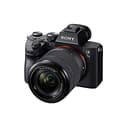
The Sony a7 III is the pick and has been the sensible full-frame answer for several years. 24.2 MP is the resolution that most photographers actually want — enough to print large and crop a little, not so much that every file is a storage problem. 5-axis IBIS, 650 g with the battery, and the Sony E mount, which is the single biggest reason to choose it: you can buy a $198 Sony FE 50mm f/1.8, a $344 Sigma 30mm f/1.4 or a $695 Tamron 28-75mm f/2.8 and all of them autofocus properly. No other full-frame system offers that range of affordable glass.
What it is not is new. Sony publishes 4K30 with a full-width readout, which is fine and is not why you would buy it. If video is genuinely half of what you shoot, our hybrid camera roundup is the right page and it will point you at newer bodies.
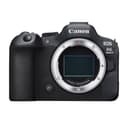
The Canon R6 Mark II is the pick if you are already in Canon — if you own RF or EF glass, or you simply prefer how Canon bodies handle, the cost of switching systems is not worth saving on a body. It is also 24.2 MP full-frame with 5-axis IBIS, at 670 g. It is the most expensive camera on this page, and the honest caveat is the lens market: Canon has not licensed third-party autofocus lenses for full-frame RF, so your glass options are Canon’s own, at Canon’s prices. Our full-frame roundup puts it against the a7 III and the a7 IV directly.
And the question behind both: do you need full-frame at all? If you shoot landscapes in good light, or you are mostly posting online, an APS-C body plus a good prime will beat a full-frame body plus a kit zoom, for less money. The format matters most in low light and for shallow depth of field at a given framing. If neither is central to your photographs, spend the difference on lenses — our camera or lens guide works through that properly.
The APS-C bodies, which is where most people should buy
The Fujifilm X-T30 II is the pick for anyone who does not want to edit. A 26.1 MP X-Trans CMOS 4 sensor, a 2.36M-dot EVF and 383 g with the battery, and Fujifilm’s film simulations applied in camera. That last part is the real argument: if you want JPEGs you can post straight off the card and genuinely like, this is the system that does it, and no amount of editing software makes another body feel the same way. It is the highest-resolution sensor on this page. It is also APS-C only and X-mount glass is not cheap at the wide end. Our Fujifilm roundup covers the rest of the range.
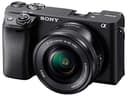
The Sony a6400 is the pick if you want one camera to do everything without paying full-frame money. 24.2 MP APS-C, a 2.36M-dot EVF, 403 g, and Sony’s autofocus, which remains the benchmark at this price. The reason it is the all-rounder is the mount again: an a6400 with a Sigma 30mm f/1.4 is a genuinely excellent stills kit for well under half the cost of the a7 III, and every lens you buy still fits if you move to full-frame Sony later. Our Sony APS-C lens guide and Sony lens roundup cover where to start.
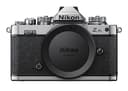
The Nikon Z fc is the pick if you want to shoot in manual. 20.9 MP APS-C, a 2.36M-dot EVF, 445 g, and physical dials for shutter speed and exposure compensation on the top plate rather than buried in menus. If you learn by changing one setting at a time and watching what happens, a dial-driven body teaches you faster than a mode wheel does — our manual mode guide is written around exactly that. The costs are honest: the lowest resolution here, and Nikon’s APS-C prime selection is the thinnest of the four mounts on this page.
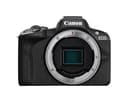
The Canon EOS R50 is the budget pick and the lightest body here at 375 g with the battery. 24.2 MP APS-C and Dual Pixel CMOS AF II, which is the autofocus system that makes Canon bodies so forgiving for a first camera — it finds a face and holds it without you managing it. For a first real camera, that matters more than any specification on this page, which is why it is also the top pick on our beginner mirrorless roundup. RF-S glass is limited and there is no third-party autofocus option, so plan on Canon’s own lenses — our R50 lens guide lists what exists.
What to buy after the body
Three things, in this order, and the order matters more than people expect.
A fast prime. Whatever body you buy, the kit zoom is the weakest part of the kit. A 30mm or 50mm f/1.8 or f/1.4 gathers two to three stops more light than a kit zoom and renders backgrounds in a way it simply cannot, and it usually costs less than a quarter of the camera. This is the single biggest improvement available to a new photographer. Our prime lens roundup is the page.
A second battery and a decent card. Unglamorous, and the difference between coming home with the photographs and coming home without them. Our SD card roundup explains which speed class you actually need rather than which is most expensive.
A way to carry it. A camera in a drawer takes no photographs. A bag you do not mind carrying, or a strap that does not dig in, is what gets the body out of the house — our camera bag roundup covers it.
What you do not need yet: a tripod, filters, a second body, or a faster computer. Those are answers to problems you have not met. The one exception is a tripod if you already know you want long exposures or landscapes at dusk, and our tripods under $200 roundup covers that without overspending.