Wide Open. Gear

The Best Shotgun Mic for Streaming

Keep the mic out of frame without sounding like you are in a bathroom — the shotguns that work on a boom arm, and the one thing you must get right.

By Stephen V.Last updated How we pick

Most streamers buy a big USB condenser, put it in the middle of the frame, and spend the next year trying to crop around it. A shotgun mic is the answer to that specific problem: it is directional enough to sit on a boom arm above the top edge of frame, pointed down at your mouth, and still sound close. The camera never sees it, and your face is not hidden behind a metal grille.

The catch is that a shotgun off-axis is far less forgiving of a bad room than a dynamic mic held six inches from your face. Get the distance right and it sounds broadcast-clean; get it wrong and you hear the room, the keyboard and the PC fans. Below are the shotguns that make sense for a streaming desk — starting with the only one here that is also a full USB microphone — plus what you actually need to change to make any of them sound good.

How this is funded:we earn a commission if you buy through our links, at no extra cost to you. It never changes which product we recommend, and we’ll tell you plainly when to skip one. Full disclosure.

Quick picks

Ranked on published specs and buyer fit. Select a row to jump to the full write-up. We have not tested these products — here is exactly what we do instead.

#ProductBest forPrice
1
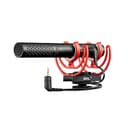
RODE VideoMic NTG

RODE VideoMic NTG

The shotgun that is also a USB microphone, which is exactly what a streamer wants. It carries the acoustic design of RODE's NTG5 broadcast shotgun, then adds a USB output so it can go straight into a computer, a variable gain dial, a high-pass filter, a -20dB pad, a high-frequency boost and a safety channel. The 3.5mm jack auto-senses whether it is plugged into a camera or a phone, and doubles as a headphone output when you are on USB.

Best overall
$239.40 · View on Amazon

Price as of September 3, 2026. #ad How we’re funded

2
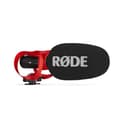
RODE VideoMic GO II

RODE VideoMic GO II

The best on-camera mic for most creators, and the one to buy if you buy one. It plugs into a camera by 3.5mm or straight into a computer or phone over USB, needs no battery, and sounds dramatically better than any built-in mic. Directional enough to reject room noise, simple enough to forget about.

Best value USB shotgun
$94.99 · View on Amazon

$109.0013% off

Price as of September 3, 2026. #ad How we’re funded

3
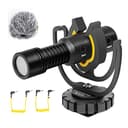
Deity V-Mic D4 Mini

Deity V-Mic D4 Mini

The value on-camera shotgun. It draws power straight from the camera's mic jack — no battery to forget — and delivers clean, directional sound for less than most rivals. A strong wind rating makes it a sensible cheap upgrade for outdoor talking-to-camera on a mirrorless or phone.

Cheapest way in
$49.95 · View on Amazon

Price as of September 3, 2026. #ad How we’re funded

The picks in full

#1Best overall

RODE VideoMic NTG

The shotgun that is also a USB microphone, which is exactly what a streamer wants. It carries the acoustic design of RODE's NTG5 broadcast shotgun, then adds a USB output so it can go straight into a computer, a variable gain dial, a high-pass filter, a -20dB pad, a high-frequency boost and a safety channel. The 3.5mm jack auto-senses whether it is plugged into a camera or a phone, and doubles as a headphone output when you are on USB.

Strengths

  • Works as a full USB microphone into a computer, not just a camera mic
  • 3.5mm jack doubles as headphone monitoring while running over USB
  • Auto-sensing output switches between camera and mobile without adapter cables
  • Infinitely variable gain, high-pass filter, -20dB pad, HF boost and safety channel

Trade-offs

  • Costs several times what a basic on-camera shotgun does
  • Digital use with an iPhone needs RODE's SC15 Lightning cable
TypeBroadcast-grade on-camera shotgun
OutputsUSB-C and auto-sensing 3.5mm
Monitoring3.5mm doubles as headphone out on USB
ControlsVariable gain, high-pass, -20dB pad, HF boost
Warranty10 years

Specifications read from the manufacturer listing, on September 3, 2026.

#2Best value USB shotgun

RODE VideoMic GO II

The best on-camera mic for most creators, and the one to buy if you buy one. It plugs into a camera by 3.5mm or straight into a computer or phone over USB, needs no battery, and sounds dramatically better than any built-in mic. Directional enough to reject room noise, simple enough to forget about.

Strengths

  • Works as both a camera mic (3.5mm) and a USB mic
  • No battery — powered by the camera or USB port
  • Tight directional pattern cuts room and side noise

Trade-offs

  • No headphone monitoring or on-mic gain controls
  • Still picks up handling noise without a shock mount
TypeOn-camera shotgun (condenser)
Outputs3.5mm TRS and USB-C
PowerCamera or USB (no battery)
PatternSupercardioid (directional)

Specifications read from the manufacturer listing, on July 18, 2026.

#3Cheapest way in

Deity V-Mic D4 Mini

The value on-camera shotgun. It draws power straight from the camera's mic jack — no battery to forget — and delivers clean, directional sound for less than most rivals. A strong wind rating makes it a sensible cheap upgrade for outdoor talking-to-camera on a mirrorless or phone.

Strengths

  • Powered by the camera — no battery to charge or forget
  • Good wind rejection for the price
  • Very affordable for a directional shotgun

Trade-offs

  • No headphone monitoring or USB output
  • Needs a device that supplies plug-in power
TypeOn-camera shotgun (condenser)
Output3.5mm TRS/TRRS
PowerPlug-in power from camera (1-5V)
PatternSupercardioid

Specifications read from the manufacturer listing, on July 18, 2026.

USB output is the feature that matters

A shotgun designed for a camera expects a camera at the other end. On a streaming desk there is no camera in that chain — there is a PC. A shotgun with a USB output plugs straight into the computer and appears as an input in OBS, Streamlabs, Discord and everything else, with no audio interface to buy and no phantom power to think about. Both RODE mics here do that; the Deity does not, which is why it is the value pick rather than the pick.

The VideoMic NTG goes a step further and turns its 3.5mm jack into a headphone output while it is running over USB, so you can monitor your own voice with no software round-trip and no latency. On a live stream, hearing yourself is how you catch a dead mic before chat tells you about it.

Distance is everything

The single biggest mistake with a shotgun on a stream is mounting it too far away. Directionality is not the same as reach: a supercardioid pattern rejects sound from the sides, but it does not make a distant voice sound close. Aim for roughly a foot to eighteen inches from your mouth, angled down from above the frame line, and the difference is dramatic. A boom arm makes that trivial to hold and easy to swing out of the way.

If you cannot get the mic that close — a standing setup, a big desk, a shared room — a shotgun is the wrong tool and a dynamic USB microphone in front of you will beat it every time. Dynamics reject the room by being close, not by being directional, and they do not care what your ceiling is made of.

Streaming from a real camera

If your stream cam is a mirrorless camera rather than a webcam, the calculation changes: an on-camera shotgun feeds the camera, the camera feeds a capture card, and the audio arrives with the video already in sync. That is the classic reason to buy a camera shotgun rather than a desk mic. Pair it with a key light and the production jump over a webcam is obvious to anyone watching.

Frequently asked questions

Is a shotgun mic good for streaming?

Yes, if you can mount it close. The reason to choose one is that it stays out of frame on a boom arm above your monitor while still sounding close and clean — you get the audio without a large mic covering half your face. If it has to sit further than about eighteen inches away, a dynamic USB mic is the better choice.

Do I need an audio interface for a shotgun mic?

Not if the mic has a USB output. The RODE VideoMic NTG and VideoMic GO II both plug straight into a computer over USB and show up as a normal input in OBS or Discord. A 3.5mm-only shotgun like the Deity V-Mic D4 Mini does need an interface or a device that supplies plug-in power.

How far should a shotgun mic be from my mouth?

Roughly one foot to eighteen inches, angled down at your mouth from just above the top of frame. Directionality rejects sound from the sides but does not make a distant voice sound close — the further back you mount it, the more room you hear, no matter how directional the mic is.

Shotgun mic or a USB condenser for streaming?

A shotgun stays out of frame and keeps your face visible; a large USB condenser or dynamic sits in shot but is far more forgiving of an untreated room because it is close to you. If how the shot looks matters most, take the shotgun and mount it close. If how it sounds matters most and your room is echoey, take the dynamic.

Can I monitor my audio with a shotgun mic?

Only with a mic that gives you a headphone output. The VideoMic NTG turns its 3.5mm jack into a headphone out while running over USB, so you hear yourself with no latency. Otherwise you monitor through your streaming software, which adds a small delay and can be distracting to talk over.

Will a shotgun mic pick up my keyboard and PC fans?

Less than an omnidirectional mic, but yes, if they are in front of it. A shotgun rejects the sides and rear, so point it away from the tower and across the keyboard rather than down the length of the desk. Getting the mic close to your mouth also raises your voice relative to everything else, which does most of the work.

Sources

Keep reading