Ball head or video head? This is the whole decision
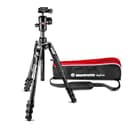
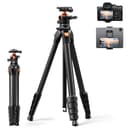
A ball head is one locking sphere. Loosen the knob, point the camera anywhere including straight down or into portrait orientation, tighten. It is fast, it is compact, and it is what you want for stills, landscapes, travel and anything where you reframe often. What it cannot do is move smoothly while you are recording — unlock a ball head mid-shot and the camera flops.
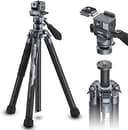
A video head is damped on two axes: it resists your hand a little, so a pan starts and stops without a jerk. That damping is the entire point, and it is why the ULANZI F38 is on this page despite being the worse choice for stills. Its head also sits on a leveling bowl, which means you straighten the horizon with one twist instead of adjusting three legs on uneven ground — a genuinely large time saver outdoors.
The honest limitation on the ULANZI is that its damping is fixed. Pricier fluid heads let you dial resistance up for a long lens and down for a wide one; this one gives you a single feel, and you either like it or you do not. It also uses ULANZI’s own F38 quick-release plates rather than the Arca-style plates most other gear here takes, so your plates do not travel between systems.
What $200 does not buy
Height without compromise. Every tripod at this price gets to eye level by extending a thin bottom leg section, a center column, or both. Both cost you stability. The rule that costs nothing: extend the thickest sections first and the thinnest last, and raise the center column only when you have run out of leg.
A head you would choose separately. Above this band people buy legs and a head as two purchases and match them to the camera. Under $200 you take the bundled head, which is why its quality dominates the ranking here.
Serious weight capacity. These hold a mirrorless body with a normal lens comfortably. Put a 150-600mm telephoto from our wildlife lens guide on one and you are past what the head was designed for — the camera will not fall off, but it will creep, and long-lens work wants a heavier tripod and a tripod collar.
None of that is a reason to spend more before you need to. A $50 tripod used properly — legs wide, column down, strap tucked, weight hung from the hook — takes sharper pictures than a $400 tripod used carelessly.
The flexible tripod is a different tool
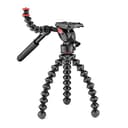
The JOBY GorillaPod 3K PRO is on this list because it does something none of the others can: it wraps. Around a stair rail, a branch, a fence post, a lamp post. For vloggers, product shooters and anyone mounting a camera somewhere there is no floor, it solves a problem a conventional tripod simply cannot, and it doubles as a handheld grip.
It is not a substitute for a tall tripod and should not be bought as one. It stands about a foot high, its ball head is basic, and it is rated for a mirrorless body plus lens rather than anything heavier. Plenty of people own both, and the pairing — one real tripod plus one GorillaPod — still comes in under $300 together.
How this page differs from our travel tripod guide
Our travel tripod roundup ranks on folded length and carried weight, because that is what matters when the tripod has to fit in a carry-on. This page has a hard price ceiling instead, and ranks on head quality first — which changes the order and pulls in two tripods a travel list would not lead with: a flexible grip and a video tripod. Two tripods we rate highly are missing here for one reason only: at the last price check they were above $200 or carried no live price, so they could not honestly sit on a page with this title. Both are on the main tripod roundup.
Three habits that matter more than the tripod
Hang weight from the hook. Every pick here except the GorillaPod has a hook under the center column. A camera bag or a water bottle hung from it lowers the center of gravity and kills most wind shake for free.
Turn stabilization off, usually. Older in-lens and in-body stabilizers can hunt against a locked tripod and soften the frame. Many modern systems detect a tripod and handle it; if yours does not say so, switch it off when the camera is locked down. Our stabilization explainer covers which is which.
Do not touch the camera. Use the self-timer or a remote. The sharpest tripod in the world cannot undo a finger pressing a shutter button, which is the single most common cause of a soft tripod shot — and one of the reasons covered in why your photos are blurry.
How we ranked these
Head type and head quality first, then what the tripod weighs, then how short it folds, then published load capacity. We have not tested these tripods — here is exactly what we do instead— and every figure quoted is the manufacturer’s own published specification with the date it was read. Where a maker publishes no figure, we say nothing rather than estimate one. Prices come only from the live price layer with the date above.