Wide Open. Gear

The Best Action Cameras

Waterproof, mountable cameras that survive what a mirrorless body can't - ranked on sensor size, stabilization, battery and what you actually mount them to.

By Stephen V.Last updated How we pick

An action camera is the one camera you buy expecting to abuse. It goes underwater without a housing, bolts to a helmet or a handlebar, and keeps rolling through the kind of knock that would end a mirrorless body’s afternoon. That is the whole value proposition — not image quality, which a cheap mirrorless camera still wins on, but access. The shot from inside the wave, on the bike, at the end of the ski pole: no other camera is going there.

The flip side is that the category has quietly split in two. Four of the cameras below are traditional, forward-facing action cameras with sensors around 1/1.3 inch— roughly fingernail sized, which is why they all struggle after sunset and why none of them will replace a real camera. The fifth, the Insta360 X5, shoots a full sphere with two lenses and lets you choose the framing afterwards, which solves a different problem entirely and creates a new one (every clip needs editing).

We have not strapped these to a helmet ourselves, and we are not going to pretend otherwise. What we did was read each manufacturer’s published specifications, resolve every pick to a listing that is genuinely in stock today, and do the comparisons that actually decide a purchase — sensor size against low-light performance, published runtime against a real day out, waterproof depth against what you will actually do with it. The rankings and the cons are ours. You can read exactly how we work on our methodology page.

How this is funded:we earn a commission if you buy through our links, at no extra cost to you. It never changes which product we recommend, and we’ll tell you plainly when to skip one. Full disclosure.

Quick picks

Ranked on published specs and buyer fit. Select a row to jump to the full write-up. We have not tested these products — here is exactly what we do instead.

#ProductBest forPrice
1
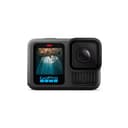
GoPro HERO13 Black

GoPro HERO13 Black

The action camera to beat: waterproof without a case, absurdly stable footage, and a wide, immersive look you can't get from a mirrorless body. It is a specialist — small sensor, wide-only field of view — but for POV, sports and anywhere you'd worry about a bigger camera, nothing else comes close.

Best overall
$369.99 · View on Amazon

$429.9914% off

Price as of October 9, 2026. #ad How we’re funded

2
DJI Osmo Action 5 Pro

DJI Osmo Action 5 Pro

The action camera for people who are tired of running out of battery and storage. DJI publishes a 240-minute runtime figure and builds in 64 GB, so a long day on the bike or in the water doesn't turn into a card-swapping errand. The 1/1.3-inch sensor is also physically larger than the GoPro's, which is why its night footage is the cleaner of the two. What you give up is GoPro's mount ecosystem and its higher 5.3K ceiling.

Best battery and low light
$319.00 · View on Amazon

$349.009% off

Price as of October 9, 2026. #ad How we’re funded

3
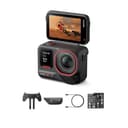
Insta360 Ace Pro 2

Insta360 Ace Pro 2

The only action camera here with a 2.5-inch screen that flips up to face you, which changes what the category is good for: you can frame a talking-head shot without guessing. Pair that with a 1/1.3-inch sensor, 8K30 capture and Insta360's Leica co-engineering and it is the action camera that doubles as a vlogging camera. It is also the chunkiest of the three traditional models at 177 g.

Best for vlogging
$309.99 · View on Amazon

$399.9923% off

Price as of October 9, 2026. #ad How we’re funded

4
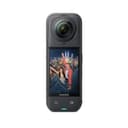
Insta360 X5

Insta360 X5

A different kind of camera: two lenses shooting in opposite directions, so you capture everything and choose the framing afterward in the app. That is a genuine superpower for anything fast or unrepeatable, and the invisible-selfie-stick trick still looks like magic. The catch is real — 8K of 360 footage becomes a roughly 4K flat clip once you reframe it, and every shot needs editing before it is watchable.

Best 360 camera
$464.99 · View on Amazon

$549.9915% off

Price as of October 9, 2026. #ad How we’re funded

5
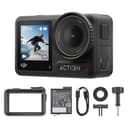
DJI Osmo Action 4

DJI Osmo Action 4

The previous-generation DJI, still sold in an Essential Combo and usually the cheapest way to get a large-sensor action camera. It shares the 1/1.3-inch sensor size and the 4K120 ceiling with the Action 5 Pro — what you lose is the longer runtime, the built-in storage and the bigger rear screen. For a first action camera that is a very easy trade.

Best budget pick
$181.00 · View on Amazon

$239.0024% off

Price as of October 9, 2026. #ad How we’re funded

The picks in full

#1Best overall

GoPro HERO13 Black

The action camera to beat: waterproof without a case, absurdly stable footage, and a wide, immersive look you can't get from a mirrorless body. It is a specialist — small sensor, wide-only field of view — but for POV, sports and anywhere you'd worry about a bigger camera, nothing else comes close.

Strengths

  • Waterproof to 10m with no housing
  • HyperSmooth stabilization is the benchmark for action footage
  • Tiny, tough, and mounts to anything

Trade-offs

  • Small sensor struggles in low light
  • Ultra-wide look only unless you crop in
Sensor1/1.9-inch, 27 MP
Video5.3K60, 4K120
StabilizationHyperSmooth (electronic)
Waterproof10m without a case
Weight159 g

Specifications read from the manufacturer listing, on August 3, 2026.

#2Best battery and low light

DJI Osmo Action 5 Pro

The action camera for people who are tired of running out of battery and storage. DJI publishes a 240-minute runtime figure and builds in 64 GB, so a long day on the bike or in the water doesn't turn into a card-swapping errand. The 1/1.3-inch sensor is also physically larger than the GoPro's, which is why its night footage is the cleaner of the two. What you give up is GoPro's mount ecosystem and its higher 5.3K ceiling.

Strengths

  • 1/1.3-inch sensor is larger than the HERO13's, and it shows after sunset
  • DJI's published 240-minute runtime is the longest here by a wide margin
  • 64 GB of built-in storage (47 GB usable) means a forgotten card isn't a dead day

Trade-offs

  • Tops out at 4K120 — no 5.3K mode like the GoPro
  • Fewer third-party mounts and accessories than GoPro's ecosystem
Sensor1/1.3-inch CMOS
Video4K up to 120fps; 1080p up to 240fps
StabilizationRockSteady 3.0+ with HorizonBalancing
Waterproof20 m without a case; 60 m with the case
BatteryUp to 240 min (DJI test: 1080p/24fps, screens off)
Storage64 GB built in (47 GB usable)
Weight146 g

Specifications read from the manufacturer listing, on October 9, 2026.

#3Best for vlogging

Insta360 Ace Pro 2

The only action camera here with a 2.5-inch screen that flips up to face you, which changes what the category is good for: you can frame a talking-head shot without guessing. Pair that with a 1/1.3-inch sensor, 8K30 capture and Insta360's Leica co-engineering and it is the action camera that doubles as a vlogging camera. It is also the chunkiest of the three traditional models at 177 g.

Strengths

  • 2.5-inch flip-up screen makes self-framing possible without a phone
  • 8K30 capture from a 1/1.3-inch sensor co-engineered with Leica
  • Insta360 publishes a 180-minute runtime and 30W fast charging

Trade-offs

  • Heaviest of the standard-shape action cameras at 177 g
  • The flip screen is another hinge to worry about on a crash-prone camera
Sensor1/1.3-inch, co-engineered with Leica
Video8K30; 4K60 with Active HDR
Screen2.5-inch flip-up touchscreen
Waterproof12 m without a case; 60 m with the dive case
Battery1,800 mAh; up to 180 min, 30W fast charging
Weight177 g

Specifications read from the manufacturer listing, on October 9, 2026.

#4Best 360 camera

Insta360 X5

A different kind of camera: two lenses shooting in opposite directions, so you capture everything and choose the framing afterward in the app. That is a genuine superpower for anything fast or unrepeatable, and the invisible-selfie-stick trick still looks like magic. The catch is real — 8K of 360 footage becomes a roughly 4K flat clip once you reframe it, and every shot needs editing before it is watchable.

Strengths

  • Shoot first, frame later — you cannot miss the action
  • User-replaceable glass lenses, the part that always got scratched
  • Dual 1/1.28-inch sensors and a published 185-minute Endurance-mode runtime

Trade-offs

  • Reframed 360 footage lands near 4K, not 8K — the headline number is the sphere
  • Every clip needs app work before it is shareable; flat-video shooters will find it a chore
SensorsDual 1/1.28-inch
Video8K30 360; 5.7K60; 4K120
LensesUser-replaceable glass
WaterproofIP68, to 15 m
Battery2,400 mAh; up to 185 min in Endurance mode
Weight200 g

Specifications read from the manufacturer listing, on October 9, 2026.

#5Best budget pick

DJI Osmo Action 4

The previous-generation DJI, still sold in an Essential Combo and usually the cheapest way to get a large-sensor action camera. It shares the 1/1.3-inch sensor size and the 4K120 ceiling with the Action 5 Pro — what you lose is the longer runtime, the built-in storage and the bigger rear screen. For a first action camera that is a very easy trade.

Strengths

  • Same 1/1.3-inch sensor class and 4K120 ceiling as the newer Action 5 Pro
  • Magnetic quick-release mount is still the fastest system to live with
  • Routinely the cheapest large-sensor action camera on the shelf

Trade-offs

  • Published runtime is 160 min against the Action 5 Pro's 240
  • No built-in storage, and a smaller 2.25-inch rear screen
Sensor1/1.3-inch CMOS
Video4K up to 120fps; 1080p up to 240fps
StabilizationRockSteady 3.0+, HorizonSteady
Waterproof18 m without a case; 60 m with the case
BatteryUp to 160 min (DJI test: 1080p/24fps, Wi-Fi off)
Weight145 g

Specifications read from the manufacturer listing, on October 9, 2026.

How we picked

Action cameras are sold on resolution numbers, and resolution is close to the least important thing about them. These are the five criteria we ranked on instead, in the order they matter to someone spending the money:

  • Sensor size before resolution.Every camera here shoots more pixels than you need. What separates them is sensor area, because that is what governs noise and dynamic range — the difference between usable footage at dusk and a grainy mess. The DJI and Insta360 models use a 1/1.3-inch sensor; the GoPro HERO13 Black uses a 1/1.9-inch chip. That gap is the single most honest spec comparison in the category, and it is why we gave the low-light award to DJI rather than to our overall pick. The same logic drives our full-frame vs APS-C guide, just at a much smaller scale.
  • Stabilization that holds the horizon.All of these use electronic stabilization — there is no room for a mechanical gimbal inside a case this small, which is exactly what our gimbal vs in-body stabilization explainer is about. GoPro’s HyperSmooth remains the reference, and DJI’s RockSteady is genuinely close. The feature to look for is horizon leveling, which keeps the frame upright when the camera rolls; it is the thing that makes handlebar and helmet footage watchable rather than nauseating.
  • Published battery runtime, read honestly.Every runtime figure in this guide is the manufacturer’s own number, measured under flattering conditions — DJI’s 240 minutes for the Action 5 Pro is at 1080p/24fps with the screens off. Treat these as a ranking, not a promise: at 4K with the screen on, expect a fraction of it. What matters is the relative order, and on that the DJI models lead comfortably.
  • Waterproofing without a case.A camera you have to assemble a housing for is a camera you leave behind. All five here are swimmable as they come — from 10 m on the GoPro to 20 m on the Action 5 Pro — and all offer a dive case for serious depth. If your plan involves snorkeling or a pool, any of them is fine; if it involves scuba, you are buying the case regardless.
  • Mounts and the ecosystem around them.This is where GoPro keeps its lead and it is not close. Two decades of third-party clamps, suction cups, chest harnesses and helmet mounts fit the GoPro finger-mount pattern, usually for a few dollars. DJI’s magnetic quick-release is the nicer system to use — it clicks on one-handed in gloves — but there is far less to buy for it.

What we deliberately did not do is invent test results. There is no lab here, no helmet rig, no dunk tank. Specs are the manufacturer’s published figures, read on the date shown in the sources below, and every pick was checked as in stock before it was featured.

Which one should you actually buy?

If you want the default, buy the GoPro. The HERO13 Blackis our overall pick not because it wins any single spec — it does not win sensor size or battery — but because it is the camera that fits everything, has the highest resolution ceiling at 5.3K60, and will still have mounts and spare batteries on a shelf in three years. For most buyers, ecosystem beats a stop of low-light performance.

If you shoot long days or late light, buy the DJI. The Osmo Action 5 Propairs the larger 1/1.3-inch sensor with a published 240-minute runtime and 64 GB of built-in storage. That combination — more battery, more sensor, a card you cannot forget — makes it the better travel-and-hike camera, and the better choice if a lot of your shooting happens in the hour after sunset.

If you talk to the camera, buy the Insta360 Ace Pro 2. A 2.5-inch screen that flips up to face you sounds like a small thing until you have tried to frame your own head using a one-inch front display. It is the action camera that can double as a vlogging camera, and if your footage is mostly you narrating to the lens, that one hinge is worth more than any sensor spec on this page.

If you want to never miss a shot, buy the X5. The Insta360 X5records everything around it and lets you point the camera in the edit. For mountain biking, skiing, a dog, or kids — anything where you cannot predict where the moment will happen — that is transformative. Just understand the deal: a reframed 360 clip lands somewhere near 4K, not 8K, and nothing is shareable until you have been through the app.

If this is your first one, buy the Action 4. The Osmo Action 4 is the previous generation, still sold in an Essential Combo, and it shares the sensor class and the 4K120 ceiling of the current model. Spending the least you can on an action camera is a legitimate strategy, because this is the one camera category where the thing genuinely might come back broken.

What the resolution numbers really mean

Action-camera marketing has settled on resolution as the headline, and it is the spec most likely to mislead you. Three things are worth knowing before you compare an 8K number to a 5.3K one.

First, on a 360 camera the resolution describes the whole sphere. The X5’s 8K is spread across everything the two lenses see; by the time you crop out a normal, flat, forward-facing shot, you are working with roughly a quarter of it. Reframed X5 footage is good — comparable to a decent 4K clip — but comparing its 8K to the Ace Pro 2’s 8K is comparing two different measurements.

Second, stabilization costs resolution. Electronic stabilization works by cropping into the frame and shifting the crop window to cancel out shake, so the strongest stabilization modes always narrow your field of view and eat pixels. That is the real reason the top resolution modes on these cameras often cannot be combined with the strongest stabilization setting — it is a physical trade, not a software limitation someone forgot to fix.

Third, high frame rates matter more than high resolution for this kind of footage. Action is fast, and the clip you will actually want is the slow-motion one. 4K at 120fps gives you a four-times slowdown at a resolution nobody will question; 1080p at 240fps gives you eight. Every traditional pick here can do both, which is a better reason to be happy with any of them than the 8K badge on the box.

Three things to budget for beyond the camera

Action cameras are unusual in that the body is genuinely not the whole cost. Three items are close to mandatory:

  • A fast microSD card, or two. High-bitrate 4K and 8K will stutter or refuse to record on a slow card, and action cameras fill them quickly. The speed classes explained in our SD card guide apply identically to microSD — look for a V30 rating as a floor. The Osmo Action 5 Pro is the exception that can shoot to its own internal 64 GB in a pinch.
  • At least one spare battery. Cold weather roughly halves what you get, and these are not cameras you can conveniently charge mid-activity. The multi-battery bundles are almost always cheaper than buying cells separately later.
  • The right mount for your actual sport.Spend the few dollars on a proper chest harness or handlebar clamp rather than wedging the camera somewhere and hoping. This is where GoPro’s back catalogue is worth real money, and it is a bigger determinant of whether your footage is any good than anything on the spec sheet.

When an action camera is the wrong buy

We would rather talk you out of a purchase than sell you the wrong thing, so: an action camera is a bad choice if your footage is mostly indoors, mostly in low light, or mostly of people’s faces. The tiny sensor and fixed ultra-wide lens that make it survivable also make it unflattering and noisy in exactly those conditions. If that describes your shooting, a compact or mirrorless body from our vlogging camera guide will give you better results for similar money.

It is also the wrong buy if what you actually want is smooth motion rather than toughness. Electronic stabilization is impressive but it is still a crop-and-shift trick; a real camera on a mechanical stabilizer from our camera gimbal guide produces a visibly different, more cinematic kind of movement. And if the shot you are imagining is from above rather than from your helmet, you want a drone — our photography drone guide covers that side.

Where action cameras earn their place in a kit is as the second or third camera: the one that goes where the expensive body does not, and the one that gets you a cutaway angle you could not otherwise shoot. Used that way — as a b-rollmachine rather than a main camera — even the cheapest pick here pays for itself.
Frequently asked questions

GoPro or DJI - which action camera is better?

They win on different things, which is why both are in this guide. DJI's Osmo Action 5 Pro has the larger 1/1.3-inch sensor, the longer published runtime (240 minutes against GoPro's figures) and 64 GB of built-in storage, so it is the better choice for long days and for shooting in dim light. GoPro's HERO13 Black has the higher resolution ceiling at 5.3K60, the benchmark HyperSmooth stabilization, and twenty years of third-party mounts that fit it. If you already own GoPro mounts, stay with GoPro; if you are starting fresh and care about battery and low light, take the DJI.

Is a 360 camera like the Insta360 X5 better than a normal action camera?

It is different rather than better. A 360 camera records everything around it, so you choose the framing later in the app and effectively cannot miss the shot - genuinely useful for biking, skiing, kids or pets. The costs are real though: a reframed flat clip ends up around 4K rather than the 8K on the box, every single clip needs app work before it can be shared, and the files are larger. If you want footage you can pull off the card and post, buy a traditional action camera. If you want the best possible chance of catching an unrepeatable moment, buy the X5.

Do action cameras work well in low light?

Not really, and no amount of software fixes it. Every camera here has a sensor around 1/1.3 inch or smaller, which is a tiny fraction of the area of the APS-C and full-frame sensors in our camera guides. Expect visible noise indoors and after dusk. Within the category there is a meaningful difference - the 1/1.3-inch sensors in the DJI and Insta360 models have more area to work with than the GoPro HERO13 Black's 1/1.9-inch chip - but if most of your shooting is in dim light, an action camera is the wrong tool and a mirrorless body is the right one.

Can I use an action camera for vlogging?

Yes, with one caveat: you need to be able to see yourself. That is why the Insta360 Ace Pro 2 is our vlogging pick - its 2.5-inch screen flips up to face the lens, so you can frame your own head instead of guessing. The DJI and GoPro models have small front displays that help but are harder to work with at arm's length. Also plan for audio: built-in mics in a wind-exposed waterproof body are the weakest part of every action camera, so a wireless mic from our wireless microphone guide makes a bigger difference to a vlog than any image spec.

How deep can I take one without a case?

Each manufacturer publishes a figure and they differ: 10 m for the GoPro HERO13 Black, 20 m for the DJI Osmo Action 5 Pro, 18 m for the Osmo Action 4, 12 m for the Insta360 Ace Pro 2, and 15 m for the Insta360 X5 under its IP68 rating. All of those comfortably cover swimming, surfing and snorkeling. For scuba depths every one of them needs its dedicated dive case, which typically takes the rating to around 60 m. Rinse the camera in fresh water after salt water, and check the door seal is seated before you get in - a flooded camera is almost always a seal that was not closed properly.

What memory card do I need for 4K and 8K action footage?

A microSD card with a V30 Video Speed Class rating as an absolute floor, and a reputable brand rather than the cheapest one on the listing. High-bitrate 4K120 and 8K modes write a lot of data continuously, and a card that cannot sustain the write speed will stop a recording mid-clip or refuse to start it. The speed classes are the same ones explained in our SD card guide - the markings on microSD mean exactly what they mean on full-size SD. Buy capacity too: 8K and 4K120 fill a 128 GB card faster than you would expect.

Sources

Keep reading