How we ranked these
In this order, and the order matters more than any individual specification.
1. What the extra money actually buys over a $400 lens. A lens that is simply a slightly sharper version of something half its price does not earn a slot. Every pick here does something a sub-$500 lens cannot: holds f/2.8 while zooming, reaches 400mm, covers a 29-240mm equivalent range, or survives weather.
2. Maximum aperture, read honestly against the focal length. f/2.8 on a 28-75mm zoom is a genuine achievement. f/5.6-6.3 on a superzoom is the price of the range. We say which is which rather than printing the number and moving on, because aperture is the specification that changes the picture itself — not the sharpness of the picture, the look of it.
3. Weight, because a lens you leave at home has no image quality. Three of the six picks here are under 400 g, and the heaviest is about 635 g. That is deliberate. In this band the optically-best choice and the one you will actually carry are usually the same lens, which stops being true further up the range.
4. Stabilization, and whose job it is. Two picks have optical stabilization in the lens, three have none and depend entirely on the body, and one is a prime short enough that it rarely matters. If your camera has no in-body stabilization — and most APS-C bodies under $1,000 do not — this moves up the list for you. Our image stabilization explainer covers how lens IS and body IBIS combine.
5. Filter thread and what else you have to buy. Three picks share a 67mm thread, which means one set of filters covers them. That is a real saving once you own a circular polarizer or a variable ND, and it is the kind of thing nobody mentions until you have bought three different thread sizes.
We have not tested these lenses — here is exactly what we do instead— and every figure quoted on this page and on each card is the manufacturer’s own published specification with the date we read it. There are no scores here, because a score would imply a measurement we did not take.
What the second $500 buys: a constant aperture
This is the headline of the whole band. A kit zoom is typically f/3.5 at the wide end and f/5.6 by the time you zoom in, which means the lens quietly gets about a stop and a half darker as you frame tighter — exactly when you are usually shooting a person indoors and need light most. A constant f/2.8 zoom does not do that. The exposure you set at 28mm is the exposure you still have at 75mm.
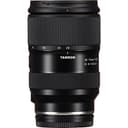
The Tamron 28-75mm f/2.8 G2 is the cheapest way to own that on full-frame, and at 540 g it is markedly lighter than the first-party 24-70mm f/2.8 zooms it competes with. Two honest costs. It has no stabilization at all, so it only makes sense on a body with IBIS. And it starts at 28mm rather than 24mm, which is noticeably tighter in a small room — if you shoot interiors or cramped venues, that 4mm is a real loss and you should know it before you buy. Its 0.18 m close focus at the wide end is the compensation: it focuses close enough to be a credible detail lens for rings and food.
It is also the overall pick on our zoom lens roundup, for the same reason, and the full-frame zoom on our Sony lens guide.
What it buys instead: reach you can carry
The other thing that becomes possible in this band is a genuinely long lens. Both telephoto picks here reach roughly 400mm or beyond, and neither exceeds about 635 g, which is the specification that decides whether a long lens gets used.
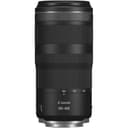
The Canon RF 100-400mm is the pick for Canon RF. It is the cheapest honest route to 400mm on any current mirrorless mount, with optical IS Canon rates at 5.5 stops, and it accepts Canon’s 1.4x and 2x extenders if you later want more. The cost is blunt: f/8 at 400mm is the darkest aperture on this page, so this is a lens for open daylight, not for dawn in the woods. It also has no tripod collar, which is awkward on a gimbal head, and Canon’s own store now lists it as no longer available — stock is retailer-dependent, so check the listing rather than assuming.
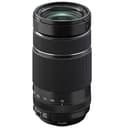
The Fujifilm XF70-300mm is the pick if you shoot X-mount, and the crop factor works in your favor here: 300mm on APS-C frames like 457mm on full-frame, so a 580 g lens sees further than the Canon does. It is also the only weather-resistant lens on this page, which matters if the reason you want reach is birds and weather. The same crop that buys you reach costs you light-gathering area and background separation, and Fujifilm publishes no stop rating for its OIS, so we do not claim one. Both of these appear on our wildlife lens roundup alongside the longer, heavier options above this budget.
What it buys if you only want one lens
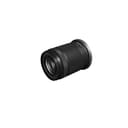
A superzoom is the opposite trade to everything above: it buys range and gives up aperture. The Canon RF-S18-150mm covers a 29-240mm equivalent from a 310 g lens, which replaces a kit zoom and a telephoto in one, and its 0.17 m closest focus makes it a surprisingly good close-up lens as well. For a trip where you will not change lenses, it is the right answer and the honest one.
What you pay is f/6.3 at the long end. Indoors or after sunset, that pushes the ISO hard and the picture gets noisy. A superzoom is also optically a compromise at both ends compared with a prime or an f/2.8 zoom — sharp enough for almost everything, never the best lens in the bag. And RF-S is APS-C only; it will not cover a full-frame RF body without cropping. If a single travel lens is what you are after, our travel lens guide compares this approach against carrying two small primes instead.
Why a sub-$400 prime is still on a $1,000 page
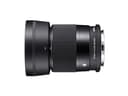
Because it is frequently the right answer, and leaving it off would be a ranking decision made to justify the page title. The Sigma 30mm f/1.4 DC DN is a 45mm-equivalent prime for Sony APS-C that weighs 265 g and is two to three stops brighter than any kit zoom. If you own a crop body and a kit lens, this is still the purchase that changes your photographs most per dollar, and you would have several hundred dollars left over.
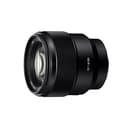
Its limits are real and short: it is APS-C only, and at a 45mm-equivalent field of view it is a little wide for tight headshots. If portraits are the actual goal, the Sony FE 85mm f/1.8 above is the lens — 371 g, the classic flattering focal length, and a fraction of the price of the f/1.4 GM for image quality that is very hard to fault. On an APS-C body it becomes a 128mm equivalent, which is tight indoors but excellent outdoors. Our portrait lens roundup goes deeper on focal length and working distance.
What this band does not buy
Three things, and it is worth naming them so the page is not quietly overselling itself.
A fast telephoto. There is no f/2.8 zoom past 200mm here, because one does not exist at this price. The 300mm and 400mm f/2.8 primes are five figures. If you shoot indoor sport, this band cannot solve it — our sports lens roundup explains why aperture, not reach, is the real constraint in a dim gym.
Full-frame ultra-wide with a constant aperture. The wide options in this band are either variable-aperture full-frame zooms or APS-C designs. The constant f/2.8 full-frame ultra-wide we recommend is the Tamron 17-28mm, which sits just under $500 and is on the cheaper page for that reason.
Professional build. One lens here is weather-resistant. The rest are not, and several use plastic in places a $2,000 lens would use metal. That affects longevity and resale more than it affects your photographs, but it is part of what the money buys higher up the range.