Wide Open. Gear

The Best Lenses for Landscape Photography

The wide-angle glass worth buying for landscapes — by mount, by budget, and by whether you shoot at golden hour or after dark.

By Stephen V.Last updated How we pick

The lens you want for landscapes is a wide zoom with a normal filter thread — wide enough to hold a whole valley, and threaded so a circular polarizer screws straight onto the front. That second part gets ignored and it should not be: a polarizer is the one filter whose effect you cannot recreate in editing, and plenty of ultra-wide lenses have a bulging front element that will not take one without a bracket system costing as much as the lens.

On Sony full-frame the Tamron 17-28mm f/2.8 Di III RXDis the pick for most people. On a crop sensor — an a6400, a ZV-E10, an X-S20, an R50 — the Tamron 11-20mm f/2.8 Di III-A RXD does the same job for the same money and is sold in three mounts. Canon RF shooters get 15mm cheaply with the Canon RF 15-30mm f/4.5-6.3 IS STM, Nikon Z shooters get the filter-friendly NIKKOR Z 14-30mm f/4 S, Fujifilm shooters get the weather-resistant XF10-24mmF4 R OIS WR, and if your landscapes happen at 2am under the Milky Way, the Sony FE 20mm f/1.8 G is the one that actually changes your results.

Prices on glass move a lot — lenses go on rebate far more often than camera bodies do — which is why this page shows a live number with the date it was checked rather than a figure typed into the copy. Our picks do not change when a price does. Check the number before you buy, and if the one you want is sitting at full price, it is usually worth waiting; wide zooms discount on a fairly reliable cycle.

How this is funded:we earn a commission if you buy through our links, at no extra cost to you. It never changes which product we recommend, and we’ll tell you plainly when to skip one. Full disclosure.

Quick picks

Ranked on published specs and buyer fit. Select a row to jump to the full write-up. We have not tested these products — here is exactly what we do instead.

#ProductBest forPrice
1
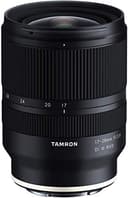
Tamron 17-28mm f/2.8 Di III RXD

Tamron 17-28mm f/2.8 Di III RXD

The sensible way into full-frame wide-angle on Sony. You give up the last 3mm of width against a 14-24mm and you get a lens that costs far less, weighs 420 g, and takes ordinary 67mm screw-in filters — which matters more for landscape work than the extra millimeters do, because a polarizer and an ND are how you control a sky and a waterfall.

Best overall (Sony full-frame)
$491.99 · View on Amazon

Price as of October 27, 2026. #ad How we’re funded

2
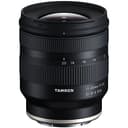
Tamron 11-20mm f/2.8 Di III-A RXD

Tamron 11-20mm f/2.8 Di III-A RXD

The ultra-wide most crop-sensor landscape shooters should buy. 11mm on APS-C frames about as wide as 17mm does on full-frame, the f/2.8 aperture holds across the zoom for night skies, and at 335 g it is lighter than most kit zooms. Tamron also builds it for Fujifilm X and Canon RF, so it is not a Sony-only answer.

Best for APS-C
3
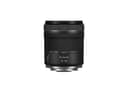
Canon RF 15-30mm f/4.5-6.3 IS STM

Canon RF 15-30mm f/4.5-6.3 IS STM

Canon's cheapest route to a real 15mm on full-frame RF, and for landscape work the slow aperture matters less than it sounds — most landscape frames are shot at f/8 on a tripod anyway. Optical stabilization rated at 5.5 stops covers the handheld shots, and at about 390 g it is the lightest full-frame zoom here.

Best for Canon RF
$539.00 · View on Amazon

$639.0016% off

Price as of October 27, 2026. #ad How we’re funded

4
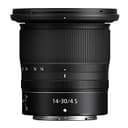
Nikon NIKKOR Z 14-30mm f/4 S

Nikon NIKKOR Z 14-30mm f/4 S

The reason a lot of landscape photographers are on Nikon Z. A 14mm ultra-wide that still takes 82mm screw-in filters is unusual — most lenses this wide have a bulbous front element and need an expensive square filter holder. Constant f/4, 485 g, and a fluorine-coated front element that sheds spray.

Best for Nikon Z
$1,096.95 · View on Amazon

Price as of October 27, 2026. #ad How we’re funded

5
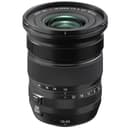
Fujifilm XF10-24mmF4 R OIS WR

Fujifilm XF10-24mmF4 R OIS WR

The X-mount landscape zoom, and the only pick here that combines stabilization, weather resistance and an aperture ring. A 15-36mm equivalent range covers the classic landscape focal lengths rather than stopping short of them, which means it can be the only lens you carry on a hike.

Best for Fujifilm X
$1,199.00 · View on Amazon

Price as of October 27, 2026. #ad How we’re funded

6
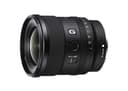
Sony FE 20mm f/1.8 G

Sony FE 20mm f/1.8 G

The pick when the landscape you care about is the night sky. f/1.8 at 20mm gathers roughly two and a half stops more light than an f/4 zoom, which is the difference between a clean Milky Way frame and a noisy one — and at 373 g it is the lightest lens on this page by a clear margin.

Best for night skies
$998.00 · View on Amazon

$1,049.995% off

Price as of October 27, 2026. #ad How we’re funded

The picks in full

#1Best overall (Sony full-frame)

Tamron 17-28mm f/2.8 Di III RXD

The sensible way into full-frame wide-angle on Sony. You give up the last 3mm of width against a 14-24mm and you get a lens that costs far less, weighs 420 g, and takes ordinary 67mm screw-in filters — which matters more for landscape work than the extra millimeters do, because a polarizer and an ND are how you control a sky and a waterfall.

Strengths

  • Constant f/2.8 across the range — unusual at this price and useful after dark
  • 67mm front filter thread, so standard circular polarizers and NDs screw straight on
  • 420 g, light enough to carry all day on a hike

Trade-offs

  • 17mm is not as dramatic as a 14mm or 15mm for tight interiors and big skies
  • Sony E only — no Canon RF or Nikon Z version
  • No optical stabilization; you rely on your body's IBIS or a tripod
Mount / formatSony E, full-frame
Focal length17-28mm
Max apertureConstant f/2.8 (minimum f/22)
Filter thread67mm
Closest focus0.19 m at 17mm, 0.26 m at 28mm
Weight420 g

Specifications read from the manufacturer listing, on October 16, 2026.

#2Best for APS-C

Tamron 11-20mm f/2.8 Di III-A RXD

The ultra-wide most crop-sensor landscape shooters should buy. 11mm on APS-C frames about as wide as 17mm does on full-frame, the f/2.8 aperture holds across the zoom for night skies, and at 335 g it is lighter than most kit zooms. Tamron also builds it for Fujifilm X and Canon RF, so it is not a Sony-only answer.

Strengths

  • Genuinely wide on a crop sensor — roughly a 17-30mm full-frame field of view
  • Constant f/2.8, which makes it a credible astro lens as well as a daylight one
  • 335 g, with the same 67mm filter thread as Tamron's other compact zooms

Trade-offs

  • No optical stabilization
  • 0.15 m closest focus is great for foreground detail, but it puts the front element very close to wet rock and sea spray
  • The zoom stops at 20mm, so it does not replace a standard zoom
Mount / formatSony E, Fujifilm X or Canon RF, APS-C
Focal length11-20mm (about 17-30mm equivalent)
Max apertureConstant f/2.8
Filter thread67mm
Closest focus0.15 m at 11mm, 0.24 m at 20mm
Weight335 g (Sony E and Fujifilm X), 340 g (Canon RF)

Specifications read from the manufacturer listing, on October 16, 2026.

#3Best for Canon RF

Canon RF 15-30mm f/4.5-6.3 IS STM

Canon's cheapest route to a real 15mm on full-frame RF, and for landscape work the slow aperture matters less than it sounds — most landscape frames are shot at f/8 on a tripod anyway. Optical stabilization rated at 5.5 stops covers the handheld shots, and at about 390 g it is the lightest full-frame zoom here.

Strengths

  • 15mm at the wide end — wider than most zooms at any price
  • Optical stabilization Canon rates at 5.5 stops, more when paired with an IBIS body
  • About 390 g, with a 67mm filter thread

Trade-offs

  • f/4.5-6.3 is slow — a real limitation for astrophotography and handheld dusk work
  • A variable aperture means exposure shifts as you zoom, which is awkward for video
  • STM-class build rather than Canon's L-series weather sealing
Mount / formatCanon RF, full-frame
Focal length15-30mm
Max aperturef/4.5-6.3 (variable)
StabilizationOptical IS, rated 5.5 stops by Canon
Filter thread67mm
WeightAbout 390 g

Specifications read from the manufacturer listing, on October 16, 2026.

#4Best for Nikon Z

Nikon NIKKOR Z 14-30mm f/4 S

The reason a lot of landscape photographers are on Nikon Z. A 14mm ultra-wide that still takes 82mm screw-in filters is unusual — most lenses this wide have a bulbous front element and need an expensive square filter holder. Constant f/4, 485 g, and a fluorine-coated front element that sheds spray.

Strengths

  • 14mm with a conventional 82mm filter thread — no bulbous element, no filter holder needed
  • Constant f/4 across the zoom, so exposure holds as you reframe
  • 485 g, and it collapses down small for a 14mm full-frame zoom

Trade-offs

  • f/4 is two stops slower than f/2 glass for night skies, and a stop behind the f/2.8 zooms here
  • Premium price — the most expensive pick on this page
  • Nikon publishes a fluorine coating but states no weather-sealing rating on this lens page
Mount / formatNikon Z, full-frame
Focal length14-30mm
Max apertureConstant f/4
Filter thread82mm, screw-in
Closest focus0.28 m at all zoom positions
Weight485 g

Specifications read from the manufacturer listing, on October 16, 2026.

#5Best for Fujifilm X

Fujifilm XF10-24mmF4 R OIS WR

The X-mount landscape zoom, and the only pick here that combines stabilization, weather resistance and an aperture ring. A 15-36mm equivalent range covers the classic landscape focal lengths rather than stopping short of them, which means it can be the only lens you carry on a hike.

Strengths

  • 15-36mm equivalent — wide enough for big scenes, long enough for a tighter composition
  • Optical stabilization plus Fujifilm's WR weather resistance
  • About 385 g, with a conventional 72mm filter thread

Trade-offs

  • Constant f/4 — slower than the Tamron 11-20mm f/2.8 for night work
  • Costs considerably more than the third-party X-mount ultra-wides
  • Fujifilm publishes no stop rating for the OIS on its specification page
Mount / formatFujifilm X, APS-C
Focal length10-24mm (15-36mm equivalent)
Max apertureConstant f/4
StabilizationOptical (OIS); no stop figure published
Filter thread72mm
WeightAbout 385 g (excluding caps and hood)

Specifications read from the manufacturer listing, on October 16, 2026.

#6Best for night skies

Sony FE 20mm f/1.8 G

The pick when the landscape you care about is the night sky. f/1.8 at 20mm gathers roughly two and a half stops more light than an f/4 zoom, which is the difference between a clean Milky Way frame and a noisy one — and at 373 g it is the lightest lens on this page by a clear margin.

Strengths

  • f/1.8 — by far the fastest aperture in this roundup, and the reason to own it
  • 373 g, lighter than every zoom here
  • 0.19 m closest focus, so foreground rocks and flowers can sit right against the lens

Trade-offs

  • A prime: 20mm is all you get, so you reframe with your feet
  • Premium price for a single focal length
  • 20mm is wide but not ultra-wide — a 14mm zoom out-frames it on a big vista
Mount / formatSony E, full-frame
Focal length20mm (prime)
Max aperturef/1.8 (minimum f/22)
Filter thread67mm
Closest focus0.19 m (autofocus), 0.18 m (manual focus)
Weight373 g

Specifications read from the manufacturer listing, on October 16, 2026.

How we picked

Landscape photography puts a specific and fairly narrow set of demands on a lens, and most of the specs people argue about online are not among them. Here is what we weighted, in order.

Field of view, judged in full-frame equivalent terms.A landscape lens needs to be wide, but “wide” is a different number on different sensors. 11mm on an APS-C body frames almost exactly what 17mm does on full-frame; 10mm on a Fujifilm X body gives you 15mm. Quoting the raw focal length across formats is how people end up buying a lens that is not wide enough for what they imagined. Every pick above lists its equivalent, and if you want the mechanics of why, crop factor explained walks through it in one page.

A conventional filter thread.This is the single most underrated spec on a landscape lens. A circular polarizer cuts glare off wet rock and foliage and deepens a blue sky in a way no slider in Lightroom reproduces, and a neutral-density filter is how you get silk out of moving water in daylight. Both need something to screw into. The Nikon 14-30mm is on this list substantially because it reaches 14mm and still takes an 82mm screw-in filter — a genuinely unusual combination. Our camera filters guide covers which filters earn their place in a bag.

Weight, because landscape gear gets carried.Landscapes happen at the end of a walk, usually before sunrise or after sunset, often with a tripod strapped to the same bag. Every lens here is under 500 g, and that is not a coincidence — it is a filter we applied. The heaviest pick on this page is the Nikon at 485 g; the lightest is the Sony prime at 373 g.

Maximum aperture, but only for the night half of the job. This is where landscape advice goes wrong most often. For a daylight scene you are shooting at f/8 or f/11 on a tripod to get the whole frame sharp, and an f/2.8 lens and an f/4.5 lens produce identical results. The aperture only starts to matter when the light goes: astrophotography, blue hour handheld, aurora. If you never shoot those, do not pay for speed you will stop down anyway.

What we did not weight: corner sharpness charts at f/2.8, bokeh, and autofocus speed. Landscape frames are stopped down, focused once on a hyperfocal point and often focused manually. A lens that is merely good wide open but excellent at f/8 is a perfectly good landscape lens.

How wide do you actually need?

Wider is not automatically better, and this is the mistake that sends people back to the shop. An ultra-wide lens makes distant things small. Point a 14mm at a mountain range and the mountains become a thin strip across the middle of an enormous, empty frame. The lens works when you have something in the foreground — rocks, a stream, a path, flowers — close enough to the lens to loom large, with the landscape stretching away behind it. That near-far composition is what ultra-wide glass is for.

If you mostly shoot distant subjects, a standard zoom at 24mm or 35mm will serve you better than anything on this page, and a telephoto compressing layers of ridgeline is a classic landscape look that most people never try. The honest version of this guide: buy an ultra-wide when you know you want the near-far shot, not because landscape photography is supposed to need one. Focal length explained and composition basics both make this concrete.

A rough rule from the picks above: 15 to 17mm equivalent is wide enough for almost every landscape you will meet, 14mm is a specialist tool for tight spaces and towering foregrounds, and 10 to 11mm on a crop sensor lands exactly in the useful band.

Full-frame or crop sensor for landscapes?

Full-frame helps less here than it does for portraits. The two advantages that make full-frame worth paying for — shallower depth of field and cleaner high-ISO files — are a daylight landscape’s least relevant properties. You want deep depth of field, and base ISO on a tripod is clean on any modern sensor.

Where full-frame genuinely pulls ahead is the night sky, where the larger sensor collects more light per frame and holds detail in shadows that a crop sensor turns to mush. If astrophotography is the reason you are buying, that is an argument for a full-frame body and the fastest lens you can afford. For everything else, an APS-C body with the Tamron 11-20mm will produce landscape files you cannot tell apart at any normal size. Our full-frame vs APS-C guide has the long version, and best APS-C cameras covers the bodies.

The gear that matters as much as the lens

Two things will improve your landscape photos more than moving from any lens on this page to any other lens on this page.

A tripod that does not move.Landscape light is at its best when there is least of it. Sunrise, sunset, the twenty minutes of blue hour after — all of them call for shutter speeds you cannot hand-hold at f/11, and all of them are when a tripod stops being optional. It also forces you to slow down and actually compose, which is the underrated half of the benefit. Our travel tripod roundup covers what carries well, and how to choose a tripod explains what the specs mean.

A circular polarizer. Roughly $40 to $80 for a good one in a 67mm or 72mm thread, and it does something no software can: it removes reflections from non-metallic surfaces. Wet leaves stop being white blobs and go green, a stream becomes transparent instead of a mirror, and a blue sky deepens. Buy one in the largest thread you own and use step-up rings for the rest. Four of the six lenses above share a 67mm thread, which makes that the obvious size to standardize on.

One option worth knowing about before you spend: the cheapest route to a genuinely new landscape angle is often not a wider lens but a different vantage point. A sub-250 gram drone costs roughly what the Tamron zooms here do and sees what no lens on the ground can — drone photography: getting started covers what that actually involves.

Settings that change the result

Landscape shooting is one of the few genres with a genuinely reliable starting recipe. Aperture priority or manual at f/8 to f/11, base ISO (usually 100), shutter speed wherever the exposure lands because the camera is on a tripod, and focus set about a third of the way into the scene rather than on the horizon. That last one is where most of the sharpness comes from — hyperfocal distance explained covers the reasoning, and how to photograph landscapes puts the whole workflow in order.

Shoot raw. A landscape frame nearly always has a bright sky and a dark foreground, and raw is what lets you recover both from one exposure instead of bracketing three. Raw vs JPEG explains what you are actually keeping, and dynamic range explained covers why that sky blows out in the first place.

What about the lens you already own?

If you own a kit zoom, you already own a landscape lens. An 18-55mm on APS-C is 27-82mm equivalent, and the wide end of it has taken an enormous number of good landscape photographs. The case for buying one of the lenses above is that you have hit the wide end repeatedly and wished for more, or that you want f/2.8 for the night sky, or that you want weather resistance for coastal and mountain work. If none of those is true yet, put the money into a tripod and a polarizer first and come back to the glass later. Should you upgrade your camera or lens is the honest version of that question. And if the landscapes are incidental to a trip rather than the point of it, our travel lens roundup ranks the same mounts on weight and range instead of on how wide they go.
Frequently asked questions

What focal length is best for landscape photography?

Somewhere around 16 to 24mm in full-frame terms covers most landscapes comfortably. Going wider than that — 14 or 15mm — is a specialist choice that works when you have a strong foreground close to the lens, and makes distant subjects look small when you do not.

Do I need a wide-angle lens for landscapes?

No. A kit zoom at its widest setting has taken an enormous number of good landscape photographs, and telephoto landscapes that compress layers of ridgeline are a classic look most people never try. Buy an ultra-wide when you keep hitting the wide end of what you own and wishing for more.

Is f/2.8 worth it for landscape photography?

Only if you shoot at night. Daylight landscapes are made at f/8 to f/11 on a tripod, where an f/2.8 lens and an f/4.5 lens give identical results. For astrophotography the fast aperture is the whole ballgame, which is why the Sony FE 20mm f/1.8 G is on this list.

Can I use a polarizer on an ultra-wide lens?

If the lens has a conventional filter thread, yes — and most of the picks here do, which is partly why they are here. Be aware that a polarizer's effect varies across a very wide frame, so a blue sky can go noticeably darker on one side at 14mm. Rotate it to a weaker position rather than maxing out the effect.

Is full-frame better than APS-C for landscapes?

Less than you would expect. Deep depth of field and base ISO on a tripod are what landscape work needs, and crop sensors deliver both. Full-frame pulls clearly ahead only for night-sky work, where the larger sensor holds shadow detail a crop sensor loses.

Do I need image stabilization in a landscape lens?

Not for tripod work, which is most landscape shooting. It is genuinely useful for handheld frames at dusk and for scrambling shots where setting up is not practical — which is why the Canon RF 15-30mm's 5.5-stop IS and the Fujifilm XF10-24mm's OIS are worth something.

What else should I buy with a landscape lens?

A tripod and a circular polarizer, in that order, before you buy a second lens. The tripod unlocks the low-light hours when landscapes look their best, and the polarizer does something no editing software can reproduce.

Sources

Keep reading