Why there is only one mirrorless camera on this page
New interchangeable-lens cameras start at around the R100’s price and the next step up — the EOS R50, the Nikon Z30, the Sony ZV-E10 — sits above this budget, which is the band our budget camera roundup covers. That leaves the R100 as the only honest mirrorless pick under $500, and it is worth knowing exactly what Canon removed to hit the price: the screen is fixed and not a touchscreen, 4K is heavily cropped, and in 4K the camera falls back to slower contrast-detect autofocus instead of the Dual Pixel system that makes Canon’s other bodies so easy to use.
None of that hurts daytime stills, which are genuinely good. All of it hurts vlogging, because a fixed screen means you cannot see yourself and a cropped 4K frame means you cannot fit yourself in at arm’s length. If you are buying this to film yourself, buy something else on this page. If you are buying it to learn photography on a real sensor with real lenses, it does that job and the whole Canon RF line-up is there to grow into.
Sensor size is the spec that matters here
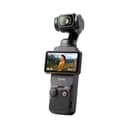
Resolution numbers at this price are mostly marketing; sensor area is not. The Osmo Pocket 3 has a 1-inch sensor, the three action cameras have 1/1.3-inch sensors, and the R100 has an APS-C sensor that is far larger than any of them. More area means more light per frame, which means cleaner footage indoors and after sunset — the one thing you cannot fix in software or in editing.
But sensor size is not the only axis, which is the trap. The R100 has the biggest sensor on this page and the worst video, because its video modes and autofocus were cut to hit the price. A 1-inch sensor behind a mechanical gimbal produces a better moving picture than an APS-C sensor with a cropped 4K mode and a fixed screen. Read the specs as a package, not as a league table, and how many megapixels you actually need covers why the headline number is the least useful one.
Three action cameras, three different reasons
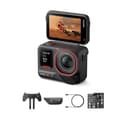
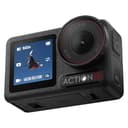
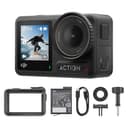
All three share a 1/1.3-inch sensor class and a 4K120 ceiling, so they are closer than their prices suggest. The Action 5 Pro is the one for long days: DJI publishes a 240-minute runtime and builds in 64 GB of storage, so a forgotten card is not a dead day. The Insta360 Ace Pro 2 is the one with a 2.5-inch flip-up screen, which is the only way to frame yourself properly on a camera this small — it is the action camera that doubles as a vlogging camera. The Action 4 is last year’s DJI at a discount, keeping the sensor and the resolution and giving up runtime and the internal storage.
All three are waterproof without a case — 20 m, 12 m and 18 m respectively — which is the practical difference between an action camera and everything else on this page. If none of your shooting involves water, mounting or impact, you are paying for durability you will never use, and the Pocket 3 or the R100 is the better buy. The GoPro alternatives page goes deeper on how these three compare with a HERO13 Black.
What to budget for beyond the camera
A camera at this price is rarely the last purchase. The R100 needs a lens beyond the kit zoom before it does anything the kit zoom cannot — a cheap fast prime is the standard first move, and our sub-$500 lens guide covers the options. Every camera here needs a fast memory card, and 4K120 action footage in particular needs a card rated for it. The Pocket 3 and the action cameras all have short batteries by mirrorless standards, so a spare or a power bank is a real line item. And if audio matters, a mic under $100 will improve your videos more than any of these cameras will.
How we ranked these
By job first — stills, handheld video, or mounted and waterproof — then by sensor area within each job, then by stabilization approach, then by what the camera needs you to buy before it works. We have not tested these cameras; here is what we do instead. Specifications are each manufacturer’s published figures with the date they were read, including each company’s own battery test conditions, which differ between brands and are not directly comparable. Prices come only from the live price layer.