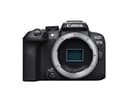
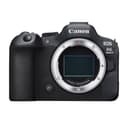
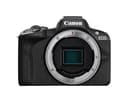
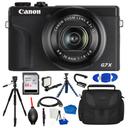
Which Canon mount do you actually need?
Canon has one modern mount, RF, and two sensor sizes inside it. Full-frame RF lenses (the ones just called “RF”) fit every body here. RF-S lenses are designed for the APS-C bodies — the R10, R50, R100 and R7 — and will only cover a crop of a full-frame sensor if you mount one on an R6 Mark II.
That matters for how you buy. An APS-C body plus RF-S glass is the cheap, light route, and the whole kit stays small. But if you think you will end up on full-frame, buying full-frame RF primes now means the glass survives the upgrade; the RF 50mm f/1.8 is the obvious first one, because it is cheap enough to buy on a crop body and still useful on a full-frame body later. Our full-frame versus APS-C explainer covers the trade in detail.
Where Canon wins, and where it does not
It wins on autofocus and on handling. Dual Pixel CMOS AF is the most forgiving system in this price range, and Canon bodies are shaped like cameras rather than like boxes — the R10’s twin dials and deep grip are a genuine advantage over the flatter crop bodies from Sony and Fujifilm if you shoot with one hand.
It loses on lenses and on stabilization. There are far fewer RF-S lenses than there are Sony E or Fujifilm X options, and third-party autofocus glass for RF has been slow to arrive. None of the APS-C bodies here has in-body stabilization, which is why handheld walking video on an R10 or R50 looks worse than the same shot on a stabilized rival. If stabilized handheld video is the point of the purchase, read gimbal versus in-body stabilization before you commit, and price a gimbal into the budget.
How we ranked these
In this order: how much of the sensor the body uses for 4K and whether the autofocus stays fast while it records; how trustworthy the autofocus is for moving subjects; how the body handles in one hand; and what the whole kit weighs once a realistic lens is on it. We have not tested these cameras, and there are no scores on this page because a score would imply a measurement we did not take — here is exactly what we do instead. Every specification quoted is Canon’s own published figure or the figure on the live listing, with the date it was read.
If you are cross-shopping outside Canon, the Sony line-up and the Fujifilm line-up have their own pages, and Sony versus Canon for video is the honest comparison if video is the main job.