Wide Open. Gear

The Best Lighting for Glasses Wearers

Glasses reflect whatever you point at them. The lights that stay out of your lenses on camera, and the placement that does most of the work.

By Stephen V.Last updated How we pick

If you wear glasses on camera, buy the Neewer 700W Softbox Lighting Kit — two 24-inch softboxes on stands. The reason is not brand or output: a reflection in your lenses is a picture of your light source, so the two things that fix it are a source large enough to be dim per square inch and a stand that lets you put that source where the camera cannot see it reflected. A kit with two boxes and two stands gives you both for less than the price of one name-brand panel. If your room is small, the 16-inch EMART Softbox Photography Kit does the same job in less space. If you are stuck at a desk on calls, the Elgato Key Light Neo clamps high and off to one side, which is the only placement that works in that situation.

Here is the mechanism, because it tells you what to buy. A spectacle lens is a curved mirror as well as a window. Light arriving at it bounces off at the same angle it came in at, which means a light placed directly in front of you — the classic ring light around the lens, or a panel on top of the monitor — sends its reflection straight back into the camera. Move the same light 45 degrees to one side and a little above eye level and the reflection goes past the camera instead of into it. Placement is free and it fixes most of the problem; the light you buy decides how easy that placement is to achieve.

The second half of the fix is size. A bare bulb or a small LED panel is a tiny, intense source, so even a glancing reflection is a hard bright rectangle in your lens. A two-foot softbox puts the same total light out through a much larger surface, so its reflection is a soft, dim wash rather than a hotspot — and because you can feather it, the edge of the beam does the lighting while the bright middle misses your face. Every pick below was chosen for being either large and diffused, or mountable somewhere a small light can get away with.

How this is funded:we earn a commission if you buy through our links, at no extra cost to you. It never changes which product we recommend, and we’ll tell you plainly when to skip one. Full disclosure.

Quick picks

Ranked on published specs and buyer fit. Select a row to jump to the full write-up. We have not tested these products — here is exactly what we do instead.

#ProductBest forPrice
1
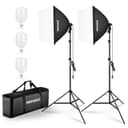
Neewer 700W Softbox Lighting Kit

Neewer 700W Softbox Lighting Kit

The cheapest way to get two soft light sources on stands. A pair of 24-inch softboxes with daylight LED bulbs covers a two-point interview or product setup for very little. The bulbs and stands are basic, but the soft, even light they produce is the real thing.

Best overall
$139.09 · View on Amazon

Price as of October 10, 2026. #ad How we’re funded

2
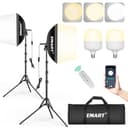
EMART Softbox Photography Kit (2-pack)

EMART Softbox Photography Kit (2-pack)

A tidier, more modern take on the budget softbox kit: two 16-inch soft boxes with adjustable-color LEDs and app control, so you can dial warm-to-cool without swapping bulbs. Compact enough for a home desk setup, and the color control is a genuine step up from fixed-daylight kits.

Best for a small room
$62.99 · View on Amazon

$70.9911% off

Price as of October 10, 2026. #ad How we’re funded

3
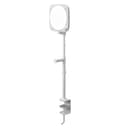
Elgato Key Light Neo

Elgato Key Light Neo

The streamer's key light, made simple. Elgato's Key Light Neo is an edge-lit panel you control from software on your PC or phone — no reaching behind the light to adjust it mid-stream. The soft, diffused output is flattering, and it clamps neatly to a desk. It is about convenience and integration, not raw power.

Best for a desk
$86.38 · View on Amazon

Price as of October 10, 2026. #ad How we’re funded

4
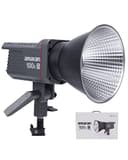
Aputure Amaran 100x S

Aputure Amaran 100x S

The step into a light that will still be in your kit years later. Aputure's Amaran line brings serious build quality, app control and reliable color accuracy, and the Bowens mount plus a bright 100W output make it a proper key light. One caveat before you buy: amaran has moved this line on to its Halo series, and the 100x S no longer appears in amaran's own COB lineup, so this is now the outgoing model rather than the one amaran sells today.

Best to grow into
$199.00 · View on Amazon

Price as of October 10, 2026. #ad How we’re funded

The picks in full

#1Best overall

Neewer 700W Softbox Lighting Kit

The cheapest way to get two soft light sources on stands. A pair of 24-inch softboxes with daylight LED bulbs covers a two-point interview or product setup for very little. The bulbs and stands are basic, but the soft, even light they produce is the real thing.

Strengths

  • Two softboxes and stands included for a low price
  • Soft, even light out of the box — no extra modifiers to buy
  • Uses standard E26 bulbs you can replace or upgrade

Trade-offs

  • Basic bulbs and flimsy stands
  • No dimming on the base bulbs
TypeContinuous softbox kit (2x 24-inch)
Color~5700K daylight LED bulbs
Includes2 softboxes, stands, bulbs
PowerAC mains

Specifications read from the manufacturer listing, on September 29, 2026.

#2Best for a small room

EMART Softbox Photography Kit (2-pack)

A tidier, more modern take on the budget softbox kit: two 16-inch soft boxes with adjustable-color LEDs and app control, so you can dial warm-to-cool without swapping bulbs. Compact enough for a home desk setup, and the color control is a genuine step up from fixed-daylight kits.

Strengths

  • Adjustable 3000-6000K color and app control
  • Compact 16-inch boxes suit a small room or desk
  • Comes as a complete two-light kit

Trade-offs

  • Lower total output than larger studio boxes
  • Plastic build; short stands
TypeContinuous softbox kit (2x 16-inch)
Color3000-6000K adjustable
ControlRemote and app
PowerAC mains

Specifications read from the manufacturer listing, on July 18, 2026.

#3Best for a desk

Elgato Key Light Neo

The streamer's key light, made simple. Elgato's Key Light Neo is an edge-lit panel you control from software on your PC or phone — no reaching behind the light to adjust it mid-stream. The soft, diffused output is flattering, and it clamps neatly to a desk. It is about convenience and integration, not raw power.

Strengths

  • Adjust brightness and color from your PC or phone
  • Soft, diffused, flattering output
  • Integrates with Elgato's streaming ecosystem

Trade-offs

  • Less raw output than a COB light with a softbox
  • Priced above generic panels for the software convenience
TypeEdge-lit LED panel
ColorBi-color 2900-7000K
ControlSoftware (PC), app, on-unit
MountingOfficial desk clamp (included), adjustable height and tilt

Specifications read from the manufacturer listing, on September 15, 2026.

#4Best to grow into

Aputure Amaran 100x S

The step into a light that will still be in your kit years later. Aputure's Amaran line brings serious build quality, app control and reliable color accuracy, and the Bowens mount plus a bright 100W output make it a proper key light. One caveat before you buy: amaran has moved this line on to its Halo series, and the 100x S no longer appears in amaran's own COB lineup, so this is now the outgoing model rather than the one amaran sells today.

Strengths

  • Bright, color-accurate 100W daylight output
  • Bowens mount and app/remote control
  • Aputure build quality and reliable support

Trade-offs

  • Costs more than a Godox SL60
  • White light only — colored looks need gels, not a built-in RGB mode
  • Superseded in amaran's own lineup by the Halo 100x, so stock is running out
Type100W bi-color LED
ColorBi-color 2700-6500K, CRI 95+
MountBowens
ControlOn-unit, remote and app

Specifications read from the manufacturer listing, on August 17, 2026.

Why a ring light is the worst choice if you wear glasses

This is worth saying plainly, because ring lights are the default recommendation everywhere and they are the one shape that cannot work here. A ring light is designed to sit around the lens, on the camera axis, which is precisely the position that guarantees its reflection lands in the frame. Worse, a ring reflects as a ring: a bright circle in each lens, instantly recognizable and impossible to ignore once a viewer has seen it.

If a ring light is what you already own, you are not stuck. Take it off the camera axis: raise it on its stand so it sits above and to one side, angled down at you, and treat it as a key light rather than a halo. You lose the shadowless look it was sold for and you gain usable video. Our ring light roundup covers the models worth owning if you also film without glasses on.

The placement that actually fixes it

Work through these in order and most people are done after the second step.

One: get the light off the camera axis.Roughly 45 degrees around from where you are looking, and raised so it is angled down at about 30 to 45 degrees. Both of those changes send the reflection down and away from the lens. This is also simply better-looking light than front-on lighting — it creates some shape in a face instead of flattening it.

Two: tilt the glasses, not the light. Push the arms of your frames slightly up where they sit over your ears, so the lenses tip a couple of degrees further down. It is invisible on camera and it redirects any remaining reflection toward the floor. Broadcast interviewees have been doing this for decades.

Three: make the source bigger and move it closer. A larger box closer to you is softer and needs less output, which means a dimmer reflection if any survives. This is the opposite of the instinct to push a light further away.

Four: kill the competing sources.A window behind the camera, a bright monitor, a white ceiling bounce — each is its own reflection in your lenses, and you cannot angle your way out of three of them at once. Turn the room lights off, close the blind, and let your key light be the only thing your glasses can see. The three-point lighting guide explains how to add a controlled fill back in once the key is clean.

What about anti-reflective coatings?

An anti-reflective coating genuinely reduces the strength of a reflection — that is what it is sold to do, and if you are buying new lenses it is worth asking for. What it does not do is eliminate one. A coating cuts the brightness of the bounce; it does not change the angle it bounces at. So it makes a well-placed light look flawless and a badly placed light look slightly less bad. Buy the coating for everyday comfort, and still move the light.

The same logic applies to photochromic and blue-light lenses. They change what the lens does to light passing through it, not what it does to light bouncing off the front surface. Placement is still the fix.

Which of these to buy for your situation

Filming at a desk, on calls, in a normal room.The Elgato Key Light Neo on its desk clamp, raised to its full height and set off to one side behind your monitor. It is edge-lit and diffused rather than a bare LED array, and you control brightness from software, which matters because the right answer for glasses is usually “dimmer and closer” and you will want to adjust it without reaching behind the light. See also the dedicated key lights for Zoom calls roundup.

Filming a seated talking-head with a camera on a tripod. The Neewer kit. Put one 24-inch box at 45 degrees as your key, and either put the second box on the other side much further back as fill, or point it at the background. Two soft sources with real stands is the whole professional answer to this problem.

Small room, or a desk with no floor space. The EMART kit. The 16-inch boxes are still far larger than your face, the stands are short enough to sit on a desk, and the adjustable 3000-6000K color means you can match a warm room instead of fighting it. There is more on sizing in what size softbox do I need.

You will be doing this for years. The Amaran 100x S on a Bowens-mount softbox. One bright, color-accurate COB light plus whatever modifier you want, dimmed smoothly from an app, is the setup that stops being a compromise. It costs more and arrives in more boxes. Our video lighting kit roundup covers the COB-plus-modifier route in full.
Frequently asked questions

What is the best light for video if you wear glasses?

A large, diffused source you can place off the camera axis — in practice a softbox on a stand. The Neewer 700W Softbox Lighting Kit is the value pick because it gives you two 24-inch boxes and two stands, and the stands are what let you put the light at 45 degrees and above eye level where its reflection misses the lens.

How do I stop glare on my glasses on Zoom?

Move your light off the camera axis and above your eyeline, then turn off everything else that is bright in front of you. A panel sitting on top of your monitor, a ring light around a webcam, or a window behind the camera will all reflect straight back. Raise one soft light to one side, angle it down at you, and tilt your frames very slightly down by pushing the arms up over your ears.

Are ring lights bad for glasses?

For glasses, yes — a ring light is designed to sit on the camera axis, which is the exact position that puts its reflection in your lenses, and it reflects as an obvious bright circle. If you already own one, raise it on its stand and move it off to one side so it works as a key light instead of a halo.

Does a bigger softbox reduce glasses glare?

It reduces how harsh the reflection looks rather than removing it. A big box spreads the same output over a much larger surface, so any reflection is a soft, dim wash instead of a small hotspot, and you can feather the edge of the beam onto your face. Size helps, but angle is what actually gets the reflection out of the frame.

Do anti-reflective lens coatings fix glare on camera?

They weaken a reflection but do not change where it goes. A coating cuts the brightness of the bounce off the front of the lens; the angle is still governed by where your light is. Treat the coating as a bonus on top of correct placement, not a substitute for it.

Can I just take my glasses off for video?

You can, and plenty of presenters do, but it changes how you look and it may stop you reading a script or seeing your framing. If you present regularly in glasses, it is worth solving the lighting once — off-axis placement plus one large diffused source — rather than removing them for every take.

Will two softboxes cause two reflections?

They can, which is why the second light should be weaker and further back, or pointed at the background rather than at you. Set your key light first, check your lenses in a test recording, and only then add the second light — and recheck after you add it.

Sources

Keep reading