How we ranked these
1. Whether Neewer publishes a color-accuracy figure, and what it is. CRI and TLCI are scored out of 100 and describe how faithfully a light renders color compared with daylight. The RGB panel publishes CRI/TLCI 97+ and the desktop ring light publishes CRI 97+ with TLCI 98+. The softbox kit and the 18-inch ring light publish nothing, which is not the same as being bad — it means we cannot tell you, and neither can the listing.
2. Source size relative to how far away you sit. Softness is a function of apparent size, not diameter. A 12-inch ring at 60 cm from your face is a softer light than a 24-inch softbox three metres away. We say what each light is sized for rather than treating bigger as better — our ring light sizing explainer does the arithmetic.
3. Color temperature range, because fixed-color is a real limitation. Two of these are bi-color and go warm enough to match a lamp-lit room. The softbox kit ships with roughly 5700K daylight bulbs and that is what you get.
4. What controls it and what powers it. App control and on-unit dials matter when a light lives behind you. Mains-only power matters when you want to take a light outside, and three of these four are mains-only.
We have not tested these lights — here is exactly what we do instead — and every figure is Neewer’s own published specification with the date we read it. No scores, because a score would imply a measurement we did not take.
The two lights with a published number
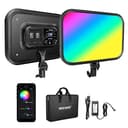
The 18-inch RGB LED Panel is the most capable light Neewer makes in our registry and the one we would buy. The 18.3-inch panel is big enough to be a genuinely soft key light at a normal seated distance; the white range runs 2500K to 8500K, which covers a tungsten room at one end and shade at the other; the full RGB means it also does the colored wall wash that makes a streaming background look deliberate rather than beige. CRI/TLCI 97+ is published. It is controllable on the unit and from an app, which is what you want for a light mounted behind or above you.
Its costs are the usual panel costs. It is mains-powered, so it stays indoors. A flat panel with no diffusion dome is a harder source than a softbox of the same width, so for faces it wants to be close. And RGB is the feature people buy and then use twice — if you only ever want white light, the money is better spent on size.
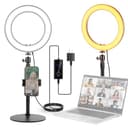
The 12-inch Desktop Ring Light (RH12B) is the surprise of this page. It publishes CRI 97+ and TLCI 98+, which is the highest color-accuracy claim of anything here, at the lowest price of anything here. 24W, 2900K to 7000K, dimmable from 0 to 100%, on a desk stand adjustable from 11 to 18 inches. For a webcam, a laptop camera or a Zoom call it is simply the right answer, and it is why it earns the budget slot rather than being a compromise.
What it cannot do is light a room or a second person. A 12-inch ring at desk distance lights a face beautifully and falls off almost immediately. It also produces the circular catchlight in the eyes that is the ring-light signature — charming to some, a giveaway to others. If you wear glasses, a ring directly in front of you is the worst possible shape, and our lighting for glasses wearers guide explains what to do instead.
The two lights with no published figure
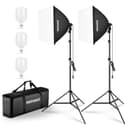
The 700W Softbox Lighting Kit is the cheapest way to own two real light sources, and two lights is a bigger jump in how footage looks than any single-light upgrade. Two 24-inch softboxes, two stands, daylight-balanced bulbs at roughly 5700K, mains powered. For a seated interview, a product table or a two-person podcast, it is the shape of lighting a professional would recognize, at a price that reads like an accessory.
Three honest limits. Neewer publishes no CRI figure for the included bulbs, so color rendering is unknown — if accurate skin tone is the whole job, that is a real risk. The color temperature is fixed, so you cannot dial it warm to match a room. And it is physically large: two 24-inch boxes on stands need floor space you may not have, and they do not fold away quickly. It is the top pick on our podcast lighting roundup for exactly the multi-person case it suits.
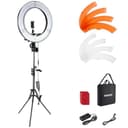
The 18-inch Ring Light Kit (RL-18) is the bigger ring, on a floor stand, bi-color and dimmable, with a phone holder and a bag included. The size is the argument: an 18-inch ring at a metre is a much softer, more flattering source than a small ring held close, which is why beauty and seated talking-head setups use this shape. Neewer publishes no CRI figure for it, which is why it sits below the desktop ring here despite being the larger and more expensive light. It is mains powered and the floor stand is the part that takes up your room.
How to spend the money, in order
If you are starting from a ceiling bulb and nothing else, the order that gets you the most improvement per dollar is: one light close to your face, then control over its brightness and color, then a second light, then color for the background.
That means the desktop ring light first if you sit at a desk. The RGB panel first if you are further from the camera than arm’s reach, or if you need one light to serve several uses. The softbox kit first only if you already know you need two sources — a second person, or a product table where you are killing shadows from both sides. The 18-inch ring is the specialist: buy it because you want the soft frontal beauty look, not as a general-purpose light.
Where Neewer stops being the answer is control and portability. Nothing here runs off a battery, so none of it goes outside or on location. Nothing here has a Bowens mount for proper modifiers. And if you want a light that is app-controlled, battery-powered and small, that is a different class of product — our Elgato Key Light alternatives page covers where the Neewer options genuinely compete with a premium desk light and where they do not.