Wide Open. Gear

The Best Travel Tripods

The tripods light enough to carry all day and short enough to pack — ranked on folded length, carry weight and whether the head is any good.

By Stephen V.Last updated How we pick

A travel tripod is judged on one thing before any other: whether you still have it with you at golden hour on day four. Every specification below is a proxy for that. Folded length decides whether it rides inside a carry-on or flaps off the side of a daypack. Carry weight decides whether you leave it in the hotel room. Everything else — leg sections, lock type, head quality — decides how much stability you gave up to make the first two numbers small.

So we ranked these on folded length, carry weight, standing height without raising the center column, and the quality of the included head, in that order, with capacity as a filter rather than a score — almost every tripod here holds a mirrorless body and a mid-size lens with room to spare. Prices run from around fifty dollars to the price of a lens; the live figure on each card is pulled from Amazon, so it is the number you will actually pay today rather than one we typed in months ago.

How this is funded:we earn a commission if you buy through our links, at no extra cost to you. It never changes which product we recommend, and we’ll tell you plainly when to skip one. Full disclosure.

Quick picks

Ranked on published specs and buyer fit. Select a row to jump to the full write-up. We have not tested these products — here is exactly what we do instead.

#ProductBest forPrice
1
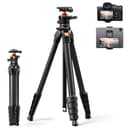
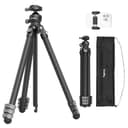
SmallRig Portable Travel Photo Tripod (Carbon Fiber)

SmallRig Portable Travel Photo Tripod (Carbon Fiber)

On published figures this is the best weight-to-height-to-price balance in a travel tripod right now: carbon fiber legs at 1.36 kg that still stand a camera at eye level, a ball head rated to 5 kg with a proper portrait lock, and a reversible center column for ground-level work. It folds longer than a Manfrotto Befree and SmallRig is newer to tripods than the legacy brands, so you are trading track record for specification.

Best overall
$114.99 · View on Amazon

Price as of September 7, 2026. #ad How we’re funded

2
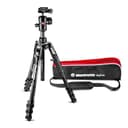
Manfrotto Befree Advanced

Manfrotto Befree Advanced

The travel tripod most photographers should buy. It folds down small, sets up fast with lever locks, and the included ball head is genuinely good — a rarity at this price. Aluminum keeps the cost sensible while holding a mirrorless body plus a mid-size lens without complaint.

Best aluminum all-rounder
$199.95 · View on Amazon

Price as of September 7, 2026. #ad How we’re funded

3
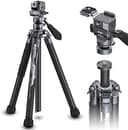
K&F Concept 63-inch Aluminum Travel Tripod

K&F Concept 63-inch Aluminum Travel Tripod

The budget travel tripod that gets the travel part right rather than the price alone. The legs fold to 15.7 inches (18.9 with the head fitted) and the whole thing weighs 2.6 lb, so it fits a 20-inch carry-on, and the 40 mm ball head takes Arca-compatible plates instead of a proprietary shoe. Five leg sections mean the thinnest bottom segment is the weak link — extend it last, and use the hook in wind.

Best budget
$49.99 · View on Amazon

$59.9917% off

Price as of September 7, 2026. #ad How we’re funded

4
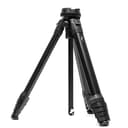
Peak Design Travel Tripod (Aluminum)

Peak Design Travel Tripod (Aluminum)

The travel tripod that solved the dead-space problem: the legs and center column pack around each other so it collapses to the width of a water bottle. The integrated ball head is clever and quick. It costs a lot, but if you carry a tripod every day, the packed size is genuinely worth it.

Best packed size
$399.95 · View on Amazon

Price as of September 7, 2026. #ad How we’re funded

5
ULANZI F38 Carbon Fiber Video Travel Tripod

ULANZI F38 Carbon Fiber Video Travel Tripod

The travel tripod for people whose trip footage is video, not stills. It ships with a damped video head rather than a ball head, so pans and tilts move smoothly instead of stepping, and the integrated leveling bowl gets your horizon straight on uneven ground in one movement rather than by fiddling with three legs. The trade is that a fixed-damping video head is worse than a ball head for quick stills reframing.

Best for video
$199.00 · View on Amazon

Price as of September 7, 2026. #ad How we’re funded

6
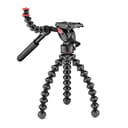
JOBY GorillaPod 3K PRO

JOBY GorillaPod 3K PRO

The flexible-leg tripod that goes where a normal one can't — wrapped around a railing, gripping a branch, or standing low on a desk for a product shot. Rated for a mirrorless body plus lens, it is the vlogger's and product-shooter's answer to 'I need to mount this somewhere weird'.

Best ultra-compact
$99.99 · View on Amazon

Price as of September 7, 2026. #ad How we’re funded

The picks in full

#1Best overall

SmallRig Portable Travel Photo Tripod (Carbon Fiber)

On published figures this is the best weight-to-height-to-price balance in a travel tripod right now: carbon fiber legs at 1.36 kg that still stand a camera at eye level, a ball head rated to 5 kg with a proper portrait lock, and a reversible center column for ground-level work. It folds longer than a Manfrotto Befree and SmallRig is newer to tripods than the legacy brands, so you are trading track record for specification.

Strengths

  • Carbon fiber at 1.36 kg (3.0 lb) — light enough to carry all day
  • Stands to 161.5 cm (63.6 in), so you are not shooting hunched over
  • Reversible center column and counterweight hook for low angles and wind

Trade-offs

  • Folds to 51 cm (20.1 in) — longer than the shortest-packing rivals
  • Head rated to 5 kg, below the 8-10 kg heads on pricier travel tripods
  • Newer to tripods than Manfrotto or Peak Design, with less long-term track record
MaterialCarbon fiber legs, 4 sections, lever locks
Folded / weight51 cm (20.1 in) / 1.36 kg (3.0 lb)
Height range49-161.5 cm (18.9-63.6 in)
HeadBall head, 5 kg (11 lb) load, 90-degree portrait lock
Center column180-degree reversible, detachable hook

Specifications read from the manufacturer listing, on September 7, 2026.

#2Best aluminum all-rounder

Manfrotto Befree Advanced

The travel tripod most photographers should buy. It folds down small, sets up fast with lever locks, and the included ball head is genuinely good — a rarity at this price. Aluminum keeps the cost sensible while holding a mirrorless body plus a mid-size lens without complaint.

Strengths

  • Folds small; quick lever-lock legs
  • Genuinely capable included ball head
  • Holds a mirrorless body and mid-size lens steadily

Trade-offs

  • Aluminum is heavier than a carbon-fiber rival
  • Max height is modest for taller shooters
MaterialAluminum
HeadBall head included
Folded length~40 cm
Weight~1.49 kg

Specifications read from the manufacturer listing, on July 18, 2026.

#3Best budget

K&F Concept 63-inch Aluminum Travel Tripod

The budget travel tripod that gets the travel part right rather than the price alone. The legs fold to 15.7 inches (18.9 with the head fitted) and the whole thing weighs 2.6 lb, so it fits a 20-inch carry-on, and the 40 mm ball head takes Arca-compatible plates instead of a proprietary shoe. Five leg sections mean the thinnest bottom segment is the weak link — extend it last, and use the hook in wind.

Strengths

  • Folds to 15.7 in (18.9 in with the head) and weighs 2.6 lb
  • Arca-compatible 40 mm ball head with a 360-degree panning base
  • Reversible center column and a weight hook, which cheaper tripods skip

Trade-offs

  • Five leg sections: the thinnest section flexes, so extend it last
  • Aluminum, so it transmits more vibration than carbon in wind
  • Build and finish are budget-grade next to a Manfrotto or Peak Design
MaterialAluminum alloy, 5 sections
Folded / weight15.7 in legs (18.9 in with head) / 2.6 lb
Height range17-63 in
CapacityUp to 22 lb
Head40 mm Arca-compatible ball head, 90-degree vertical tilt

Specifications read from the manufacturer listing, on September 7, 2026.

#4Best packed size

Peak Design Travel Tripod (Aluminum)

The travel tripod that solved the dead-space problem: the legs and center column pack around each other so it collapses to the width of a water bottle. The integrated ball head is clever and quick. It costs a lot, but if you carry a tripod every day, the packed size is genuinely worth it.

Strengths

  • Packs to roughly the width of a water bottle
  • Fast, clever integrated ball head
  • Excellent build quality and stability for the size

Trade-offs

  • Expensive
  • Aluminum version is not light despite the small pack size
MaterialAluminum
HeadIntegrated ball head
Packed diameter~8 cm
Capacity~9 kg (20 lb)

Specifications read from the manufacturer listing, on July 18, 2026.

#5Best for video

ULANZI F38 Carbon Fiber Video Travel Tripod

The travel tripod for people whose trip footage is video, not stills. It ships with a damped video head rather than a ball head, so pans and tilts move smoothly instead of stepping, and the integrated leveling bowl gets your horizon straight on uneven ground in one movement rather than by fiddling with three legs. The trade is that a fixed-damping video head is worse than a ball head for quick stills reframing.

Strengths

  • Damped video head with 360-degree pan and -55 to 90-degree tilt
  • Integrated leveling bowl levels the camera in one step on rough ground
  • Carbon fiber at a published 2.38 lb, rated to 22 lb of load

Trade-offs

  • Damping is fixed, not adjustable — you get one feel, take it or leave it
  • A video head is slower than a ball head for recomposing stills
  • Quick-release is the proprietary F38 system, so plates are Ulanzi-specific
MaterialCarbon fiber
Height range44-156 cm (17-61 in)
Weight / capacity2.38 lb / up to 22 lb (10 kg)
HeadFluid-damped video head, 360-degree pan, -55 to 90-degree tilt
LevelingIntegrated leveling bowl
Quick releaseF38 quick-release plate system

Specifications read from the manufacturer listing, on September 7, 2026.

#6Best ultra-compact

JOBY GorillaPod 3K PRO

The flexible-leg tripod that goes where a normal one can't — wrapped around a railing, gripping a branch, or standing low on a desk for a product shot. Rated for a mirrorless body plus lens, it is the vlogger's and product-shooter's answer to 'I need to mount this somewhere weird'.

Strengths

  • Wraps around poles, rails and branches
  • Holds a mirrorless body plus lens (up to ~3 kg)
  • Doubles as a handheld vlogging grip

Trade-offs

  • Not a substitute for a tall tripod
  • Ball head is basic
TypeFlexible-leg tripod
CapacityUp to 3 kg
HeadBall head included
UseWrap, stand or handheld grip

Specifications read from the manufacturer listing, on July 18, 2026.

The four numbers that decide a travel tripod

Folded length is the one people underestimate. Anything under about 40 cm (16 in) fits diagonally inside a standard 20-inch carry-on; anything much over 50 cm (20 in) is going on the outside of a bag, which is fine on a hike and awkward in an airport. That single number explains most of the price gap between the tripods on this page: folding short means reverse-folding legs, more leg sections, or a center column that nests between the legs rather than sitting above them.

Carry weightis what you feel on day three. Somewhere around 1.5 kg (3.3 lb) is the line between “I brought it” and “I left it” for most people walking a city all day with a camera already on their shoulder. Standing heightis the most commonly oversold figure: manufacturers quote maximum height with the center column fully raised, which is the least stable configuration a tripod has. Look at the height with the column down — that is the height you will actually use for anything long enough to need a tripod.

Capacity is the number that matters least here, because it is quoted generously and almost never binds for a travel kit. A mirrorless body and a 24-70mm sits comfortably under 2 kg. If you shoot a long telephoto, you are outside travel-tripod territory and should be reading our full camera tripod guide instead.

Carbon fiber or aluminum: what the money buys

Carbon fiber buys you roughly 25-30% less weight for a similar leg diameter, plus better vibration damping — carbon absorbs the ring from a shutter or a gust more quickly than aluminum, which matters at exposures of a second or more. It does not buy you more stability in the sense of resisting wind; a light tripod is a light tripod, and the fix for wind is the weight hook, not the material.

Aluminum buys you a better head, a better lock mechanism, or simply money left over, at the cost of a few hundred grams. That is why the Manfrotto Befree Advanced remains an easy recommendation despite being the heavier material: the head that comes with it is genuinely good, and a good head on aluminum legs beats a mediocre head on carbon every time. If your longest exposures are a few seconds and you are not hiking with the tripod strapped to your back, aluminum is the sensible default and the savings are real.

Leg sections and locks: where stability leaks

Every leg section is a joint, and every joint is somewhere the tripod can flex. A four-section tripod folds longer and stands steadier; a five-section tripod folds shorter and has a thinner, wobblier bottom segment. Neither is wrong — but the practical habit is the same on both: extend the thickest sections first and the thinnest last, and only extend the bottom section when you actually need the height. Most people do the opposite out of convenience and then blame the tripod for soft frames.

Lock type is mostly preference. Lever locks are faster to operate and let you see at a glance whether a leg is locked; twist locks are cleaner in a bag and less likely to snag, but need a firm hand and can seize with sand or grit in them. If you shoot on beaches, rinse and dry either type — grit, not wear, is what kills travel-tripod legs. Our how to choose a tripod guide goes deeper on load ratings, materials and heads if you want the full explanation.

The head is half the tripod

A ball head is right for stills: you loosen one knob, move the camera anywhere, tighten, shoot. The two things that separate a good one from a bad one are whether it sags when you lock it (cheap heads drop a few degrees as they tighten, which ruins a carefully leveled horizon) and whether it has a dedicated notch for portrait orientation. A video head is right for footage: fixed or adjustable damping makes a pan start and stop smoothly rather than jerking, which is why the Ulanzi F38 is here as a separate pick rather than a better version of the same thing.

Check the plate standard before you buy. Arca-compatible plates are the de facto standard and are shared across brands, L-brackets and clamps; proprietary systems lock you into one manufacturer’s accessories. Both approaches ship on this page, and it is worth a moment’s thought if you already own plates or an L-bracket.

Flying with a tripod

The TSA lists tripods as permitted in both carry-on and checked bags, with the usual caveat that the officer at the checkpoint makes the final call. In practice a travel tripod is far safer in your carry-on than in the hold, which is another argument for the folded-length number: a tripod that fits inside the bag never gets confiscated at the gate as an oversize item, and never arrives with a bent leg. A carbon tripod strapped to the outside of a checked bag is the single most common way people break one.

When a travel tripod is the wrong buy

If you only ever need a camera held still on a table, a desk or a wall, a flexible grip like the GorillaPod does that for a fraction of the weight and cost. If you shoot long lenses, night skies for hours, or video with a heavy rig, buy a full-size tripod and accept that it stays in the car — a travel tripod asked to do that job will disappoint you at exactly the wrong moment. And if your problem is handheld shake in normal daylight, the honest answer is that modern stabilization has largely solved it: read image stabilization explained before you spend money on legs you will not carry.

Once the tripod is sorted, the rest of the travel kit follows: a camera small enough to carry all day, a bag that does not advertise what is inside it, and enough card capacity that you are not deleting frames in a hotel room.
Frequently asked questions

What is the difference between a travel tripod and a regular tripod?

A travel tripod is built around folded length and carry weight rather than outright rigidity. It achieves that with more leg sections, thinner tubes and often legs that fold back around the head, which is why it packs to roughly half the length of a conventional tripod. You give up some stability and some maximum height to get there, which is a good trade if it means the tripod is with you rather than at home.

Is a carbon fiber travel tripod worth the extra money?

It is worth it if you hike or walk with the tripod for hours, or shoot exposures of several seconds where vibration damping matters. Carbon is roughly a quarter to a third lighter than aluminum for a similar leg diameter and settles faster after a knock. If your tripod mostly travels in a bag and comes out for a few shots, aluminum saves you real money and the practical difference is small.

Can I take a tripod on a plane in my carry-on?

The TSA lists tripods as allowed in both carry-on and checked bags, with the final decision resting with the officer at the checkpoint. The practical constraint is your airline's cabin-bag size, which is why folded length matters: a tripod that fits inside a 20-inch carry-on avoids the whole conversation, while one strapped to the outside of a bag is the one that gets questioned or damaged.

How tall should a travel tripod be?

Aim for a model that reaches your eye level with the center column down, because a raised column is the least stable part of any tripod. For most adults that means a maximum quoted height of around 150-165 cm (59-65 in), since the quoted figure usually includes the column. If you are tall, check the column-down height specifically rather than the headline number.

How do I stop a light tripod from shaking in the wind?

Use the weight hook under the center column and hang your camera bag from it, keep the center column down, extend the thickest leg sections first and the thinnest last, and widen the leg angle where the ground allows. Those four habits do more for a light tripod than upgrading the material does, and they cost nothing.

Do I need an Arca-compatible head?

You do not need one, but it is the more flexible choice. Arca-style plates are a de facto standard shared across brands, L-brackets and clamps, so a plate you buy today keeps working with your next tripod. Proprietary systems can be faster or more secure, but they tie your accessories to one manufacturer, which is worth knowing before you invest in extra plates.

Is a cheap travel tripod good enough?

For a mirrorless body and a small lens in reasonable conditions, yes — a well-designed budget tripod with a hook and an Arca-compatible head does the job. What you give up is refinement: thinner bottom leg sections, more flex, and a head that may sag slightly as it locks. Spending more mostly buys a better head and shorter folded length, not a fundamentally different capability.

Sources

Keep reading