If you want the control: an app-controlled panel
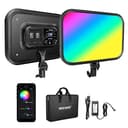
The Key Light’s real selling point is that you adjust it without touching it, and that your lighting is identical every session. The Neewer 18-inch RGB panel replicates that with its own app, covers 2500-8500K in white mode — a wider range than the Neo’s 2900-7000K — and publishes a CRI/TLCI figure of 97 or better, which is the specification that decides whether skin tones look right rather than slightly green. Our CRI explainer covers why that number is the one to check on any cheaper panel.
Two honest differences. It does not integrate with Stream Deck or Elgato’s streaming software, so if your whole desk is already Elgato you lose one-button scene control. And it is a panel, not a desk-clamp product — a stand is not always included, so budget for one or for a clamp if your desk has no room. The Key Light Neo including its clamp is a genuine convenience advantage.
If you want more light: a COB light
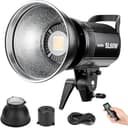
This is the upgrade people are usually really after. A 60W COB light like the Godox SL60W is in a different class of output from any edge-lit desk panel, and because it mounts on a Bowens fitting you can bolt a real softbox onto it and make the source as large and as soft as you like. That combination — power plus a big modifier — is what produces the look people associate with a studio rather than a desk.
The costs are real and worth stating. It is daylight-only at 5600K with no color adjustment, so you white-balance your camera to it rather than tuning it to the room. It needs a stand and a modifier you buy separately. It has a fan. And it is not a desk product at all — it needs floor space. If that sounds like the right trade, the video lighting kits roundup covers the whole COB-and-softbox route properly.
If you want softer light on your face: go bigger
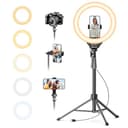
Softness is a function of how large the light source is relative to your face, and nothing else. That is the single most useful fact in lighting, and it means an 18-inch ring light is physically capable of a softer, wraparound result than a small edge-lit panel can manage, for a similar price. The Neewer 18-inch ring kit also includes the stand and phone holder, so it is a complete setup out of the box.
What a ring gives up is shape. Front-on circular light is flat and shadowless — flattering for beauty and talking-head work, less interesting than a key placed off to one side. It is also the worst option if you wear glasses, because a bright ring directly in front of you reflects straight back into the lens; the fix is in best lighting for glasses wearers.
If you want to spend less: two cheap lights beat one good one
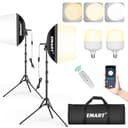
For less than the price of a single Key Light, the EMART kit gets you two 16-inch softboxes with 3000-6000K adjustable color and remote and app control. Two soft sources you can place where you want is a bigger step forward in how your video looks than one better single light, because it lets you control the shadow side of your face instead of accepting whatever the room gives you. The build is plastic and the stands are short, which is exactly what you would expect at the price.
At the very bottom, the UBeesize 12-inch ring is the cheapest usable lighting upgrade there is — a small ring on a 62-inch stand with a phone clamp. It will not light a room and the stand tips if you knock it, but for calls and phone video it is a real improvement over nothing, and the sub-$100 lighting roundup covers that whole band.
How we compared these
Against the Key Light’s own published strengths, in this order: remote and software control; white color range and published color accuracy; source size relative to a face; raw output; and what is in the box, since the Key Light Neo includes its desk clamp and several of these do not include a stand. Every Elgato figure quoted is from Elgato’s published specification for the Key Light Neo, the current model in the line, with the date it was read — we do not quote figures for the Key Light, Air or Mini that we have not sourced. We have not tested any of these lights; here is exactly what we do instead.