How we ranked these
In this order, and the order is the whole reason this page is not a longer version of the $100 one.
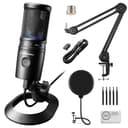
1. Can you hear yourself while you record? A headphone output on the mic is the difference between finding out about the fridge hum now and finding out tomorrow. Three picks here have one. The AT2020USB-X goes further with a mix control, which lets you balance your own voice against playback instead of hearing one or the other.
2. Can you change the pickup pattern? Two picks offer cardioid, omnidirectional, bidirectional and stereo from one capsule assembly, which means one mic covers a solo take, two people across a desk and room capture. Our polar patterns explainer covers what each one is actually for.
3. Is the recording recoverable if you set the level wrong? This is what 32-bit float recording buys, and it is the most underrated feature in this band. The transmitter captures the audio at a dynamic range wide enough that a take which clips on the receiver can still be pulled back in editing. Two picks record 32-bit float onboard.
4. What can you adjust, and where? On-mic controls beat software for anything you change between takes. Software controls that stick — like the VideoMic GO II’s high-pass, HF boost and pad, which you set once in RODE Central and leave — are fine for things you set and forget.
5. Price, last, and with the headroom stated rather than hidden.
We have not tested these microphones — here is exactly what we do instead — and every figure is the manufacturer’s published specification or the verified live listing, with the date we read it. No scores, because a score would imply a measurement we did not take.
The two desk mics, and why the cheaper one is not the pick
The AT2020USB-X is a cardioid USB-C condenser, which means it hears what is in front of it and rejects a reasonable amount of what is beside it. Its headphone output with a mix control is the feature that earns it the top slot: you set how much of your own voice you hear against the computer, which is the difference between a comfortable recording session and one where you shout because you cannot hear yourself. One pattern, no RGB, nothing else — that focus is the point.
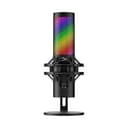
The HyperX QuadCast 2 S is the streaming answer and the more featured product of the two. Four switchable patterns, a tap-to-mute sensor on the top and a shock mount built into the body rather than bought separately. If your mic lives on a desk you also type on, that internal shock mount is a real practical win. The cost of all that capability is a condenser capsule that is no less sensitive to your room than the Audio-Technica, plus features you may never touch.
Neither of these is a dynamic mic, and in a hard, untreated room a dynamic capsule rejects the space far better. That is a Shure MV7 or MV7+, and both are above this band — see our Shure MV7 alternatives page for what that costs and what it buys. Both picks here also appear on our USB microphone roundup, where they are ranked against the dynamics rather than inside a price ceiling.
The wireless systems: two transmitters for under $200
This is the single most surprising thing about the sub-$200 band, and the thing an under-$100 page cannot deliver with the same confidence: you can buy a complete two-person wireless system inside it, with the audio captured in 32-bit float inside the transmitter as a safety net.
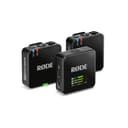
The RODE Wireless GO is the pick. Two transmitters and a receiver, 32-bit float onboard, and it connects to a camera over 3.5mm or to a computer over USB-C. For a two-person interview, it is the answer in this band and it is a core pick on our interview mic roundup.
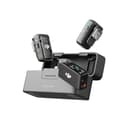
The DJI Mic 2 is the pick if your shoots involve more than one kind of device. It has 32-bit float and active noise cancelling, it ships with a charging case, and it connects to a camera, USB-C, Lightning and over Bluetooth — which is four routes into whatever you are filming on today. If you move between a phone and a camera, that flexibility is the feature. Our DJI Mic alternatives page ranks it against the RODE directly.
Both of these read within a few dollars of $200 as of the date stamped above. They are in the band today and they may not be tomorrow; we would rather say that than quietly drop them.
On camera: where the band stops mattering
If the microphone is going on a camera, the useful news is that the sub-$200 ceiling is irrelevant — the good answers cost well under half of it.
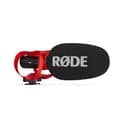
The RODE VideoMic GO II is the default. It mounts in the hot shoe, runs on power from the camera or over USB with no battery of its own, and its high-pass filter, HF boost and pad are set once in RODE Central and stay set. The included HELIX isolation mount is the part that keeps handling noise out of the track. It appears on our RODE microphone roundup as the overall pick of that whole line-up.
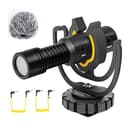
The Deity V-Mic D4 Mini is the budget pick and the cheapest mic here by a distance. Supercardioid, 3.5mm TRS/TRRS so it works on cameras and phones, and it draws plug-in power at 1-5V from the camera, so there is nothing to charge. What you give up is every control and any way to monitor: you point it, you record, and you find out afterwards. For a second camera or a B-roll rig that is exactly the right trade.
What $200 does not buy
A dynamic capsule. Every desk mic in this band is a condenser. If your room is the problem rather than the mic, no amount of condenser quality fixes it — you want a dynamic, and that means spending above this ceiling.
XLR. Nothing here has an XLR output, so nothing here grows into an interface-based setup later. If that path matters to you, read our XLR vs USB explainer before buying, because it is a decision that is awkward to reverse.
Timecode or long range. The wireless kits here do the job at conversational distances. Timecode sync and several hundred metres of range are features of the tier above, and our wireless microphone roundup covers what that costs.
Room treatment. Worth saying because it is the cheapest upgrade on this page and it is not on it. A duvet on a bare wall behind you does more for an untreated room than $100 of extra microphone. Spend on the mic second.