How we ranked these: four criteria, in this order
A sports lens has one job — freeze a moving human being sharply enough to print — and it either passes enough light to do that in the building you are standing in, or it does not. These are the four things that decide it, ordered by how often each one is the reason a photograph failed.
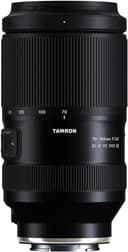
1. Maximum aperture, because shutter speed is not optional.Sport needs 1/500 s to stop a running body and 1/1000 s or faster for a swung bat, a hand at the rim or a ball leaving a foot. You cannot negotiate those numbers down the way you can for a portrait. That leaves aperture and ISO to find the exposure, and every stop of aperture is a stop you do not have to pay for in noise. f/2.8 to f/5.6 is two stops — the difference between ISO 3200 and ISO 12800 in the same gym. This is the single reason the Tamron 70-180mm f/2.8 tops the list despite being the shortest zoom here.
2. Autofocus motor and how it behaves on a subject coming toward you.Lateral movement is easy; a player running straight at the camera is what separates lenses. Linear and stepping-motor designs (Tamron’s VXD, Fujifilm’s LM, Canon’s USM) drive focus groups fast enough to keep up with modern continuous AF; older screw-drive and micro-motor designs do not, which is most of why a 20-year-old 70-300mm bargain is a trap. Aperture feeds back into this: most mirrorless bodies focus fine at f/8, but with fewer phase-detect pixels active and less confidence in low contrast — exactly the conditions of an evening game.
3. Focal length matched to where they let you stand. Reach is third because it is the one variable you can usually solve with your feet. On a basketball court from the baseline, 50-85mm is right and 200mm is unusable. On a soccer or football field from the touchline, 300-400mm covers the near two thirds and 600mm reaches the far goal. Track, swimming and gymnastics sit in between. Buying 600mm for a sport played 15 m away is the most common and most expensive mistake on this list.
4. Weight you can hold at your eye for two hours. Wildlife photographers carry a long lens and then put it down on a tripod. Sports photographers hold it up, tracking, for the length of a game. 855 g is a lens you can pan with all afternoon; 1,955 g is a lens that wants a monopod by the second half. This is a real criterion, not a footnote — a fatigued photographer misses the goal.
Indoor or outdoor? That is the whole decision
Before you compare any two lenses, work out which of these two problems you actually have. They have different answers and the answers barely overlap.
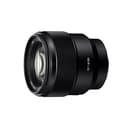
Indoor sport — basketball, volleyball, wrestling, gymnastics, indoor swimming.A typical high-school gym gives you something in the region of f/2.8 at 1/500 s and ISO 3200-6400 on a modern sensor, and that is with a fast lens. The constraint is light, full stop. You want f/2.8 at the absolute slowest, and f/1.8 is genuinely better; you want to be close to the action, which means 50-135mm rather than 300mm; and you want to accept that no amount of stabilization helps, because the blur you are fighting is the player’s movement, not yours. The Sony FE 85mm f/1.8 at 371 g is on this page purely for this situation, and on an APS-C body its 128mm equivalent framing is a good courtside length.
Outdoor sport in daylight — soccer, football, baseball, track, cycling, motorsport.Here light is free and distance is the constraint, so the ranking inverts: buy reach, accept f/5.6 or f/6.3, and spend the savings on the body’s autofocus instead. The Canon RF 100-400mm at about 635 g is the clearest example of the trade working in your favor — f/8 at the long end is genuinely slow, and in open sun at 1/1000 s it simply does not matter.
Outdoor sport under floodlights — Friday-night football, evening soccer. This is the hardest case of the three and the one people underestimate, because it looks bright to your eyes and meters like a dim room. Floodlit fields combine gym-level light with field-level distance, which is exactly the combination no affordable lens solves. Be honest with yourself: at that point you are either moving closer and using the f/2.8 zoom, or you are shooting at ISO 12800 and cropping. Our low-light shooting guide covers how far a modern sensor will actually stretch.
By camera system
Sony E.The deepest choice. The Tamron 70-180mm f/2.8 G2 is the indoor-and-everything lens, the Tamron 150-500mm is the sideline lens, and the FE 85mm f/1.8 is the cheap gym answer. If your sport is played at genuine distance — far-side soccer, track events, motorsport — Sony’s FE 200-600mm f/5.6-6.3 G OSS is the longer option and takes a 1.4x teleconverter; we write it up on best lenses for wildlife photography, where its 2.4 m closest focus and 2,115 g make more sense than they do on a touchline.
Nikon Z.The NIKKOR Z 180-600mm is the obvious field lens, and its internal zoom is a practical advantage for sport specifically: the barrel does not extend, so the balance point stays put as you zoom and nothing is pumping air in and out next to a dusty infield. The Tamron 150-500mm is also made in Z mount, which gives Nikon shooters the lighter option. Tamron lists the 70-180mm f/2.8 G2 in Z mount too, at 865 g rather than the 855 g Sony version, so the indoor-court answer is available on Nikon as well — the listing we link is the Sony E one, so check the mount before you order.
Canon RF.The RF 100-400mm is the cheap, light way to 400mm, and it accepts Canon’s RF 1.4x and 2x extenders if you later want 560mm or 800mm — though each extender costs you light, which on an f/8 lens is a serious consideration. Note that Canon’s own store now lists this lens as no longer available, so you are buying from retailer stock; check the current listing before you commit. For courtside, the RF 50mm f/1.8 STM we cover on best lenses for the Canon R50 is the inexpensive fast option.
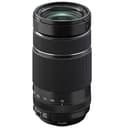
Fujifilm X. The XF70-300mm f/4-5.6 R LM OIS WR is the pick, and the 1.5x crop does real work: 300mm frames like 457mm, so a 580 g lens sees further than the 635 g Canon. It is also the only weather-resistant lens on this page at anything like its price, which matters for a sport played in November rain. The cost of the crop is light-gathering area, which you pay for in noise at the ISO settings floodlit sport forces on you.
What the lens cannot fix
Three settings will ruin more sports photographs than your choice of glass.
Shutter speed too slow. The most common sports mistake is shooting at 1/250 s because that is what the camera chose. Put the camera in shutter priority or manual, set 1/1000 s, and let ISO float. A noisy sharp frame is a photograph; a clean blurry one is not. Our shutter speed explainer has the numbers per sport, and why are my photos blurry helps you work out whether you are fighting subject movement, camera shake or missed focus — three problems with three different fixes.
The wrong autofocus mode. Continuous AF, a tracking area that is not the entire frame, and subject detection switched on. Single-point AF-S on a moving player will miss most frames no matter what lens is on the front. Our autofocus modes explained covers the setup and back-button focuscovers the technique that lets you hold focus without holding the shutter. Panning technique matters as much — see how to pan your camera.
Filming sport rather than photographing it. If you are shooting video of a game, the advice above inverts: video wants a shutter near 1/50 s for natural motion, which in daylight is several stops too much light at f/2.8. That is an ND filter problem, not a lens problem, and it is the one accessory a sports videographer genuinely cannot work around in the camera.
Expecting stabilization to help. Optical IS and in-body IS steady you. They do nothing about a sprinting athlete, which is the movement that actually blurs a sports frame. Stabilization earns its keep on a long lens for framing and for keeping the viewfinder calm while you track, not for freezing action. Image stabilization, explained is honest about what a stop rating buys.
Where we would spend the money
If you have one budget and one decision, buy for the venue you shoot most, not the venue you shoot occasionally. An indoor-sport parent who buys a 600mm zoom has spent a great deal of money on a lens that cannot be used in the building, while a sideline parent who buys an 85mm prime will spend the season cropping. Nothing else on this page matters as much as getting that one call right.
After that, the next dollar belongs to the camera body rather than to more glass. Sports photography fails at the autofocus and burst-rate stage far more often than at the resolution stage, and a 300mm frame you can crop beats a 600mm frame that missed focus. Our sports camera roundup covers which bodies track reliably, and should you upgrade your camera or lens works through the trade in general. If you are still assembling a first kit, the wedding lens guide makes the same f/2.8-zoom case for a different one-chance event, and the tripod guide explains what a monopod does for a long lens over a two-hour game.