Wide Open. Gear

The Best Sony Lenses

One mount, two sensor sizes and three brands worth buying - the E-mount glass that earns its place, from a $200 prime to a constant f/2.8 zoom.

By Stephen V.Last updated How we pick

The first lens most Sony owners should buy is the Sigma 30mm f/1.4 DC DN — a 45mm-equivalent prime for a crop body like the ZV-E10 or a6400 that is two to three stops brighter than the kit zoom and weighs 265 g. It is the upgrade that makes photographs look different rather than just sharper, and it costs a fraction of a new body. If you shoot full-frame and want one lens on the camera all day, the Tamron 28-75mm f/2.8 Di III VXD G2 is the answer. And the budget pick is the Sony FE 50mm f/1.8, the cheapest lens here and still a real jump in background blur over any zoom — as long as you can live with its old, audible autofocus motor.

The thing that makes E-mount the easiest system to buy glass for is also the thing that makes it confusing: Sony does not have to make your next lens. Sony opened the mount to third parties years ago, and Sigma and Tamron now build autofocus lenses that compete directly with the first-party line — frequently at two-thirds of the price and occasionally at two-thirds of the weight. Two of the six picks below are not Sony-branded, and that is not a compromise; it is the single biggest practical advantage of being on this mount. We rank on what the lens does for the money, not on the badge.

Before anything else, work out which half of the system you are in. APS-C bodies— ZV-E10, ZV-E10 II, a6400, a6700 — take small, cheap crop lenses, and multiply every focal length by about 1.5, so a 30mm frames like a 45mm. Full-frame bodies— a7 III, a7 IV — take the larger FE lenses at their stated focal length. FE lenses mount and work perfectly on a crop body, just acting longer; crop lenses on a full-frame body force the camera into a cropped mode and throw away most of its resolution. Our full-frame versus APS-C explainer covers what that means in practice, and crop factor explained covers the arithmetic.

One buying note that saves real money: if you own a crop body but expect to move to full-frame, buying FE primes now means the glass survives the upgrade. The Sony FE 50mm f/1.8 on an a6400 acts like a 75mm portrait lens today and becomes a standard 50mm the day you switch bodies. A crop-only Sigma does not make that move.

How this is funded:we earn a commission if you buy through our links, at no extra cost to you. It never changes which product we recommend, and we’ll tell you plainly when to skip one. Full disclosure.

Quick picks

Ranked on published specs and buyer fit. Select a row to jump to the full write-up. We have not tested these products — here is exactly what we do instead.

#ProductBest forPrice
1
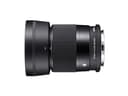
Sigma 30mm f/1.4 DC DN

Sigma 30mm f/1.4 DC DN

The default everyday prime for a Sony crop body like the ZV-E10 or a6400. A ~45mm equivalent field of view, a bright f/1.4 aperture for low light and blur, and a price that makes it a no-brainer first upgrade from the kit zoom.

Best first lens
$344.00 · View on Amazon

Price as of November 13, 2026. #ad How we’re funded

2
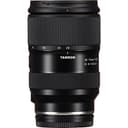
Tamron 28-75mm f/2.8 Di III VXD G2

Tamron 28-75mm f/2.8 Di III VXD G2

The standard zoom that covers most of a wedding day on one lens. A constant f/2.8 from 28mm to 75mm handles the room-wide establishing shot and the half-length portrait without a lens change, and at 540 g it is markedly lighter than the first-party 24-70mm f/2.8 zooms it competes with. The 0.18 m close focus at the wide end is unusual for this class and genuinely useful for rings and detail shots. What you give up is 28mm instead of 24mm at the wide end, and there is no stabilization in the lens at all.

Best full-frame zoom
$699.00 · View on Amazon

Price as of November 13, 2026. #ad How we’re funded

3
Sony E 16-55mm f/2.8 G

Sony E 16-55mm f/2.8 G

The one zoom to rule an APS-C kit. A constant f/2.8 across a 24-82mm equivalent range means it covers vlogging, portraits and everyday shooting without swapping lenses, and it is genuinely sharp corner to corner. Pricey, but it replaces two or three primes for run-and-gun video work.

Best APS-C zoom
$1,498.00 · View on Amazon

$1,699.9912% off

Price as of November 13, 2026. #ad How we’re funded

4
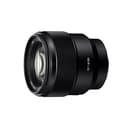
Sony FE 85mm f/1.8

Sony FE 85mm f/1.8

The best-value portrait lens in Sony's full-frame line, and the one to buy first. 85mm is the classic flattering focal length, f/1.8 melts the background, and the price is a fraction of the f/1.4 GM for image quality that is very hard to fault. On APS-C it becomes a 128mm tight-headshot lens.

Best for portraits
$509.00 · View on Amazon

Price as of November 13, 2026. #ad How we’re funded

5
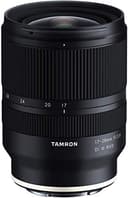
Tamron 17-28mm f/2.8 Di III RXD

Tamron 17-28mm f/2.8 Di III RXD

The sensible way into full-frame wide-angle on Sony. You give up the last 3mm of width against a 14-24mm and you get a lens that costs far less, weighs 420 g, and takes ordinary 67mm screw-in filters — which matters more for landscape work than the extra millimeters do, because a polarizer and an ND are how you control a sky and a waterfall.

Best ultra-wide
$499.99 · View on Amazon

Price as of November 13, 2026. #ad How we’re funded

6
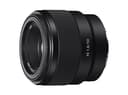
Sony FE 50mm f/1.8

Sony FE 50mm f/1.8

The cheapest way to get that blurred-background, low-light look on a Sony full-frame body. Optically it is a big jump over a kit zoom for the money — the honest caveat is the older, slower autofocus motor, which hunts and buzzes a little. For photos it is a bargain; for fast video AF, look higher up.

Budget pick
$198.00 · View on Amazon

Price as of November 13, 2026. #ad How we’re funded

The picks in full

#1Best first lens

Sigma 30mm f/1.4 DC DN

The default everyday prime for a Sony crop body like the ZV-E10 or a6400. A ~45mm equivalent field of view, a bright f/1.4 aperture for low light and blur, and a price that makes it a no-brainer first upgrade from the kit zoom.

Strengths

  • ~45mm equivalent — a natural, versatile field of view
  • Bright f/1.4 for low light and background blur
  • Excellent image quality for the money

Trade-offs

  • APS-C only
  • A little wide for tight headshot portraits
Mount / formatSony E, APS-C
Focal length30mm (45mm equivalent)
Max aperturef/1.4
Weight265 g

Specifications read from the manufacturer listing, on July 18, 2026.

#2Best full-frame zoom

Tamron 28-75mm f/2.8 Di III VXD G2

The standard zoom that covers most of a wedding day on one lens. A constant f/2.8 from 28mm to 75mm handles the room-wide establishing shot and the half-length portrait without a lens change, and at 540 g it is markedly lighter than the first-party 24-70mm f/2.8 zooms it competes with. The 0.18 m close focus at the wide end is unusual for this class and genuinely useful for rings and detail shots. What you give up is 28mm instead of 24mm at the wide end, and there is no stabilization in the lens at all.

Strengths

  • Constant f/2.8 across 28-75mm covers ceremony, groups and portraits without a lens swap
  • 540 g on Sony E — light enough to hang off one body for a long day
  • 0.18 m minimum object distance at 28mm gives a 1:2.7 magnification for ring and detail shots
  • 67mm filter thread, shared with the matching 70-180mm G2

Trade-offs

  • No stabilization of any kind, so you depend entirely on the body's IBIS
  • 28mm is noticeably tighter than the 24mm of first-party 24-70mm zooms in small venues
  • Sony E and Nikon Z only — there is no Canon RF version
Mount / formatSony E and Nikon Z, full-frame
Focal length28-75mm
Max aperturef/2.8 constant (minimum f/22)
Filter thread67mm
Closest focus0.18 m at 28mm (1:2.7); 0.38 m at 75mm
Weight540 g (Sony E); 550 g (Nikon Z)

Specifications read from the manufacturer listing, on October 30, 2026.

#3Best APS-C zoom

Sony E 16-55mm f/2.8 G

The one zoom to rule an APS-C kit. A constant f/2.8 across a 24-82mm equivalent range means it covers vlogging, portraits and everyday shooting without swapping lenses, and it is genuinely sharp corner to corner. Pricey, but it replaces two or three primes for run-and-gun video work.

Strengths

  • Constant f/2.8 across a versatile 24-82mm equivalent range
  • Sharp across the frame; G-series build quality
  • Fast, quiet autofocus for video

Trade-offs

  • Expensive — more than most crop bodies
  • No optical stabilization; heavier than a prime
Mount / formatSony E, APS-C
Focal length16-55mm (24-82mm equivalent)
Max apertureConstant f/2.8
Weight494 g

Specifications read from the manufacturer listing, on August 17, 2026.

#4Best for portraits

Sony FE 85mm f/1.8

The best-value portrait lens in Sony's full-frame line, and the one to buy first. 85mm is the classic flattering focal length, f/1.8 melts the background, and the price is a fraction of the f/1.4 GM for image quality that is very hard to fault. On APS-C it becomes a 128mm tight-headshot lens.

Strengths

  • Classic flattering 85mm focal length with lovely background blur
  • Sharp wide open, with fast, quiet autofocus
  • A fraction of the price of the f/1.4 GM

Trade-offs

  • On APS-C the 128mm equivalent is tight for indoor use
  • No optical stabilization (relies on in-body IS)
Mount / formatSony E, full-frame
Focal length85mm (128mm on APS-C)
Max aperturef/1.8
Weight371 g

Specifications read from the manufacturer listing, on July 18, 2026.

#5Best ultra-wide

Tamron 17-28mm f/2.8 Di III RXD

The sensible way into full-frame wide-angle on Sony. You give up the last 3mm of width against a 14-24mm and you get a lens that costs far less, weighs 420 g, and takes ordinary 67mm screw-in filters — which matters more for landscape work than the extra millimeters do, because a polarizer and an ND are how you control a sky and a waterfall.

Strengths

  • Constant f/2.8 across the range — unusual at this price and useful after dark
  • 67mm front filter thread, so standard circular polarizers and NDs screw straight on
  • 420 g, light enough to carry all day on a hike

Trade-offs

  • 17mm is not as dramatic as a 14mm or 15mm for tight interiors and big skies
  • Sony E only — no Canon RF or Nikon Z version
  • No optical stabilization; you rely on your body's IBIS or a tripod
Mount / formatSony E, full-frame
Focal length17-28mm
Max apertureConstant f/2.8 (minimum f/22)
Filter thread67mm
Closest focus0.19 m at 17mm, 0.26 m at 28mm
Weight420 g

Specifications read from the manufacturer listing, on October 16, 2026.

#6Budget pick

Sony FE 50mm f/1.8

The cheapest way to get that blurred-background, low-light look on a Sony full-frame body. Optically it is a big jump over a kit zoom for the money — the honest caveat is the older, slower autofocus motor, which hunts and buzzes a little. For photos it is a bargain; for fast video AF, look higher up.

Strengths

  • Genuinely affordable route to f/1.8 background blur
  • Light and small; sharp stopped down a touch
  • The classic, versatile 50mm focal length

Trade-offs

  • Older DC autofocus motor is slow and audible
  • Not the pick if you rely on fast video autofocus
Mount / formatSony E, full-frame
Focal length50mm (75mm on APS-C)
Max aperturef/1.8
Weight186 g

Specifications read from the manufacturer listing, on July 18, 2026.

Sony, Sigma or Tamron?

All three make autofocus lenses that work properly on E-mount, including eye autofocus and in-camera corrections. The differences are real but narrower than brand loyalty suggests.

Sony has the widest range by a distance, the only options at the extreme ends (the fastest apertures, the longest reach), and the deepest weather sealing in its G and G Master lines. Resale is strongest here too.

Sigma is where the value is on crop bodies. The DC DN primes — the 30mm and 56mm on this page — have no first-party equivalent at anything like the price, and they are the reason an APS-C Sony kit can be genuinely cheap to build out.

Tamron competes on full-frame zooms by shaving range off each end. Its 28-75mm starts at 28mm rather than the 24mm of a first-party 24-70mm, and its 17-28mm stops at 17mm rather than 14mm or 16mm. In exchange you get a constant f/2.8, markedly less weight, and a much lower price — and Tamron standardizes on a 67mm filter thread across several of these lenses, so one polarizer and one variable ND covers the set.

The two lenses that cover most of what people shoot

If you are building a kit rather than filling a gap, the shape that works is one fast prime plus one standard zoom. The prime handles low light, portraits and anything where you want the background to melt; the zoom handles everything where you cannot move your feet.

On APS-C that is the Sigma 30mm f/1.4 plus the Sony E 16-55mm f/2.8 G. The 16-55mm is expensive — more than most crop bodies — but a constant f/2.8 across a 24-82mm equivalent range genuinely replaces two or three primes for run-and-gun work, and it is sharp corner to corner. Its honest costs are the price, the weight next to a prime, and that it has no optical stabilization, which matters on the many Sony crop bodies that have no in-body stabilization either.

On full-frame it is the Tamron 28-75mm G2 plus whichever prime suits your subject. At 540 g the Tamron is light enough to hang off one body for a whole day, and its 0.18 m close focus at the wide end is unusually useful for detail shots. It has no stabilization at all, so it leans entirely on your body’s IBIS, and 28mm is noticeably tighter than 24mm in a small room — the two things to weigh before buying it over a first-party 24-70mm.

Portraits, and why the 85mm is the one people keep

The Sony FE 85mm f/1.8 is the best-value portrait lens in the full-frame line and the one we would buy first. 85mm is the classic flattering length: long enough that you are not standing uncomfortably close, and compressed enough that it renders a face kindly. At f/1.8 the background separates cleanly, it is sharp wide open, and it costs a fraction of the f/1.4 G Master.

Two caveats worth knowing. It has no optical stabilization, so it relies on in-body stabilization or a fast shutter. And on an APS-C body it becomes a 128mm-equivalent lens, which is tight for indoor use — if you shoot portraits on a crop body, the Sigma 56mm f/1.4 is the lens that lands at the right field of view instead, and our portrait lens roundup ranks that whole decision.

Going wide without going broke

The Tamron 17-28mm f/2.8 is the sensible route into full-frame wide-angle. You give up the last few millimeters against a 14-24mm and you get a lens that costs far less, weighs 420 g, and — the part that matters most for landscape work — takes ordinary 67mm screw-in filters. A polarizer and an ND are how you control a sky and smooth water, and a bulbous front element that cannot take them is a bigger practical limit than three millimeters of extra width.

What it is not is the most dramatic wide-angle available. 17mm is wide; 14mm is startling. For tight interiors and big night skies that gap is real, and our landscape lens guide covers the wider options and what they cost.

What is missing from this page, and why

No G Master glass. Sony’s flagship line is excellent and we have no reason to talk anyone out of it, but almost nothing on it changes the recommendation for someone building a first or second lens kit: you are paying a large premium for a fraction of a stop, weather sealing and the last few percent of optical performance. When we can make the case for one on buyer value rather than prestige, it will appear here.

No telephoto either, beyond what our wildlife and sports lens guides already cover in depth — those pages rank long E-mount glass properly, and repeating them here would make this page worse rather than longer.

How we ranked these

What the lens does for the money first, which is why two picks are not Sony-branded; then maximum aperture and whether it holds across a zoom range; then equivalent focal length on the body it fits, because a 56mm on APS-C and a 56mm on full-frame are different lenses in practice; then weight; then filter thread. We have not tested these lenses — here is exactly what we do instead— and every figure quoted is the manufacturer’s own published specification with the date it was read. Where a maker publishes no stabilization rating, we say nothing rather than estimate one.
Frequently asked questions

What is the best Sony lens to buy first?

On an APS-C body like the ZV-E10 or a6400, the Sigma 30mm f/1.4 DC DN - a 45mm-equivalent prime that is around three stops faster than the kit zoom for 265 g. On full-frame, the Sony FE 50mm f/1.8 if you want the cheapest step up, or the Tamron 28-75mm f/2.8 G2 if you would rather have one lens that covers most of a day.

Are Sigma and Tamron lenses as good as Sony's own?

For the lenses on this page, they compete directly - full autofocus, eye detection and in-camera corrections all work. Sony's advantages are range (it makes options nobody else does), the deepest weather sealing in its G and G Master lines, and stronger resale. Sigma and Tamron generally win on price and weight, which is why both appear here.

Can I use full-frame FE lenses on a Sony APS-C camera?

Yes, and they work perfectly - the crop just makes them act longer, so a 50mm frames like a 75mm. It is often the smart buy if you expect to move to full-frame later, because the lens survives the upgrade. The reverse does not work well: a crop-only lens on a full-frame body forces a cropped mode and throws away most of the resolution.

Do Sony lenses need optical stabilization?

It depends on the body. Several Sony crop bodies we recommend, including the ZV-E10, have no in-body stabilization, so an unstabilized lens leaves you relying on a fast shutter speed or a tripod. Full-frame bodies like the a7 III and a7 IV have IBIS, which covers an unstabilized prime or zoom for stills and most handheld video.

Which filter size should I buy for a Sony kit?

Check the threads first, then buy for the largest and use step-up rings for the rest. Tamron standardizes several of its E-mount lenses on 67mm, including both the 28-75mm G2 and the 17-28mm on this page, so a single 67mm polarizer and variable ND can cover most of a Tamron-based kit.

Sources

Keep reading