How we ranked these
1. Sensor size, because it is the hardest thing to make up elsewhere. The Pocket 3 publishes a 1-inch sensor. One alternative here matches it; the rest are 1/1.3-inch or a pair of 1/1.28-inch sensors. That gap is most of what you will notice once the sun goes down, and no software feature closes it.
2. How the camera is stabilized, and what it costs you. A mechanical gimbal loses no pixels. Electronic stabilization crops into the frame and corrects in software, which works well in daylight and less well when the sensor is already short of light. We say which kind each camera uses rather than treating “stabilized” as one thing.
3. Whether you can see yourself. A front-facing or flip-up screen is not a luxury if you are the subject — it is the difference between framing and hoping.
4. What each one can do that a Pocket 3 cannot. Waterproofing, mounting, a zoom, replaceable lens glass, reframing a shot after the fact. This is where the alternatives win, and it is usually the real reason to buy one.
5. Price, last.
We have not tested these cameras — here is exactly what we do instead — and every figure, including the DJI ones, is the manufacturer’s own published specification with the date we read it. No scores, because a score would imply a measurement we did not take.
Keeping the sensor: the Sony ZV-1 II
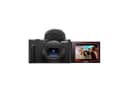
This is the pick because it keeps the part that matters most. A 1-inch stacked 20.1 MP sensor is the same class as the Pocket 3’s, and it comes attached to something the Pocket 3 does not have at all: a fixed 18-50mm equivalent f/1.8-4 zoom. 18mm at the wide end is genuinely wider than the Pocket 3, which matters when you are holding the camera at arm’s length, and 50mm at the long end gives you a second framing without walking. The screen flips forward, it shoots 4K30 and FHD up to 120p, and it weighs 292 g with the battery.
What you give up is the gimbal, and the specification is blunt about it: Sony publishes digital (Active) stabilization only, no IBIS. Walking footage from a ZV-1 II is stabilized in software, with the crop and the occasional wobble that implies. It is also roughly 113 g heavier, it is not waterproof, and 4K is capped at 30fps where the Pocket 3 reaches 4K120 for slow motion.
If you want these two compared directly rather than through a list, we have done exactly that on our ZV-1 II vs Osmo Pocket 3 comparison. It is also a core pick on our vlogging camera roundup and our compact camera roundup.
Keeping the screen, losing the sensor: the Insta360 Ace Pro 2
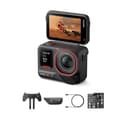
The Ace Pro 2 is the action camera built for people who are in front of it. It has a 2.5-inch flip-up touchscreen, which is the closest thing on this page to the Pocket 3’s rotating display, and its 1/1.3-inch sensor is co-engineered with Leica. It shoots 8K30 and 4K60 with Active HDR, runs up to 180 minutes on an 1,800 mAh battery with 30W fast charging, weighs 177 g, and — the part no Pocket 3 can match — it is waterproof to 12 m without a case and 60 m with the dive case.
The sensor is the trade. 1/1.3-inch is a substantial step down from 1-inch in area, which shows up as noise arriving earlier indoors and after sunset. Stabilization is electronic, so it crops. And an action camera’s fixed ultra-wide lens flatters landscapes and distorts faces held close, which is the opposite problem to the one the Pocket 3 solves. It also appears on our action camera roundup.
Replacing the gimbal with software: the Insta360 X5
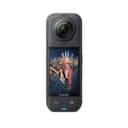
The X5 is the most interesting answer here, because it attacks the gimbal problem rather than working around it. It records everything — dual 1/1.28-inch sensors, 8K30 in 360 — and you choose where the camera was pointing afterwards, in the edit. Because the footage is a sphere, the software can hold a level, smooth horizon through almost anything you do with your arm, which is functionally very close to what a gimbal gives you, arrived at from the other end.
It also has user-replaceable lens glass, which is a real practical advantage on a camera that lives in pockets and on handlebars, plus IP68 to 15 m, 5.7K60 and 4K120 flat modes, and up to 185 minutes on a 2,400 mAh battery in Endurance mode. 200 g.
The costs are real and they are not all about hardware. Every shot needs a reframing pass before you can publish it, which is a workflow change rather than a setting. Final resolution after reframing is lower than the headline 8K suggests, because you are cropping a flat frame out of a sphere. And the sensors are small, so low light is harder than a Pocket 3 again. It is the top pick for reframing on our GoPro alternatives page.
Keeping the gimbal, bringing your own camera
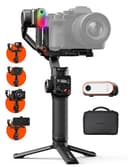
If the mechanical gimbal is genuinely the reason you wanted a Pocket 3, the only way to get one on this page is to buy a gimbal. The Hohem iSteady MT2 Kit is the honest answer: a 653 g three-axis stabilizer with a 1.2 kg payload, which carries a mirrorless body with a light lens or a phone, and it ships with a magnetic AI tracker module and a magnetic CCT/RGB fill light in the box. Hohem rates the battery at up to 17 hours, or 6-8 with AI tracking running.
This is a different kind of purchase and we are not pretending otherwise. You carry two objects instead of one, you balance it before you shoot, and the total weight is several times a Pocket 3’s. What you get is a mechanical gimbal under any camera you already own, including one with a far bigger sensor than 1 inch, plus subject tracking the Pocket 3 does in software. For someone who already has a good camera and wants Pocket 3 motion, this is cheaper and better than buying a second camera. Our gimbals under $500 roundup covers the alternatives to it.
The cheap answer, and what it is actually for
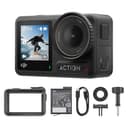
The DJI Osmo Action 4 is the budget pick and it is a fraction of a Pocket 3’s price. A 1/1.3-inch sensor, 4K up to 120fps, 1080p up to 240fps, RockSteady 3.0+ with HorizonSteady, waterproof to 18 m without a case and 60 m with it, 145 g, and up to 160 minutes by DJI’s own 1080p/24fps test with Wi-Fi off.
Buy it not as a cheaper Pocket 3 but as the thing a Pocket 3 cannot be. The Pocket 3 is a delicate, beautifully stabilized camera you hold. The Action 4 is a camera you bolt to a helmet, drop in a river and do not think about. If your footage involves water, mud, speed or any real chance of damage, this is the correct camera and the gimbal question does not arise. It is on our cameras under $500 roundup and our DJI camera roundup.
What none of these replaces
A mechanical gimbal in a 179 g pocketable body. This is the Pocket 3’s actual monopoly and the reason it keeps selling. If you want motors holding the lens level in something that fits a jacket pocket, the answer is the Pocket 3, and the honest advice is to buy it.
A 1-inch sensor and a rotating screen in one object. The ZV-1 II keeps the sensor and flips its screen but is not a vertical-native camera; the Ace Pro 2 flips its screen but drops to 1/1.3-inch. Pick which half matters.
4K120 from a 1-inch sensor. The ZV-1 II caps 4K at 30fps. If slow motion at full resolution is part of your style, nothing here does it at Pocket 3 sensor size.
One-object simplicity. Worth naming because it is why people love the Pocket 3. Two of the five answers above involve a workflow change — reframing every shot, or balancing a gimbal before you leave the house. That cost does not appear on a specification sheet and it is the one most likely to make a cheaper setup go unused.