How we ranked these: four criteria, in this order
A body-specific lens list is not a “best glass” contest. The R50 costs what it costs, has no in-body stabilization, and will be the first interchangeable-lens camera most of its owners have held. Those three facts decide the order below.
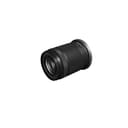
1. What it adds that the kit zoom cannot do. A lens that overlaps the RF-S18-45mm is a worse buy than one that goes somewhere the kit lens cannot, however sharp it is. The 18-150mm adds 190mm of equivalent reach; the 50mm f/1.8 adds about two and a half stops of aperture; the 10-18mm adds 13mm of equivalent width at the short end. Each of those is a capability, not a refinement.
2. Stabilization, because the R50 has none.The R50 has no in-body stabilization, so a lens that stabilizes is doing the whole job alone. Four of the five picks here have optical IS and Canon publishes a stop rating for each: 4.5 stops on the 18-150mm and the 55-210mm, 4 stops on the 10-18mm, 5.5 stops at 400mm on the RF 100-400mm. The RF 50mm f/1.8 is the exception — it has no IS at all, and relies on its f/1.8 aperture letting you keep the shutter fast instead. Our image stabilization explainer covers what a stop rating actually buys you and what it does not fix.
3. Weight, because of the body it hangs on. The R50 weighs 375 g with its battery and has a small grip. A 310 g or 150 g lens feels like part of the camera; a 635 g telephoto makes the R50 feel like a handle attached to a lens. That is not a reason to avoid the big lens, but it is the reason the light ones rank higher for most people.
4. Aperture honesty at the long end. Three of these lenses end at f/6.3, f/7.1 or f/8. Those are daylight apertures. A cheap telephoto with a dark long end is a genuinely useful lens outdoors and a genuinely frustrating one in a school gym, and we say which is which on each card rather than letting the focal length speak for itself.
The crop factor, and why these numbers look odd
Every focal length on this page is quoted twice: the number on the barrel, and the full-frame equivalent. The R50’s APS-C sensor is smaller than a full-frame one, so it records a tighter slice of whatever the lens projects — about 1.6x tighter on Canon bodies. An 18mm lens frames like a 29mm lens. A 50mm lens frames like an 80mm lens. A 210mm lens frames like a 336mm lens.
That multiplier is why the R50 is a bargain for reach and a compromise for width. Getting to 336mm equivalent costs you a 270 g RF-S lens here; on full-frame it costs considerably more and weighs several times as much. Getting to a genuinely wide 16mm equivalent, though, requires a 10mm lens, and only one affordable RF-S lens goes that wide. Our crop factor explainer works through the arithmetic, and full-frame vs APS-C is honest about what the smaller sensor costs you elsewhere.
One practical consequence: a full-frame RF lens on an R50 does not become a better lens, it becomes a longer one. The RF 100-400mm is a 100-400mm lens on a full-frame body and frames like a 160-640mm lens on your R50. You are buying the full-frame lens for its optics and its reach, not because the R50 needs it — and you are carrying glass sized for a sensor you do not have. Our lens mounts explainer covers which lenses physically fit what, including why EF-M lenses from Canon’s old M-series cameras will never work on an R50.
What to buy first, by what you shoot
You take the camera on holidays and to family events. Buy the RF-S18-150mm and stop. One lens, no swapping, enough reach for a stage or a stadium seat, and 0.44x magnification at 50mm means it handles close-ups of food and flowers too. It will not give you a blurred background the way a prime does, and in a dim restaurant it will struggle — but it will be on the camera when something happens, which is the only property of a lens that always matters.
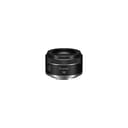
You want your photos to look more like the ones you admire. Buy the RF 50mm f/1.8. The blurred backgrounds, subject separation and low-light ability you are chasing come from aperture, and at f/1.8 this lens gathers roughly 12 times as much light as the kit zoom does at f/6.3 at its long end. It is the cheapest pick here by a wide margin. The discipline it demands is your feet: it does not zoom, so you move. Most people find that improves their photographs rather than limiting them, which is the argument our prime vs zoom guide makes at more length, and the blurry background guide explains exactly how to get the look once you own it.
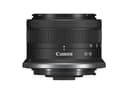
You film yourself.Buy the RF-S10-18mm. At 10mm it frames like a 16mm lens, which is wide enough to hold the camera at arm’s length and still have your head, your shoulders and the room behind you in the frame. The kit zoom at 18mm frames like 29mm and will not do that. It is 150 g, which matters if the camera ever goes on a gimbal, and it has 4 stops of optical stabilization, which matters a lot on a body with no IBIS. Keep yourself near the middle of the frame: at 10mm, anything near the edge gets stretched. If vlogging is the main job, our R50 vs Sony ZV-E10 comparison is worth a read too — the ZV-E10’s lens system has more options at this end.
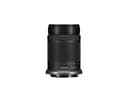
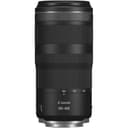
You photograph your kid’s sport, or animals. Start with the RF-S55-210mm. 336mm equivalent, 270 g, 4.5 stops of IS, and a price that will not make you flinch. In daylight it is genuinely all most people need. Its limit is f/7.1 at the long end: an indoor gym or a 7pm kickoff in November will force the ISO uncomfortably high, and no amount of stabilization fixes a subject that is moving. If you have hit that wall, or you photograph birds, step up to the RF 100-400mm — 640mm equivalent on the R50, with Canon’s RF 1.4x and 2x extenders available on top. Our sports camera guide and wildlife lens roundup cover where the limits really are.
You shoot interiors, real estate or architecture. The RF-S10-18mm again, and for the same reason — 16mm equivalent is the difference between showing a room and showing a corner of it. Keep the camera level to avoid converging verticals; our architecture guide covers the technique and real estate cameras covers whether the R50 is the right body for paid work.
What we would not buy for an R50
An EF or EF-S lens plus an adapter, as a first move. Canon’s EF-EOS R adapter does work, and a used EF 50mm f/1.8 is cheap. But you end up with a longer, heavier assembly, older autofocus behavior, and a lens designed for a DSLR’s mirror box on a camera that does not have one. If you already own EF glass, adapt it and enjoy it. If you are starting fresh, native RF-S is smaller, better matched to the R50’s autofocus, and usually not much more expensive. Our used-gear guide covers how to judge older lenses if you go that route anyway.
An expensive full-frame RF zoom.An RF 24-70mm f/2.8 L costs several times what the R50 does, weighs more than twice as much as the body, and gives you a 38-112mm equivalent range on this sensor — not an obviously useful one. If your budget stretches that far, the honest answer is that the money belongs in a different body, not in L glass on an R50.
A third-party autofocus lens, without checking first. Canon has licensed RF-S autofocus designs to a small number of third-party makers, and the catalog is still thin and changes often. Some lenses advertised for “Canon RF” are manual-focus only. Read the mount line on the listing before you buy, and check that autofocus is explicitly claimed.
Where we would spend the money
If you own an R50 and the kit zoom and have one budget, our order is: the RF 50mm f/1.8 first, because it is cheap and it changes how your photographs look; then the RF-S18-150mm or the RF-S10-18mm depending on whether your problem is reach or width; then a telephoto only once you have found yourself wishing for one twice. That sequence spends the least money on the biggest change, and it does not assume we know what you shoot.
The one thing worth saying about the body: the R50 has no in-body stabilization and a modest grip, and those are the two reasons people trade up rather than any image-quality limit. If you find yourself fighting both, read R50 vs R100 for what Canon charges for the basics at this end of the range, and best mirrorless cameras for beginners for the bodies one step up. Every RF-S lens you buy now moves across to an R10, R7 or R50 II unchanged, so none of this spending is stranded.