Wide Open. Gear

The Best Lights for Podcasting

Two or three people around a table, mics in shot, a wide camera angle - the lights that stay out of frame and still flatter everyone.

By Stephen V.Last updated How we pick

For a video podcast with two or three people at a table, the best buy is the Neewer 700W Softbox Lighting Kit — two 24-inch softboxes on stands, which is the smallest setup that can actually cover more than one face. A 24-inch box is large relative to a head, so the light wraps and the shadows stay soft even when someone leans forward, and two of them placed high and wide keeps both hosts lit without anybody turning into a silhouette. The budget pick is the EMART Softbox Photography Kit, the same two-light idea in 16-inch boxes with adjustable 3000-6000K color, for a small room and a smaller spend.

Podcast lighting is a different problem from vlog lighting and the reason is the frame. A vlog is one face, close, on one axis — one light in front solves it. A podcast is a wide shot with two or three people, a table, mics on booms, and often a second camera from the side. That means your lights have to be high and outside the frame on both sides, they have to cover a span of four or five feet rather than one, and they have to look intentional from more than one camera angle. A single desk panel, however good, cannot do that job.

So the ranking below is built on three things in order: how wide an area the light actually covers; whether it can get high enough to stay out of a wide shot while still pointing down at faces; and whether its color temperature matches the other lights in the room, because mismatched white balance between two hosts is the most common and most noticeable podcast lighting mistake.

One structural note. Podcasts are long, and every light here except one runs on mains power rather than a battery — which is what you want for a two-hour record. Plan your cable runs before you buy a third light, and read three-point lighting explained if you want to understand why the background light matters as much as the ones on your face.

How this is funded:we earn a commission if you buy through our links, at no extra cost to you. It never changes which product we recommend, and we’ll tell you plainly when to skip one. Full disclosure.

Quick picks

Ranked on published specs and buyer fit. Select a row to jump to the full write-up. We have not tested these products — here is exactly what we do instead.

#ProductBest forPrice
1
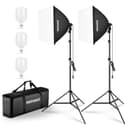
Neewer 700W Softbox Lighting Kit

Neewer 700W Softbox Lighting Kit

The cheapest way to get two soft light sources on stands. A pair of 24-inch softboxes with daylight LED bulbs covers a two-point interview or product setup for very little. The bulbs and stands are basic, but the soft, even light they produce is the real thing.

Best overall
$145.09 · View on Amazon

Price as of November 13, 2026. #ad How we’re funded

2
Godox SL60W LED

Godox SL60W LED

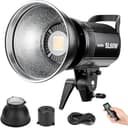
The COB light that gets serious creators off ring lights. A 60W daylight-balanced bulb on a Bowens mount means you can bolt on a real softbox and shape proper, cinematic light. Add a stand and modifier and you have a starter studio key light that punches far above its price. Know what you are buying, though: Godox now sells the SL60II generation (SL60IID daylight, SL60IIBi bi-color) and the original SL-60W's page has gone from Godox's own site, so this is the outgoing version.

Best for lighting a whole room
$109.00 · View on Amazon

Price as of November 13, 2026. #ad How we’re funded

3
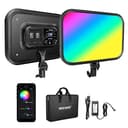
Neewer 18-inch RGB LED Panel

Neewer 18-inch RGB LED Panel

The fun light. A full-color RGB panel lets you throw a colored wash behind you — the blue-or-purple gamer/creator look — as well as clean white key light, with a high CRI so faces still look right. One panel behind you plus a key light in front is the classic two-light creator setup.

Best background light
$139.07 · View on Amazon

Price as of November 13, 2026. #ad How we’re funded

4
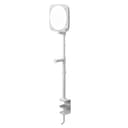
Elgato Key Light Neo

Elgato Key Light Neo

The streamer's key light, made simple. Elgato's Key Light Neo is an edge-lit panel you control from software on your PC or phone — no reaching behind the light to adjust it mid-stream. The soft, diffused output is flattering, and it clamps neatly to a desk. It is about convenience and integration, not raw power.

Best for a solo host
$87.66 · View on Amazon

Price as of November 13, 2026. #ad How we’re funded

5
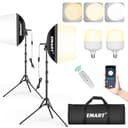
EMART Softbox Photography Kit (2-pack)

EMART Softbox Photography Kit (2-pack)

A tidier, more modern take on the budget softbox kit: two 16-inch soft boxes with adjustable-color LEDs and app control, so you can dial warm-to-cool without swapping bulbs. Compact enough for a home desk setup, and the color control is a genuine step up from fixed-daylight kits.

Budget pick
$64.99 · View on Amazon

$70.998% off

Price as of November 13, 2026. #ad How we’re funded

The picks in full

#1Best overall

Neewer 700W Softbox Lighting Kit

The cheapest way to get two soft light sources on stands. A pair of 24-inch softboxes with daylight LED bulbs covers a two-point interview or product setup for very little. The bulbs and stands are basic, but the soft, even light they produce is the real thing.

Strengths

  • Two softboxes and stands included for a low price
  • Soft, even light out of the box — no extra modifiers to buy
  • Uses standard E26 bulbs you can replace or upgrade

Trade-offs

  • Basic bulbs and flimsy stands
  • No dimming on the base bulbs
TypeContinuous softbox kit (2x 24-inch)
Color~5700K daylight LED bulbs
Includes2 softboxes, stands, bulbs
PowerAC mains

Specifications read from the manufacturer listing, on September 29, 2026.

#2Best for lighting a whole room

Godox SL60W LED

The COB light that gets serious creators off ring lights. A 60W daylight-balanced bulb on a Bowens mount means you can bolt on a real softbox and shape proper, cinematic light. Add a stand and modifier and you have a starter studio key light that punches far above its price. Know what you are buying, though: Godox now sells the SL60II generation (SL60IID daylight, SL60IIBi bi-color) and the original SL-60W's page has gone from Godox's own site, so this is the outgoing version.

Strengths

  • Bright 60W daylight output for a genuine key light
  • Bowens mount fits countless softboxes and modifiers
  • Silent fan option and steady, flicker-free output

Trade-offs

  • Daylight only — no color-temperature adjustment
  • You still need to buy a stand and softbox
  • Superseded by Godox's SL60II generation
Type60W COB LED
Color5600K daylight
MountBowens
PowerAC mains

Specifications read from the manufacturer listing, on July 18, 2026.

#3Best background light

Neewer 18-inch RGB LED Panel

The fun light. A full-color RGB panel lets you throw a colored wash behind you — the blue-or-purple gamer/creator look — as well as clean white key light, with a high CRI so faces still look right. One panel behind you plus a key light in front is the classic two-light creator setup.

Strengths

  • Full RGB color plus accurate white light
  • High CRI/TLCI for good skin tones
  • App control and built-in lighting effects

Trade-offs

  • Needs a stand (not always included)
  • One panel alone is a background accent, not a key light
Type18.3-inch RGB LED panel
ColorFull RGB, 2500-8500K white
Color accuracyCRI/TLCI 97+
ControlOn-unit and app

Specifications read from the manufacturer listing, on July 18, 2026.

#4Best for a solo host

Elgato Key Light Neo

The streamer's key light, made simple. Elgato's Key Light Neo is an edge-lit panel you control from software on your PC or phone — no reaching behind the light to adjust it mid-stream. The soft, diffused output is flattering, and it clamps neatly to a desk. It is about convenience and integration, not raw power.

Strengths

  • Adjust brightness and color from your PC or phone
  • Soft, diffused, flattering output
  • Integrates with Elgato's streaming ecosystem

Trade-offs

  • Less raw output than a COB light with a softbox
  • Priced above generic panels for the software convenience
TypeEdge-lit LED panel
ColorBi-color 2900-7000K
ControlSoftware (PC), app, on-unit
MountingOfficial desk clamp (included), adjustable height and tilt

Specifications read from the manufacturer listing, on September 15, 2026.

#5Budget pick

EMART Softbox Photography Kit (2-pack)

A tidier, more modern take on the budget softbox kit: two 16-inch soft boxes with adjustable-color LEDs and app control, so you can dial warm-to-cool without swapping bulbs. Compact enough for a home desk setup, and the color control is a genuine step up from fixed-daylight kits.

Strengths

  • Adjustable 3000-6000K color and app control
  • Compact 16-inch boxes suit a small room or desk
  • Comes as a complete two-light kit

Trade-offs

  • Lower total output than larger studio boxes
  • Plastic build; short stands
TypeContinuous softbox kit (2x 16-inch)
Color3000-6000K adjustable
ControlRemote and app
PowerAC mains

Specifications read from the manufacturer listing, on July 18, 2026.

The two-light podcast setup, in buying order

Light one: a softbox, high and to one side. Put it about 45 degrees off the camera axis and above eye level, angled down. One large soft source placed like that will light two people sitting next to each other perfectly acceptably, and if you only ever buy one light, buy this one and bounce the opposite side off a white wall.

Light two: a second softbox on the other side, dimmer. Not matched in brightness — about half. Its job is to lift the shadow side of each face so nobody has a dark half, while keeping enough contrast that the shot still has shape. Two identical lights at identical power is the look that makes a podcast feel flat and over-lit.

Light three: something on the background. This is the one that makes a podcast look produced rather than recorded, and it is why the RGB panel is on this list. A colored wash on the wall behind the hosts separates them from the background and gives the set an identity. It does nothing for faces, which is exactly the point — it is cheap visual production value.

Why a COB light is the move in a bad room

Most home podcast rooms have a low white ceiling, and that is a free giant softbox if you have a light strong enough to use it. A 60W COB light like the Godox SL60W pointed straight up at the ceiling fills the entire room with soft, even, directionless light — every seat at the table gets the same exposure, nobody has to be positioned carefully, and you can put three guests around a table without re-rigging anything.

The trade is that bounced light alone looks a bit lifeless, with no direction and flat shadows. The standard fix is bounce for the room plus one softbox as a key, which is also the cheapest way to light a three-person show. The SL60W takes a Bowens mount, so that same light can wear a softbox later when your setup changes — the softbox kit roundup covers which modifiers fit.

Mics, glasses and the two things that go wrong

Boom arms cast shadows. A podcast mic on an arm sits between the light and the face more often than people expect, and a hard-edged mic shadow across a cheek is instantly recognizable as bad lighting. Large soft sources are much more forgiving of this than small panels, which is another reason the softbox kits rank above the desk panel here.

Glasses reflect whatever you point at them. If anyone on your show wears glasses, a ring light or a small bright panel directly in front of them will put two white rectangles over their eyes. The fix is height and angle rather than a different light, and we wrote it up properly in best lighting for glasses wearers.

Matching your lights to your camera and mics

Set every light in the room to the same color temperature and then set your camera’s white balance manually to match it — auto white balance will drift mid-episode as people move, and a shot whose color shifts halfway through looks worse than one that is slightly warm throughout. The white balance explainer covers how, and how to set up a podcast studio at home puts the lighting, the room treatment and the buying order in one place. For the camera and mic halves of the same build, see our podcast camera roundup and USB microphone picks.

How we ranked these

Coverage area first, then whether the light can be rigged high and out of a wide frame, then color control and consistency across multiple units, then what is included in the box. We have not tested these lights — here is what we do instead. Where a manufacturer publishes a CRI figure we show it; where none is published we say nothing rather than estimate, and CRI explained covers why that number matters for skin tones.
Frequently asked questions

How many lights do I need for a podcast?

Two will light a two or three-person show properly: a large soft key about 45 degrees off the camera and above eye level, and a second softer light on the opposite side at roughly half the power. A third light on the background is what makes it look produced rather than merely lit. One light plus a white wall to bounce off is a workable starting point.

Is a ring light good for podcasting?

Not as the main light for a multi-person show. A ring light is designed to sit directly in front of one face at close range, which means it cannot cover two people sitting apart and it is the worst option for anyone wearing glasses. For a solo host filming close to camera it is fine, and our ring light roundup covers the sizes.

Where should podcast lights be placed?

Higher than the hosts' eye level and angled down, positioned outside the camera's widest frame on both sides. Height is what keeps the light out of the shot and stops reflections in glasses; the downward angle is what puts shadows under the chin rather than across the forehead. Keep both lights the same distance from the table so neither host is brighter.

Do podcast lights need to run on battery power?

No - mains power is better. A podcast record is long, and a battery panel that dies mid-episode is a worse problem than a cable. Every pick on this page runs on AC except where noted, which is the right trade for a fixed studio space.

Should all my podcast lights be the same color temperature?

Yes, and then set the camera's white balance manually to match. Mixing a 3200K lamp with a 5600K panel gives one host a warm face and the other a cool one, which is very visible on camera and hard to fix in editing. Adjustable bi-color lights make matching easier because you can tune every unit to one number.

Sources

Keep reading