How we ranked these
In this order, and the order is what makes this page different from our other lens roundups.
1. What first-party lens it replaces, and what the swap costs. Every Tamron here is bought instead of something else. A pick earns its place only if the thing you give up is smaller than the thing you save. We name both.
2. Weight, because that is Tamron’s most consistent win. Three of these five lenses are under 550 g. The 70-180mm f/2.8 G2 is 855 g against roughly 1,100 g for a first-party 70-200mm f/2.8 — that is the difference between hanging two bodies off your shoulders for a day and not.
3. The 67mm filter thread. The 17-28mm, 11-20mm, 28-75mm G2 and 70-180mm G2 all take 67mm screw-in filters. One circular polarizer and one variable ND cover your whole kit, which is a real saving the first time you price filters. Our ND filter roundup is sized around exactly this thread for that reason. The 150-500mm breaks the pattern at 82mm and we say so on its card.
4. Stabilization, and whether the lens has any. This is the specification Tamron is least consistent on and the one most likely to catch you out. Two of these lenses have Vibration Compensation; three have no stabilization at all and depend entirely on your camera’s IBIS. If your body has none, that reorders this page for you. Our image stabilization explainer covers how lens VC and body IBIS combine.
5. Mount availability, which we have already flagged and which is listed on every card.
We have not tested these lenses — here is exactly what we do instead — and every figure on this page is Tamron’s own published specification with the date we read it. There are no scores, because a score would imply a measurement we did not take.
The two-lens kit that is the real reason to buy Tamron
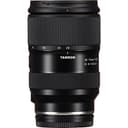
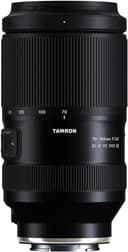
The 28-75mm f/2.8 G2 and the 70-180mm f/2.8 G2 are designed as a pair, and bought together they are the clearest value argument the brand makes. You get 28mm to 180mm at a constant f/2.8, in 540 g and 855 g respectively, on one 67mm filter size. The first-party equivalent is a 24-70mm plus a 70-200mm: wider at one end, 20mm longer at the other, several hundred grams heavier, and roughly double the money.
Both lenses also focus unusually close for their class — 0.18 m at 28mm on the standard zoom for a 1:2.7 magnification, and 0.3 m at 70mm on the telephoto for 1:2.6. That is close enough to shoot rings, food and product detail without a macro lens, which is why this pair turns up as the backbone of our wedding and event lens guide.
Two honest costs. The 28-75mm has no stabilization of any kind, so it only makes sense on a body with IBIS. And 28mm is noticeably tighter than 24mm in a small room — if you shoot cramped interiors, that 4mm is a real loss, not a rounding error. On the telephoto, 180mm instead of 200mm shows when you are stuck at the back of a venue, and Tamron publishes no stop rating for the VC, so we cannot tell you what the stabilization is worth.
Where Tamron is the only sensible answer: APS-C ultra-wide
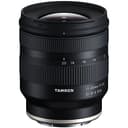
The 11-20mm f/2.8 is the pick for crop-sensor bodies and arguably the most useful lens on this page. 11mm on APS-C frames roughly like 17mm on full-frame, the f/2.8 holds across the whole zoom, and it weighs 335 g — less than most kit zooms. Tamron builds it for Sony E, Fujifilm X and Canon RF, which makes it the one pick here that fits three systems.
A constant f/2.8 at 11mm is what makes it a credible night-sky lens as well as a daylight one, and it shares the 67mm thread. The costs: no stabilization, the zoom stops at 20mm so it does not replace a standard zoom, and the 0.15 m closest focus that makes foreground rocks look dramatic also puts the front element uncomfortably close to sea spray. It is a core pick on our landscape lens roundup.
Reach, and the one place the pattern breaks
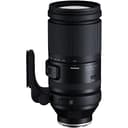
The 150-500mm f/5-6.7 is the lens that gets you to 500mm while still being something you can hand-hold and walk with: 1,725 g, roughly 400 g under Sony’s 200-600mm, and built for Nikon Z as well as Sony E. For hand-held wildlife and birding on a budget that is not five figures, it is the right answer, and it is the top pick on our wildlife lens roundup.
It is also where the Tamron pattern stops being tidy. The filter thread is 82mm, not 67mm, so it does not share filters with anything else here — and 82mm polarizers are expensive. f/6.7 at 500mm pushes ISO hard under a forest canopy or at dusk, and again there is no published VC stop rating. Its compensation is an unusually short 0.6 m closest focus at 150mm, which makes it a surprisingly good butterfly and frog lens.
What Tamron does not make
Worth naming, so this page is not quietly overselling the brand.
Fast primes. There is no Tamron equivalent of a 50mm f/1.4 or an 85mm f/1.4 in our registry. If a bright prime is what you want, our prime lens roundup is the page, and Sigma and the first parties own that ground.
Full-frame Canon RF autofocus glass. Canon has not opened the full-frame RF mount to third-party autofocus lenses. The 11-20mm exists in RF as an APS-C design; nothing else here does.
Stabilization as standard. Three of five picks have none. On a body without IBIS — which includes most APS-C cameras under $1,000 — that is the specification that should decide your order, not price.
A published stabilization rating. Where VC exists, Tamron does not print a stop figure the way Canon and Nikon do. We will not invent one, so those cards say “no stop rating published” and mean it.