Why onboard recording matters more than range
Wireless microphone marketing is all about range, and for an interview that is the least relevant number on the box. Your subject is sitting next to you. What you actually want is a transmitter that writes its own copy of the audio to internal memory while it transmits, because that copy is immune to everything that goes wrong on the day: radio interference from a venue’s wi-fi, a cable knocked out of the camera, a level set too low in a hurry.
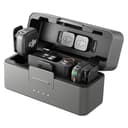
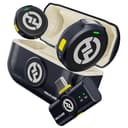
The DJI Mic 3 and the RODE Wireless GO (Gen 3) both do this, and both record 32-bit float, which is the format that makes a clipped take recoverable instead of ruined — the detail is in how to record audio for video. The Hollyland Lark M2 does not have 32-bit float, which is the single honest reason it is the budget pick rather than the top one. If you are recording something you cannot ask to be repeated, that gap is worth the money.
Clip-on or boom?
Clip a transmitter on and the mic is six inches from the mouth, which means the voice is loud relative to the room and the recording sounds close and intimate no matter how echoey the space is. That proximity is doing almost all of the work, and it is why a cheap lavalier in the right place beats an expensive shotgun in the wrong one.
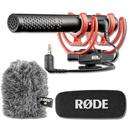
A shotgun on a boom pole wins in two situations. The first is street and event interviews where asking a stranger to thread a cable under a jacket is not going to happen; you hold the mic just out of frame and move it between speakers. The second is when you want one mic to cover an unpredictable number of people. The trade is that a shotgun is far more sensitive to distance — double the gap and the room doubles with it — which lavalier versus shotgun walks through properly. The VideoMic NTG earns its slot here because it is also a USB microphone with a gain dial, a −20 dB pad and a safety channel, so it covers the handheld interview and the desk recording with one purchase.
The seated studio interview is a different purchase
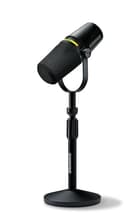
If your interviews are two people at a table and you control the room, stop looking at wireless. A dynamic mic like the Shure MV7+ in front of each person rejects room reflections in a way no clip-on can, because a dynamic capsule is simply less sensitive to everything that is not directly in front of it. That is the same reason it dominates our voice over roundup, and why dynamic versus condenser is the explainer to read before you spend. Two of them is a real cost, so a common compromise is one MV7+ for the host and a wireless transmitter for the guest.
Three things that fix an interview recording for free
Place the mic high and close. Clip a transmitter to a collar or lapel about a hand’s width below the chin, pointing up. Too low and you get chest thump; dead center and you get clothing rustle from a swinging tie or a zip.
Record a minute of room tone. Before or after the interview, have everyone sit silent for sixty seconds and record it. An editor can use that to patch gaps and smooth cuts, and you cannot create it later.
Soften the room, not the mic. A hard, empty room is the most common cause of bad interview audio. A rug, a sofa and a closed curtain do more than any gear swap, and they cost nothing if the room already has them.