The three-light stream, in buying order
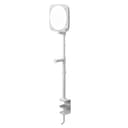
Light one — the key. Off to one side of the camera, roughly 30 to 45 degrees around, raised a little above eye level and angled down at you. Not dead-on: a light directly in front flattens your face and makes your eyes look lifeless. The Key Light Neo is built for exactly this position, on a desk clamp, at exactly this distance.
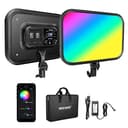
Light two — the background. On the floor behind your chair, out of frame, pointed at the wall rather than at your back. This is the one most people skip and the one that changes the shot most. A colored wash on the wall puts a visible gap between you and the background, which is most of why a professional-looking stream looks professional. One panel is enough.
Light three — the accent. A tube or small light placed behind you and off to the opposite side from the key, catching the edge of your shoulder and hair. It is the last ten percent. Do not buy it before the first two, and never buy it instead of fixing where the key light is pointing.
Software control is the spec that matters
A key light you cannot adjust from the keyboard is a key light you will set once and then leave wrong forever. Daylight moves across your room over a four-hour stream, you change shirts, you move the camera. The Key Light Neo exposes brightness and color temperature (2900–7000K) to software on the PC and to a phone app, so a scene change can take the light with it. The Amaran 100x S has app and remote control as well, so the same logic holds at a larger scale. Everything else on this page is adjusted by hand — which is fine for background and accent lights, because you place those once and never touch them again.
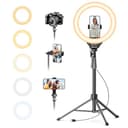
That is also why the cheapest option here is listed last rather than first. A 12-inch ring light on a 62-inch stand genuinely does fix an unlit face for the price of lunch, and if your current lighting is a ceiling bulb it is a real upgrade. But a ring light placed directly in front of you produces the flat, ringed catchlight that reads as “webcam”, and there is nothing to control. Treat it as a stopgap, not as the setup.
Why a bigger light is not automatically better
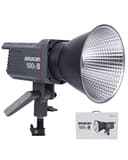
The Amaran 100x S puts out 100W from a Bowens-mount COB with CRI 95+ and bi-color control from 2700–6500K. At desk distance that is far more light than a face needs, and raw output is the wrong thing to shop for if you are framed from the chest up. Output starts to matter when the frame gets bigger: a standing IRL setup, a green screen that has to be lit separately from you, or a room where you would rather bounce the key off a wall or ceiling than point it at yourself. For those jobs a 100W COB with a modifier is the correct tool and a desk panel is not.
One honesty note on that pick: amaran has moved this line on to its Halo series and the 100x S no longer appears in amaran’s own current COB lineup, so it is the outgoing model. It remains an excellent light and is still widely stocked, but check exactly what you are being sold before you buy.
Color: match the room, or kill the room
The most common lighting mistake on a stream is not darkness — it is two different colors of light on one face. A warm lamp in the corner plus a daylight panel on the desk gives you an orange cheek and a blue cheek, and no amount of camera white balance fixes it, because the camera can only be right about one of them. Pick a side: either switch the room’s own lamps off and light yourself entirely, or dial your key down toward 3000K so it agrees with them. Both the Key Light Neo and the Amaran cover that range. There is more on why this happens in white balance, explained, and on why cheap white LEDs render skin badly in CRI, explained.
Background lights are the exception. A colored wall wash is supposed to disagree with the key — that contrast is what creates depth. Just keep the color on the wall and off your face: if your purple background light is wrapping around your cheek, it is too close to you or aimed too far forward.
Mounting: the part that decides whether you keep it
A streaming light lives six inches from your monitor for years, so how it attaches to the desk matters more than its specification sheet. A desk clamp — which the Key Light Neo ships with — keeps the floor clear and survives being nudged. A floor stand with a panel on top is the thing you knock over while reaching for a drink, and it is also the thing that makes a setup look temporary.
For the background light, the floor behind your chair is usually the right place and a short stand or a shelf does the job; the RGB panel needs a stand that is not always included, so budget for one. The Godox LC500R tube carries a built-in 2600mAh battery, which is the whole reason to pick a tube for an accent — it can sit behind a monitor, on a shelf or in a bookcase with no cable running to it. Cable management is a real specification in a room you also live in.
What this looks like at three budgets
Fix the face only. One Key Light Neo on a desk clamp. That is the entire purchase, and it is the biggest single jump in stream quality available. Our sub-$100 lighting roundup covers the cheaper route if the budget is tighter than that.
Make it look designed. Key Light Neo plus one RGB panel on the wall behind you. Two lights, one outlet each, nothing on the floor in front of you. This is where most streams should stop.
The full build. Add the LC500R tube as a rim light behind your opposite shoulder, and move the key to the Amaran 100x S with a softbox if the camera sits far enough back to see your whole body. At that point your lighting is no longer the weakest part of the stream — your audio probably is, which our USB microphone roundup deals with.