Wide Open. Gear

Alternatives to GoPro

What a GoPro is genuinely best at, and the cameras that beat it on sensor size, battery life or price - measured against those exact strengths.

By Stephen V.Last updated How we pick

The best GoPro alternative for most people is the DJI Osmo Action 5 Pro — a 1/1.3-inch sensor that is physically larger than the HERO13 Black’s 1/1.9-inch chip, a published 240-minute runtime, 64 GB of storage built into the camera, and waterproofing to 20 m with no case against the GoPro’s 10 m. It is for someone who shoots all day and often after sunset. The budget pick is the DJI Osmo Action 4, the previous generation, which keeps the same large sensor class and the same 4K120 ceiling and is routinely the cheapest large-sensor action camera on the shelf.

It is worth being precise about what you are replacing, because a GoPro is genuinely excellent at three things and the alternatives are not all better at all three. A HERO13 Black is waterproof to 10 m without a housing, its HyperSmooth stabilization is the benchmark every rival gets measured against, and it mounts to anything — the accessory ecosystem around GoPro’s finger mounts is the largest in the category by a wide margin, which matters more than any spec if you already own a drawer of helmet, chest and handlebar mounts. It also reaches 5.3K60, a higher resolution ceiling than anything else here.

Where it is beatable is sensor size and endurance. At 1/1.9 inches the HERO13’s sensor is smaller than the 1/1.3-inch chips in both DJI picks and the Insta360 Ace Pro 2, which is why those cameras hold up better in dusk and indoor light — sensor area is the one thing you cannot fix in software. And GoPro’s own runtime has never been the category’s strength, where DJI publishes 240 minutes for the Action 5 Pro and Insta360 publishes 180 for the Ace Pro 2.

So read the list below as four different exits from GoPro: a bigger sensor and battery, a flip-up screen you can frame yourself in, a camera that captures everything and lets you choose the shot later, and a gimbal camera that solves smoothness mechanically rather than electronically. If after all this a GoPro is still what you want, our action camera roundup includes it.

How this is funded:we earn a commission if you buy through our links, at no extra cost to you. It never changes which product we recommend, and we’ll tell you plainly when to skip one. Full disclosure.

Quick picks

Ranked on published specs and buyer fit. Select a row to jump to the full write-up. We have not tested these products — here is exactly what we do instead.

#ProductBest forPrice
1
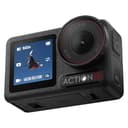
DJI Osmo Action 5 Pro

DJI Osmo Action 5 Pro

The action camera for people who are tired of running out of battery and storage. DJI publishes a 240-minute runtime figure and builds in 64 GB, so a long day on the bike or in the water doesn't turn into a card-swapping errand. The 1/1.3-inch sensor is also physically larger than the GoPro's, which is why its night footage is the cleaner of the two. What you give up is GoPro's mount ecosystem and its higher 5.3K ceiling.

Best overall alternative
$319.00 · View on Amazon

$349.009% off

Price as of November 13, 2026. #ad How we’re funded

2
Insta360 Ace Pro 2

Insta360 Ace Pro 2

The only action camera here with a 2.5-inch screen that flips up to face you, which changes what the category is good for: you can frame a talking-head shot without guessing. Pair that with a 1/1.3-inch sensor, 8K30 capture and Insta360's Leica co-engineering and it is the action camera that doubles as a vlogging camera. It is also the chunkiest of the three traditional models at 177 g.

Best for vlogging to camera
$369.99 · View on Amazon

$399.998% off

Price as of November 13, 2026. #ad How we’re funded

3
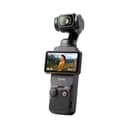
DJI Osmo Pocket 3

DJI Osmo Pocket 3

Not a traditional camera at all — a pocket gimbal with a 1-inch sensor bolted on — and that is exactly why it is the best walk-and-talk vlogging tool here. The 3-axis gimbal gives you glass-smooth motion no mirrorless body can match handheld, in something the size of a chunky pen.

Best for smooth handheld video
$439.00 · View on Amazon

Price as of November 13, 2026. #ad How we’re funded

4
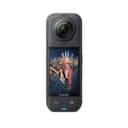
Insta360 X5

Insta360 X5

A different kind of camera: two lenses shooting in opposite directions, so you capture everything and choose the framing afterward in the app. That is a genuine superpower for anything fast or unrepeatable, and the invisible-selfie-stick trick still looks like magic. The catch is real — 8K of 360 footage becomes a roughly 4K flat clip once you reframe it, and every shot needs editing before it is watchable.

Best if you want 360
$549.99 · View on Amazon

Price as of November 13, 2026. #ad How we’re funded

5
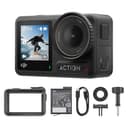
DJI Osmo Action 4

DJI Osmo Action 4

The previous-generation DJI, still sold in an Essential Combo and usually the cheapest way to get a large-sensor action camera. It shares the 1/1.3-inch sensor size and the 4K120 ceiling with the Action 5 Pro — what you lose is the longer runtime, the built-in storage and the bigger rear screen. For a first action camera that is a very easy trade.

Budget pick
$189.00 · View on Amazon

$239.0021% off

Price as of November 13, 2026. #ad How we’re funded

The picks in full

#1Best overall alternative

DJI Osmo Action 5 Pro

The action camera for people who are tired of running out of battery and storage. DJI publishes a 240-minute runtime figure and builds in 64 GB, so a long day on the bike or in the water doesn't turn into a card-swapping errand. The 1/1.3-inch sensor is also physically larger than the GoPro's, which is why its night footage is the cleaner of the two. What you give up is GoPro's mount ecosystem and its higher 5.3K ceiling.

Strengths

  • 1/1.3-inch sensor is larger than the HERO13's, and it shows after sunset
  • DJI's published 240-minute runtime is the longest here by a wide margin
  • 64 GB of built-in storage (47 GB usable) means a forgotten card isn't a dead day

Trade-offs

  • Tops out at 4K120 — no 5.3K mode like the GoPro
  • Fewer third-party mounts and accessories than GoPro's ecosystem
Sensor1/1.3-inch CMOS
Video4K up to 120fps; 1080p up to 240fps
StabilizationRockSteady 3.0+ with HorizonBalancing
Waterproof20 m without a case; 60 m with the case
BatteryUp to 240 min (DJI test: 1080p/24fps, screens off)
Storage64 GB built in (47 GB usable)
Weight146 g

Specifications read from the manufacturer listing, on October 9, 2026.

#2Best for vlogging to camera

Insta360 Ace Pro 2

The only action camera here with a 2.5-inch screen that flips up to face you, which changes what the category is good for: you can frame a talking-head shot without guessing. Pair that with a 1/1.3-inch sensor, 8K30 capture and Insta360's Leica co-engineering and it is the action camera that doubles as a vlogging camera. It is also the chunkiest of the three traditional models at 177 g.

Strengths

  • 2.5-inch flip-up screen makes self-framing possible without a phone
  • 8K30 capture from a 1/1.3-inch sensor co-engineered with Leica
  • Insta360 publishes a 180-minute runtime and 30W fast charging

Trade-offs

  • Heaviest of the standard-shape action cameras at 177 g
  • The flip screen is another hinge to worry about on a crash-prone camera
Sensor1/1.3-inch, co-engineered with Leica
Video8K30; 4K60 with Active HDR
Screen2.5-inch flip-up touchscreen
Waterproof12 m without a case; 60 m with the dive case
Battery1,800 mAh; up to 180 min, 30W fast charging
Weight177 g

Specifications read from the manufacturer listing, on October 9, 2026.

#3Best for smooth handheld video

DJI Osmo Pocket 3

Not a traditional camera at all — a pocket gimbal with a 1-inch sensor bolted on — and that is exactly why it is the best walk-and-talk vlogging tool here. The 3-axis gimbal gives you glass-smooth motion no mirrorless body can match handheld, in something the size of a chunky pen.

Strengths

  • Mechanical 3-axis gimbal — smoother than any in-body system
  • Large 1-inch sensor for a pocket device; 4K120 slow-mo
  • Face tracking spins the camera to keep you centered

Trade-offs

  • Fixed lens and a tiny screen
  • Short battery life; wind noise needs the add-on mic or windscreen
Sensor1-inch CMOS
Stabilization3-axis mechanical gimbal
Video4K120, up to 4K60 normal
Form factorPocket handheld gimbal camera
Weight179 g

Specifications read from the manufacturer listing, on July 18, 2026.

#4Best if you want 360

Insta360 X5

A different kind of camera: two lenses shooting in opposite directions, so you capture everything and choose the framing afterward in the app. That is a genuine superpower for anything fast or unrepeatable, and the invisible-selfie-stick trick still looks like magic. The catch is real — 8K of 360 footage becomes a roughly 4K flat clip once you reframe it, and every shot needs editing before it is watchable.

Strengths

  • Shoot first, frame later — you cannot miss the action
  • User-replaceable glass lenses, the part that always got scratched
  • Dual 1/1.28-inch sensors and a published 185-minute Endurance-mode runtime

Trade-offs

  • Reframed 360 footage lands near 4K, not 8K — the headline number is the sphere
  • Every clip needs app work before it is shareable; flat-video shooters will find it a chore
SensorsDual 1/1.28-inch
Video8K30 360; 5.7K60; 4K120
LensesUser-replaceable glass
WaterproofIP68, to 15 m
Battery2,400 mAh; up to 185 min in Endurance mode
Weight200 g

Specifications read from the manufacturer listing, on October 9, 2026.

#5Budget pick

DJI Osmo Action 4

The previous-generation DJI, still sold in an Essential Combo and usually the cheapest way to get a large-sensor action camera. It shares the 1/1.3-inch sensor size and the 4K120 ceiling with the Action 5 Pro — what you lose is the longer runtime, the built-in storage and the bigger rear screen. For a first action camera that is a very easy trade.

Strengths

  • Same 1/1.3-inch sensor class and 4K120 ceiling as the newer Action 5 Pro
  • Magnetic quick-release mount is still the fastest system to live with
  • Routinely the cheapest large-sensor action camera on the shelf

Trade-offs

  • Published runtime is 160 min against the Action 5 Pro's 240
  • No built-in storage, and a smaller 2.25-inch rear screen
Sensor1/1.3-inch CMOS
Video4K up to 120fps; 1080p up to 240fps
StabilizationRockSteady 3.0+, HorizonSteady
Waterproof18 m without a case; 60 m with the case
BatteryUp to 160 min (DJI test: 1080p/24fps, Wi-Fi off)
Weight145 g

Specifications read from the manufacturer listing, on October 9, 2026.

If you want a bigger sensor: the DJI route

Both DJI picks use a 1/1.3-inch sensor, which has noticeably more area than the HERO13 Black’s 1/1.9-inch chip. More sensor area means more light collected per frame, which translates directly into cleaner footage at dusk, indoors, and in the shade — the conditions where every action camera struggles most. If a lot of your shooting is late-afternoon mountain biking, evening skating or anything under tree cover, this is the single most useful difference on the page.

The DJI cameras also change how a long day works. A published 240-minute runtime on the Action 5 Pro and 64 GB of internal storage mean a forgotten memory card is not a wasted trip, and the magnetic quick-release mount is faster to live with than a finger-mount system. What you give up is resolution ceiling — 4K120 rather than 5.3K60 — and the sheer breadth of third-party mounts, which remains GoPro’s strongest card.

If you want to talk to camera: a flip-up screen

Action cameras are terrible vlogging cameras for a dull reason: you cannot see yourself. The Insta360 Ace Pro 2 is the exception here, with a 2.5-inch screen that flips up to face you, so you can frame a talking-head shot without a phone propped up beside it. Combined with a 1/1.3-inch sensor co-engineered with Leica and 8K30 capture, it is the pick if your footage is half action and half you narrating it.

The trade is physical. At 177 g it is the heaviest standard-shape camera here, and a flip screen is one more hinge on a camera whose job description includes hitting things. If you genuinely only mount it and never speak to it, the DJI is the sturdier choice.

If stabilization is why you wanted a GoPro: go mechanical

HyperSmooth is electronic: the camera crops into the frame and shifts the image to cancel motion, which is extraordinarily good and costs you a little field of view. The Osmo Pocket 3 takes a different approach entirely — a mechanical 3-axis gimbal physically moves the camera, which produces smoother walking footage than any electronic system and does not crop the frame to do it. It also carries a 1-inch sensor, the largest on this page by a long way.

It is not an action camera and should not be bought as one. It is not waterproof, it does not mount to a helmet, and the fixed lens and small screen make it a walk-and-talk tool rather than a crash-and-burn one. But if the reason you were looking at a GoPro was smooth handheld video rather than surviving a river, this is the honest answer, and gimbal versus in-body stabilization explains why the mechanical version wins.

If you want to never miss the shot: 360

The Insta360 X5 points two lenses in opposite directions and records the whole sphere, so you decide where the camera was looking afterwards in the app. For anything fast, unrepeatable or impossible to aim at — a trick, a wipeout, a car passing — that is a genuine advantage no single-lens camera can match, and the invisible-selfie-stick effect is a real creative tool.

Two honest caveats. The headline 8K figure describes the sphere, not your final clip: once you reframe to a normal flat video you land nearer 4K. And every single shot needs app work before it is watchable, which is a workflow most people underestimate. If you want to film something and post it, this is the wrong camera. If you want to film everything and edit later, nothing else competes.

How we compared these

Against the three things GoPro is actually best at, in this order: waterproof depth without a housing; stabilization approach and how much frame it costs; and mounting. Then on the two axes where GoPro is beatable: sensor size, and published battery runtime. Every figure quoted is the manufacturer’s own published specification with the date it was read, including each company’s own battery test conditions, which differ between brands and are not directly comparable — we quote the conditions rather than pretending they are. We have not tested any of these cameras; here is exactly what we do instead, and there are no scores on this page because a score would imply a measurement we did not take.
Frequently asked questions

What is the best alternative to a GoPro?

The DJI Osmo Action 5 Pro for most people. Its 1/1.3-inch sensor is larger than the HERO13 Black's 1/1.9-inch sensor, DJI publishes a 240-minute runtime, it is waterproof to 20 m without a case against the GoPro's 10 m, and it has 64 GB of storage built in. The trade is a lower 4K120 resolution ceiling and a smaller mount ecosystem.

Is there a cheaper alternative to a GoPro?

The DJI Osmo Action 4, the previous DJI generation. It keeps the same 1/1.3-inch sensor class and the same 4K120 ceiling as the Action 5 Pro; what you lose is runtime (a published 160 minutes versus 240), the built-in storage and some rear screen size. It is usually the cheapest large-sensor action camera available.

Do GoPro alternatives work with GoPro mounts?

Mostly, with an adapter. DJI's cameras use a magnetic quick-release system and ship with or sell an adapter frame that accepts standard two-prong GoPro-style mounts, and Insta360's cameras have a standard quarter-inch thread plus their own mount adapters. GoPro's own accessory range is still by far the largest, so check that the specific mount you own is covered before you switch.

Which action camera is best in low light?

The one with the largest sensor, which on this page means the DJI Osmo Action 5 Pro, the Osmo Action 4 and the Insta360 Ace Pro 2 - all 1/1.3 inch - over the HERO13 Black's 1/1.9 inch. If low light is the priority and you do not need waterproofing or mounting, the Osmo Pocket 3's 1-inch sensor is larger still.

Is a 360 camera a good GoPro replacement?

Only if you will edit every clip. A 360 camera captures everything so you cannot miss the action, which is genuinely useful for unpredictable shots, but the 8K figure refers to the full sphere - a reframed flat video lands nearer 4K - and nothing is shareable until you have reframed it in the app. For point-and-post footage, a standard action camera is better.

Sources

Keep reading