What you give up under $100
Three things, and it is worth knowing which of them you will notice.
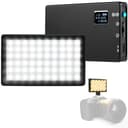
Output. Nothing at this price competes with a 60W or 100W COB light. That matters if you are lighting a whole room, shooting in daylight, or need to overpower a window. It does not matter at all for a face at three feet in a normal room, which is what most people are actually doing.
Build.Stands at this price are thin aluminum with plastic collars and they tip if you catch a leg. The standard fix is free: hang a bag or a bottle of water off the stand’s center column and run your cable so nobody walks through it.
Color accuracy.Cheap LEDs are usually fine and occasionally green. The specification to look for is CRI, and under $100 only some products publish it — we show the published figure where there is one and say nothing where there is not. If accurate skin tone is the point of the purchase, read what CRI actually means before you spend, because it is the one spec at this price that is worth paying a little more for.
Softbox kit or desk panel?
This is the real decision, and it comes down to whether your camera is on a tripod or on your monitor.
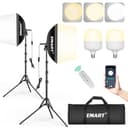
A two-light softbox kit like the EMART gives you light you can place. One box at 45 degrees as your key, one further back as fill or pointed at the background, and you have the setup every talking-head video on the internet is lit with. The boxes are large relative to a face, so the light is soft and flattering without any extra diffusion. The cost is floor space and setup time: two stands up, two cables run, five minutes before you shoot.
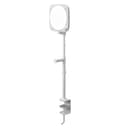
A desk panellike the Key Light Neo lives clamped to your desk permanently and is on in two seconds. You control it from software on your PC or phone, which is genuinely better than reaching behind a light mid-call, and the diffused edge-lit panel is kinder than a bare LED array. The cost is that it can only ever be where your desk is, and it is a single source — so your shadows are whatever the room gives you. The key light roundup covers that category in full.
Where ring lights still make sense
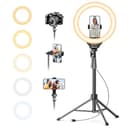
A ring light is the most-bought and most-criticised shape of cheap light, and both are deserved. It is front-on, nearly shadowless light with almost no setup, and for a phone-filmed talking-head, a tutorial where your hands are in frame, or a seated call, it does that job well and cheaply. The 18-inch Neewer is a big enough ring to be genuinely soft on a face; the 12-inch UBeesize is the one to buy if the budget is the point and the subject is a phone screen at arm’s length.
Two caveats. Flat front light has no shape to it, so it reads as “lit by a ring light” to anyone who watches a lot of video — that is an aesthetic choice, not a fault. And if you wear glasses, a ring sits exactly where its reflection lands in your lenses; see lighting for glasses wearers instead. Our wider ring light roundup compares the sizes.
The one-light setup to start with
Whatever you buy here, start with a single light and get it right before you turn the second one on. Put it in front of you and about 45 degrees to one side, raised slightly above your eyeline and angled down. Bring it as close as you can without it entering the frame — closer is softer, which is the single most counter-intuitive rule in lighting. Then turn off the room lights and the ceiling bulb, because mixing a daylight LED with a warm tungsten bulb puts two colors on one face and no amount of white balance correction untangles that.
If you have a window, use it as your second light instead of buying one: sit so it is on the opposite side from your key, and it lifts the shadows for free. The full arrangement, and why most people get more from improving one light than adding a third, is in lighting basics for video.
What to buy next, when you outgrow this
The upgrade path from here is almost always the same: one COB light on a Bowens mount plus a softbox, which gives you proper dimming, held color and a modifier system that lasts. It is roughly double this budget and it is the last lighting purchase a lot of creators make. Our video lighting kit roundup covers those, and the softbox kit roundup covers the bigger two-light sets if what you actually need is more box rather than more watts.