What Is CRI in Lighting?
The number that tells you whether a light shows skin, fabric and food their real colors - what it measures, what it misses, and when it is worth paying for.
CRI — the Color Rendering Index — is a 0-100 score for how truthfully a light shows the colors of whatever it is lighting. A light with a high CRI reveals skin, fabric and food as they actually are. A light with a low CRI distorts some of those colors while leaving others looking fine, which is why bad lighting often reads as “something looks off” rather than as an obvious color cast. For creator work the short version is: look for a published figure of CRI 95 or higher if you are lighting faces or products, treat 90 to 95 as usable, and be suspicious of any light that advertises no figure at all.
The number comes from a straightforward test. You light a set of standard color samples with your lamp, light the same samples with a reference source of the same color temperature, and score how closely the two match. Average the scores and you get the CRI, usually written Ra. Daylight and incandescent bulbs score 100 by definition, because they are the references. Everything artificial is measured against them.
Why LEDs made this a thing people check
Older light sources produced light in a broad, smooth spread across the spectrum. A tungsten bulb is a hot filament, so it emits a continuous curve of energy — heavy on red, light on blue, but with something at every wavelength. Nothing is missing, so nothing can fail to reflect.
An LED works differently. A typical white LED is a blue emitter behind a phosphor coating that converts some of that blue into other wavelengths, and the result is a spiky spectrum with peaks and gaps rather than a smooth curve. If a wavelength is barely present in the light, an object that depends on reflecting that wavelength cannot show its real color — there is nothing there to reflect. That is the whole mechanism behind poor color rendering, and it is why cheap LED panels can look fine on a wall and strange on a face.
The deep-red problem, and why skin is the test
Here is the detail that makes CRI worth understanding rather than just reading off a box. The headline figure is an average across several color samples, and an average hides its worst case. The sample that most often drags a light down is R9, the deep red.
Many inexpensive white LEDs produce very little deep red light, because red is the expensive part of the phosphor conversion. A light can therefore score a perfectly respectable general CRI while rendering deep reds poorly — and human skin tone is built on exactly those reds, because what you are looking at is blood under translucent tissue. Take away the deep red and faces go gray, sallow or faintly green. Food does the same thing: meat looks gray, tomatoes look orange.
This is why lights marketed to filmmakers often publish an R9 figure alongside the general CRI, and why a “CRI 95” claim with no R9 figure is worth less than one with it. If you are choosing between two lights with the same headline number and one publishes R9, that is the one that has been measured properly.
CRI, TLCI and the numbers on the box
You will see several indices quoted and they are not interchangeable.
CRI (Ra) is the long-standing standard, designed for human vision and architectural lighting. It is the number nearly everyone publishes, which makes it useful for comparison even though it was not designed with cameras in mind.
TLCI— the Television Lighting Consistency Index — scores the same idea as a camera sees it rather than as an eye does. Since you are filming, not looking, a published TLCI figure is arguably more relevant to video than CRI. Fewer manufacturers publish it, so when one does it is usually a sign the light was engineered for broadcast work.
Other indicesexist — newer systems that score fidelity and saturation separately, and which the industry is slowly adopting. For buying purposes in 2026, CRI with an R9 figure, or CRI plus TLCI, is as much information as the market reliably gives you.
One warning that applies to all of them: these are manufacturer-published numbers, not independently verified ones, and at the cheap end of the market they are sometimes optimistic. We quote what the manufacturer publishes and say nothing where they publish nothing — an absent figure is information in itself.
CRI is not color temperature
These two get mixed up constantly and they describe different things. Color temperature, in kelvin, is what color the light is — 3200K is warm and orange, 5600K is cool and daylight-like. CRI is how accurately that light renders the colors of objects, whatever its temperature.
The practical consequence: your camera can correct color temperature with a single white balance setting, because the whole image shifts the same way. It cannot correct poor color rendering the same way, because different colors are affected by different amounts — you would have to adjust individual hues, clip by clip. A warm light is a setting. An inaccurate light is a problem. White balance explained covers the first half of that; this page is the second.
What to look for when you are buying
Four things, in order of how much they tell you.
A published figure at all.If a light’s own specifications do not mention color accuracy, assume it was not a design priority. This alone filters out most of the cheapest panels.
CRI 95 or higher if faces or products are the subject. Below that, you are buying correction work in editing. Between 90 and 95 is fine for casual video, backgrounds and anything where approximate color is acceptable.
An R9 or TLCI figure alongside it. Either one suggests the manufacturer measured more than the headline average.
Consistency across dimming and color temperature. Some lights hold their rendering as you dim them or shift the temperature, and some drift. This is rarely published, but it is one of the real differences between a name-brand COB light and a generic panel, and it is the reason a more expensive light stays trustworthy at 20 percent output.
The three picks below are the lights in our registry that publish a real color-accuracy figure, grouped by the job you are buying the light for.
How this is funded:we earn a commission if you buy through our links, at no extra cost to you. It never changes which product we recommend, and we’ll tell you plainly when to skip one. Full disclosure.
Quick picks
Ranked on published specs and buyer fit. Select a row to jump to the full write-up. We have not tested these products — here is exactly what we do instead.
| # | Product | Best for | Price |
|---|---|---|---|
| 1 | 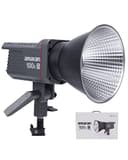 Aputure Amaran 100x S The step into a light that will still be in your kit years later. Aputure's Amaran line brings serious build quality, app control and reliable color accuracy, and the Bowens mount plus a bright 100W output make it a proper key light. One caveat before you buy: amaran has moved this line on to its Halo series, and the 100x S no longer appears in amaran's own COB lineup, so this is now the outgoing model rather than the one amaran sells today. | Best published accuracy for a key light | $199.00 · View on Amazon Price as of October 10, 2026. #ad How we’re funded |
| 2 | 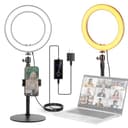 Neewer 12-inch Desktop Ring Light (RH12B) The desk ring light for anyone who lives on video calls. A 12-inch ring on an adjustable desk stand with a high CRI rating, so skin tones look right. It is the tidy, permanent option that sits by your monitor rather than the tall stand you keep tripping over. | Best accuracy on a desk | $61.89 · View on Amazon Price as of October 10, 2026. #ad How we’re funded |
| 3 | 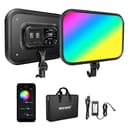 Neewer 18-inch RGB LED Panel The fun light. A full-color RGB panel lets you throw a colored wash behind you — the blue-or-purple gamer/creator look — as well as clean white key light, with a high CRI so faces still look right. One panel behind you plus a key light in front is the classic two-light creator setup. | Best accuracy with color effects |
Why those three
Each of them publishes a figure, which is the first filter. The Amaran 100x Sis rated CRI 95+ and is a bright enough COB light to be a real key on a Bowens-mount softbox, so it covers the case where accuracy and output both matter — interviews, portraits, paid work. The Neewer 12-inch Desktop Ring Light publishes CRI 97+ and TLCI 98+, which is a higher figure than most desk lighting, and it is the cheapest way to put accurate light on a face for calls and webcam work. The Neewer 18-inch RGB LED Panel publishes CRI/TLCI 97+ for its white output, which is the specification to look for on an RGB light: plenty of color panels throw a good blue wash and render skin badly when you switch them to white.
Two of our other recommended lights are deliberately not on this list. The Godox SL60W is excellent value as a key light but Godox does not publish a CRI figure we can cite for it, and “probably fine” is not a specification. The budget softbox kits use standard replaceable bulbs, which means their color accuracy is a property of whatever bulb is in them — upgradeable, but not a number the kit can claim. Where a manufacturer does not publish a figure, we say so rather than guess.
When CRI is not worth paying for
If you shoot black and white, CRI is irrelevant. If you light a background rather than a subject, it barely matters. If you are lighting a gaming setup where the whole point is a saturated purple wash, you are not asking the light to tell the truth about color in the first place.
And if you are buying your first light at all, buy the bigger, softer, better-placed light over the more accurate one. A CRI 98 panel in the wrong position looks worse than a CRI 90 softbox in the right one, every time. Accuracy is the thing you upgrade to once placement, size and control are already handled — which is the order our budget lighting roundup and three-point lighting guide both work in.
Frequently asked questions
What is CRI in lighting?
CRI, the Color Rendering Index, is a 0-100 score for how accurately a light source shows the colors of what it illuminates, compared with a reference source of the same color temperature. A high CRI light reveals the real color of skin, fabric and food; a low CRI light distorts some colors while leaving others looking normal.
What CRI do I need for video?
Look for CRI 95 or higher if you are lighting faces, products or anything where color has to be right. CRI 90 to 95 is usable and often invisible in a single-light setup. Below 90 you start seeing muddy skin tones and colors that will not correct cleanly in editing.
Is a higher CRI always better?
For accuracy, yes, but accuracy is not always what you want and it is never the most important thing about a light. Size, placement, output and dimming all affect how a shot looks more than the last few CRI points do. A high-CRI light in the wrong place still looks bad.
What is the difference between CRI and TLCI?
CRI was designed for human vision and architectural lighting; TLCI, the Television Lighting Consistency Index, scores the same thing as a camera sensor sees it. Because you are filming rather than looking, a published TLCI figure is arguably the more relevant number for video — which is why some manufacturers publish both.
Why do cheap LED lights make skin look wrong?
Usually a weakness in deep reds. Many inexpensive white LEDs produce very little deep red light, which is exactly the part of the spectrum skin tone depends on, so faces look slightly gray or green. The general CRI average can still look respectable while that one region is poor, which is why the R9 deep-red sub-score matters.
What is R9 and why does it matter?
R9 is the deep-red component of the CRI calculation. The headline CRI figure is an average across several color samples, so a light can score well overall while rendering deep reds badly. Since skin tone relies on those reds, a light with a good general CRI and a poor R9 will still make people look unhealthy.
Does CRI affect photography as well as video?
Yes, for continuous light. Any inaccuracy in the light becomes inaccuracy in the file, and unlike white balance it is not a single global correction — different colors shift by different amounts, so you end up correcting individual hues. It matters most for product work, food and portraits.
Can I fix bad CRI in editing?
Only partly. White balance corrects an overall color cast, which is a different problem. Poor color rendering distorts some hues more than others, so fixing it means selective hue adjustments on every clip or frame — possible, tedious, and never quite as clean as lighting it correctly in the first place.
Sources
- Aputure — Official lighting specifications — Aputure/amaran official spec pages (accessed July 18, 2026)
- Neewer — Official product specifications — Neewer official lighting and studio spec pages (accessed July 18, 2026)
- Godox — Official lighting specifications — Godox official continuous-light spec pages (accessed July 18, 2026)
Keep reading
Best Video Lighting Kits
The COB lights and kits that publish real color-accuracy figures.
See lighting kitsWhite Balance Explained
The other half of color: matching your camera to your light.
Read the explainerBest Lights for Product Photography
Where color accuracy stops being nice and starts being the job.
See product lightsLighting Basics for Video
Soft vs hard light, color temperature and where to put one light.
Read the basics