What Size Softbox Do I Need?
Softness is box size measured against your subject, not against the room. How to pick a size for faces, half-body portraits and tabletop products — and why bigger is not always better.
The short answer: a 24-inch box is the right default for faces, a 16-inch box is right for a desk or a tabletop product setup, and half-body or full-body portraits want something larger or two boxes working together. But the number on the box is only half the story, because softness is not a property of the softbox — it is a relationship between the box, the subject and the distance between them.
The one rule that decides everything
Light is soft when the source is large relative to the subject. That is the entire mechanism. A large source sends light at a face from many slightly different angles, so the edges of shadows are gradual and the dark side fills in gently. A small source sends light from effectively one angle, so shadow edges are abrupt — the hard, unflattering look of a bare bulb or midday sun.
Two consequences follow, and they are the two things people miss. First, distance changes softness. What matters is how big the box appears from where the subject is standing, so moving a box closer makes it effectively larger and softer, and pulling it back makes it smaller and harder. A 16-inch box a foot away can be softer than a 36-inch box across the room.
Second, the right size depends on the subject. A 24-inch box is huge next to a coffee mug, comfortably large next to a face, and quite small next to a standing adult. The same box is a soft light and a hard light depending on what you point it at, which is why “what size softbox” has no single answer.
Sizes by what you are shooting
Head-and-shoulders video and portraits. A 24-inch box at roughly three to four feet is the practical sweet spot, and it is why most two-light kits are built around that size. It is bigger than a face, so the light is genuinely soft; it is small enough to place in a normal room without choreography; and it is easy to keep out of a tight frame. If you want softer, move it closer before you buy bigger.
Half-body and seated two-person shots. Now your subject is three or four feet of frame, and a 24-inch box starts behaving like a harder source with visible falloff from the near shoulder to the far one. Go larger, or place two boxes side by side and feather them so their coverage overlaps. This is the point where a single lamp on a Bowens mount with a bigger modifier beats a kit.
Full-body portraits.Six feet of subject needs a very large source to stay soft top to bottom, which in a home studio usually means two boxes stacked or a large box placed further back and accepted as somewhat harder. A strip box — long and narrow — is the specialist tool here, because it matches the shape of a standing figure and spills less onto the background.
Tabletop and product work. The easy case. Your subject is a few inches tall, so even a 16-inch box placed close is an enormous source, and you get the smooth gradients that make a product look three-dimensional. Cheap compact kits do genuinely professional work here, which is the single best-value fact in lighting. More detail in lights for product photography.
Why bigger is not automatically better
It is tempting to buy the largest box available and consider the problem solved. Three reasons not to. A big box in a small room cannot be placed properly — if you cannot get it close and at the right angle, its size is wasted. A big box is hard to keep out of a wide frame, and the moment you push it back out of shot you have reduced its apparent size anyway. And a big box spills: light goes everywhere, including onto the background you were trying to keep dark or a different colour.
The useful formulation is this: buy the largest box you can comfortably place close to your subject in the room you actually have. In most homes that is a 24-inch box, not a 36-inch one, and the people who end up happiest with their lighting are usually the ones who bought a modest box and learned to move it.
Shape, and whether it matters
Less than size, but not nothing. An octagonal box leaves a round catchlight in the eyes, which many photographers prefer for portraits because it resembles a daylight source. A rectangular box leaves a window-shaped catchlight, which looks natural for the same reason. A strip box is long and narrow, which makes it excellent for edge-lighting a figure and for keeping light off a nearby wall.
What does matter is whether the box takes a grid. A grid is a honeycomb fabric that clips to the front and narrows the beam, so the light still arrives soft but stops spreading across the room. On a small set, that one accessory does more for control than going up a box size — it is how you light a face without lighting the wall behind it. If you are weighing a box against the cheaper alternative, our softbox vs umbrella comparison covers where each one ends up.
How this is funded:we earn a commission if you buy through our links, at no extra cost to you. It never changes which product we recommend, and we’ll tell you plainly when to skip one. Full disclosure.
Quick picks
Ranked on published specs and buyer fit. Select a row to jump to the full write-up. We have not tested these products — here is exactly what we do instead.
| # | Product | Best for | Price |
|---|---|---|---|
| 1 | 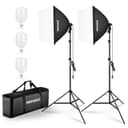 Neewer 700W Softbox Lighting Kit The cheapest way to get two soft light sources on stands. A pair of 24-inch softboxes with daylight LED bulbs covers a two-point interview or product setup for very little. The bulbs and stands are basic, but the soft, even light they produce is the real thing. | Best 24-inch pair | $139.07 · View on Amazon Price as of October 5, 2026. #ad How we’re funded |
| 2 | 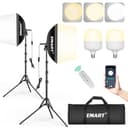 EMART Softbox Photography Kit (2-pack) A tidier, more modern take on the budget softbox kit: two 16-inch soft boxes with adjustable-color LEDs and app control, so you can dial warm-to-cool without swapping bulbs. Compact enough for a home desk setup, and the color control is a genuine step up from fixed-daylight kits. | Best compact 16-inch | |
| 3 | 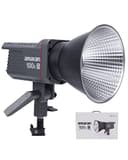 Aputure Amaran 100x S The step into a light that will still be in your kit years later. Aputure's Amaran line brings serious build quality, app control and reliable color accuracy, and the Bowens mount plus a bright 100W output make it a proper key light. One caveat before you buy: amaran has moved this line on to its Halo series, and the 100x S no longer appears in amaran's own COB lineup, so this is now the outgoing model rather than the one amaran sells today. | Best light to pair with any box | $199.00 · View on Amazon Price as of October 5, 2026. #ad How we’re funded |
Which of these fits your situation
If you are shooting talking-head video or portraits, the 24-inch Neewer pair is the straightforward answer: the right default size, two of them, with stands, for very little. The compromise is fixed-output bulbs, so you set brightness by moving the light — which, as above, also changes softness.
If you are working at a desk or on a table, the 16-inch EMART kit is the better buy and the adjustable 3000-6000K colour is a real advantage in a room that has its own warm lighting. Small boxes are not a compromise for small subjects; they are the correct tool, and they do not dominate a room you also have to live in.
If you would rather buy the light and choose the box separately, do that. A COB light on a Bowens mount like the Amaran 100x S accepts any modifier the standard fits, so you can run a 24-inch box for faces and a larger one for half-body work from the same lamp, and dim it smoothly rather than walking it backwards. It costs more and arrives in more pieces, and nothing in it becomes disposable. The full comparison lives in our softbox lighting kit roundup.
Frequently asked questions
What size softbox should I get?
For head-and-shoulders video and portraits, a 24-inch box placed a few feet away is the practical default — comfortably larger than a face, so the light is soft, and small enough to position in a normal room. Go to 16 inches for a desk or tabletop product setup, and larger or to two boxes for half-body and full-body portraits.
Is a bigger softbox always better?
No. A bigger box is softer, but it is also harder to place in a small room, harder to keep out of frame, and spills more light onto the background you were trying to keep dark. The best size is the largest one you can comfortably position close to your subject, which in most home rooms is not the largest one you can buy.
What size softbox for full-body portraits?
Bigger than you would use for a face — the rule compares the box to the subject, and a full body is roughly six feet of subject. A single large box or, more practically, two boxes feathered together gives you even coverage head to toe. A 24-inch box lighting a standing figure behaves like a much harder source than it does on a face.
What size softbox for product photography?
Small boxes work beautifully, because products are small. A 16-inch box placed close to a bottle or a watch is an enormous source relative to the subject, which gives the soft gradient-free light catalogue shots need. This is why cheap compact kits punch well above their weight for tabletop work.
Does the distance to the subject change how soft the light is?
Yes, and it is the control people forget. What matters is the apparent size of the box from the subject's point of view, so moving a box closer makes it effectively larger and therefore softer, and moving it away makes it smaller and harder. A small box close in can be softer than a big box across the room.
Can one softbox be enough?
Yes. One correctly sized and correctly placed box plus a white bounce card on the opposite side will light a face or a product properly, and it is how a great many professional images are made. A second box buys you precise control over the shadow side rather than a fundamentally better look.
Do octagonal softboxes look different from rectangular ones?
Slightly, and mostly in the reflections. An octagonal box leaves a rounder catchlight in the eyes, which some people prefer for portraits, and a rectangular or strip box leaves a long rectangular one that resembles a window. The shape also affects spill control — a strip box is easier to keep off a background. Size matters far more than shape.
Sources
- Neewer — Official product specifications — Neewer official lighting and studio spec pages (accessed July 18, 2026)
- Aputure — Official lighting specifications — Aputure/amaran official spec pages (accessed July 18, 2026)
Keep reading
Best Softbox Lighting Kits
The kits worth owning, 16-inch through 24-inch.
See softbox kitsSoftbox vs Umbrella
Two ways to make light soft, and when each one wins.
Compare themThree-Point Lighting, Explained
Where to put the box once you have chosen it.
Read the guideBest Lights for Product Photography
Where small boxes do their very best work.
See product lights