Softbox vs Umbrella
Both make light soft. They differ on where the light does not go — which is what you are really buying. Which one to pick for portraits, video and product work.
Buy a softbox. The light quality is similar either way, but a softbox controls where the light does not go, and in a normal-sized room that is the thing you are actually paying for. An umbrella is cheaper, faster to put up and easier to carry, and if you are lighting a large space or working on a tight budget it is a perfectly good tool. But most people shooting portraits, video or products at home want the light on the subject and not on the wall, and that is a softbox’s whole argument.
How each one works
A softbox is an enclosed box. The light sits at the back, the interior walls are reflective, and the front is a sheet of diffusion fabric. Light bounces around inside and leaves through that front panel, so you get a large, even, soft source that emits in one direction. Most have a second inner baffle for extra evenness, and many accept a grid on the front to narrow the beam further.
An umbrella is open. There are two kinds. A reflective umbrella has an opaque, usually silver or white, inside: you point the light into it and the subject is lit by the bounce, which makes the whole inner surface your source. A shoot-through umbrella is translucent: you point the light at the subject through the fabric, which diffuses it much as a softbox front panel does.
Both arrive at the same destination — a big surface emitting soft light — and on the subject’s face the difference is subtle. The real difference is everything that happens outside the frame.
Spill: the actual difference
An umbrella leaks. A reflective one throws light past its edges; a shoot-through one sends roughly as much light backwards and sideways as it sends forward. That light hits your walls and ceiling and comes back as a soft ambient wash from every direction.
Sometimes that is a gift. If you are lighting a group in a large room, or you want a bright, airy, low-contrast look, a bounced umbrella fills a space beautifully with one lamp. It is forgiving of placement, because the light is coming from everywhere anyway.
Often it is a problem. That ambient wash lifts the shadow side of the face, so the shape your key light was creating gets diluted. It lifts the background, so the dark backdrop you wanted goes grey. And it bounces colour: a warm wooden floor or a coloured wall tints the fill you did not know you had. A softbox, with its solid sides, sends light forward and leaves the rest of the room alone, which is why it is the default on small sets and the near-universal choice for product work.
The practical trade-offs
Cost.Umbrellas win easily — they are simple objects and a perfectly usable one is very cheap. Softboxes cost more for the frame and fabric, though budget kits that bundle lights, stands and boxes have narrowed the gap a lot.
Setup and portability. Umbrellas win again. One opens like an umbrella because it is one, it collapses to a stick, and it lives in a bag. Softboxes mean assembling a frame and threading fabric, and while quick-release designs have improved this, nothing beats an umbrella for speed. For location work where you carry everything, that matters.
Stability. Softboxes win. An umbrella on a stand is a sail: it catches a draught, it is easily caught by a passing elbow, and on a long video take a moving modifier shows up as a shifting exposure. Softboxes are more compact and sit closer to their stand, and they still need weighted legs.
Control.Softboxes win decisively. Grids, strip shapes and solid sides give you a light you can aim and feather — turning the box slightly so the edge of its beam falls on the subject, which is the single most useful technique in soft lighting and effectively impossible with a bounced umbrella.
So which, for what
Portraits in a normal room: softbox, 24 inches or so, close in. You want shape, and shape needs the shadow side to stay dark. Talking-head video: softbox, for the same reason plus stability. Product and tabletop: softbox, without much argument. Groups in a big space, or an airy high-key look: a large bounced umbrella is both cheaper and better suited. Travelling light: umbrella, because the one you actually bring beats the one in the cupboard.
If you are buying your very first modifier and you do not yet know what you shoot, buy the softbox. It is the more controllable tool, it teaches you more about light because its effects are legible, and an umbrella is cheap enough to add later without regret.
How this is funded:we earn a commission if you buy through our links, at no extra cost to you. It never changes which product we recommend, and we’ll tell you plainly when to skip one. Full disclosure.
Quick picks
Ranked on published specs and buyer fit. Select a row to jump to the full write-up. We have not tested these products — here is exactly what we do instead.
| # | Product | Best for | Price |
|---|---|---|---|
| 1 | 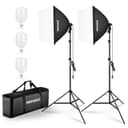 Neewer 700W Softbox Lighting Kit The cheapest way to get two soft light sources on stands. A pair of 24-inch softboxes with daylight LED bulbs covers a two-point interview or product setup for very little. The bulbs and stands are basic, but the soft, even light they produce is the real thing. | Best softbox kit overall | $139.07 · View on Amazon Price as of October 5, 2026. #ad How we’re funded |
| 2 | 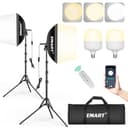 EMART Softbox Photography Kit (2-pack) A tidier, more modern take on the budget softbox kit: two 16-inch soft boxes with adjustable-color LEDs and app control, so you can dial warm-to-cool without swapping bulbs. Compact enough for a home desk setup, and the color control is a genuine step up from fixed-daylight kits. | Best compact softbox kit | |
| 3 | 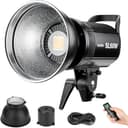 Godox SL60W LED The COB light that gets serious creators off ring lights. A 60W daylight-balanced bulb on a Bowens mount means you can bolt on a real softbox and shape proper, cinematic light. Add a stand and modifier and you have a starter studio key light that punches far above its price. Know what you are buying, though: Godox now sells the SL60II generation (SL60IID daylight, SL60IIBi bi-color) and the original SL-60W's page has gone from Godox's own site, so this is the outgoing version. | Best light for either modifier | $109.00 · View on Amazon Price as of October 5, 2026. #ad How we’re funded |
What we would actually buy
A note on what is and is not listed above: these are softboxpicks and a light to put behind one. Umbrellas are genuinely commodity items — a reflective or shoot-through umbrella is a few pounds of fabric and ribs, there is very little to distinguish one from another, and we do not think a specific recommendation would tell you anything useful. If you want one, buy a large cheap one from whoever and spend the difference on the light.
For a first purchase, the 24-inch Neewer pair is the sensible answer: two boxes, two stands, soft light in the box, and no research required. The compact EMART kit is the pick if you are working at a desk or in a small room, and its adjustable 3000-6000K colour helps when you cannot turn off the room lighting.
If you already own a light — or are buying a COB light like the Godox SL60W on a Bowens mount — then the modifier question is genuinely open and you can own both. Many people do: a softbox for anything where the background matters, and a big umbrella for the days when you need to fill a whole room with soft light fast. The sizing guide is the next thing to read, and the softbox kit roundup has the full comparison.
Frequently asked questions
Softbox or umbrella — which is better?
A softbox for most people, because it controls where the light does not go. Both produce soft light of similar quality, but a softbox has solid sides that keep the light pointed forward, while an umbrella throws light across the whole room. In a small room, that control is the difference between lighting your subject and lighting everything.
What is the difference between a softbox and an umbrella?
A softbox is an enclosed box with reflective interior walls and a diffusion panel on the front, so light leaves in one direction. An umbrella is open: either you bounce light off its reflective inside back towards the subject, or you shoot through its translucent fabric. The softbox controls spill; the umbrella spreads light widely and sets up faster.
Is an umbrella good for portraits?
Yes, and it is a long-standing portrait tool. A large umbrella is a big, soft, forgiving source that wraps around a face and is very quick to set up. Its weakness is spill — light bounces off nearby walls and ceilings and lifts the shadows and the background, which flattens the look and is harder to avoid in a small room.
Which is better for product photography?
A softbox, fairly clearly. Product work depends on precise control of highlights and a clean background, and an umbrella's spill lifts the backdrop and fills the shadows you were using to show shape. A small softbox placed close, with black card to control reflections, is the standard tabletop setup.
Is a shoot-through umbrella the same as a softbox?
It is closer, but not the same. Shooting through a translucent umbrella diffuses the light much as a softbox front panel does, so the quality on the subject is similar. The difference is that roughly half the light also escapes backwards and sideways past the open frame, so you still get the spill a softbox prevents.
Which one is cheaper?
Umbrellas, usually by a wide margin — they are simple, commodity items and a usable one costs very little. Softboxes cost more because of the frame and the fabric, though budget softbox kits that include the lights and stands have made the price gap much smaller than it used to be.
Can I use an umbrella for video?
Yes, with one caveat specific to video: an umbrella on a stand is a large sail, so it is easily knocked and it moves in any draught, which shows up as flicker across a long take. A softbox is more compact and more stable. Both work; the softbox is the lower-drama choice on a set people walk around.
Sources
- Neewer — Official product specifications — Neewer official lighting and studio spec pages (accessed July 18, 2026)
- Godox — Official lighting specifications — Godox official continuous-light spec pages (accessed July 18, 2026)
Keep reading
Best Softbox Lighting Kits
The kits worth owning, compared on size and control.
See softbox kitsWhat Size Softbox Do I Need?
Box size against subject size, with real numbers.
Read the sizing guideThree-Point Lighting, Explained
Where the modifier goes once you have chosen it.
Read the guideLighting Basics for Video
Soft vs hard, colour temperature and CRI from the start.
Read the basics