Dynamic vs Condenser Microphones
The choice is not about quality. It is about your room. Which type ignores the air conditioning, which one captures every detail, and which one you should buy.
If you record in an ordinary room, buy a dynamic microphone. If you record in a quiet, soft, treated room, buy a condenser. That is very nearly the whole decision, and it is worth stating plainly because the usual framing — that condensers are the better, more professional microphone — sends a lot of people home with a sensitive studio mic that faithfully records their computer fan.
What the two things actually are
A dynamicmicrophone works like a loudspeaker in reverse. A diaphragm is attached to a coil of wire sitting in a magnetic field; sound moves the diaphragm, the coil moves, and that movement generates a small electrical current. It needs no power to do this. The moving mass is relatively heavy, which makes the microphone comparatively insensitive — it takes real sound pressure to move it.
A condenserworks on capacitance. A very thin conductive diaphragm sits a hair’s width from a fixed backplate, the two form a capacitor, and sound changes the distance between them, which changes the capacitance and produces a signal. It requires power — 48V phantom power over XLR, or the USB connection on a USB model. The moving mass is tiny, so it responds to very quiet, very fast detail.
Everything that follows is a consequence of that one difference in sensitivity.
Why sensitivity decides everything
A microphone does not record your voice. It records everything, and what you hear afterwards is the balance between your voice and the rest. A condenser hears your voice beautifully and also hears the laptop fan, the fridge compressor, the keyboard, the traffic, and the hard reflections bouncing off your bare walls. A dynamic hears your voice and, being far less sensitive, hears all of that so much more quietly that most of it effectively disappears.
This is why a dynamic microphone used close up sounds clean in a room where a condenser sounds like a recording made in a room. The effect compounds with proximity: speak a hand’s width from a dynamic and your voice is enormous relative to everything else. That ratio is the single most powerful tool available to anyone recording at home, and it costs nothing.
The flip side is honest too. In a properly quiet space, the condenser’s sensitivity is not a liability, it is the point — you get the high frequency detail and the sense of air around a voice that makes studio recordings sound expensive. Dynamics sound warmer and closer and slightly more contained. Neither is better in the abstract; they are differently suited.
The room, not the budget
The practical test is not how much you want to spend, it is what you can hear when you stop talking. Stand in your recording space and listen for ten seconds. A computer fan, a fridge, an air vent, traffic, a clock? Clap once — does the sound ring briefly off the walls? If the answer to any of that is yes, a dynamic will produce a better finished recording than a condenser costing three times as much.
If you want to use a condenser, treating the room is the real purchase. That does not mean foam tiles on every wall; it means soft things in the right places. A rug, curtains, a bookcase, a duvet on a stand behind you, recording in a corner facing into soft furnishings rather than at a bare wall. Echo is the one problem you cannot fix in editing, and absorbing it is cheaper than most microphones.
Pattern matters more than people think
Alongside the capsule type is the polar pattern— which directions the microphone listens to. A cardioid pattern is most sensitive in front, less to the sides, and rejects what is directly behind it. For a single person speaking, cardioid is almost always right, and both a cardioid dynamic and a cardioid condenser will reject noise better than an omnidirectional version of either.
Multi-pattern microphones that offer omnidirectional, bidirectional and stereo modes are genuinely useful for two people at one microphone or for recording a room deliberately. But for a single voice, those extra modes are the ones you will never use, and a mic switched to omni in an untreated room undoes every advantage you were paying for.
What to look for when you buy
Capsule type matched to your room, as above. Cardioid pattern for one voice. A headphone output on the microphone, which lets you monitor yourself with no delay and is the fastest way to learn good mic technique. A connection that survives your next upgrade— a hybrid USB and XLR microphone works plug-and-play now and still works when you add an interface, which we cover in XLR vs USB microphones. And a mount that isolates, because a mic sitting directly on a desk transmits every keystroke straight into the capsule.
How this is funded:we earn a commission if you buy through our links, at no extra cost to you. It never changes which product we recommend, and we’ll tell you plainly when to skip one. Full disclosure.
Quick picks
Ranked on published specs and buyer fit. Select a row to jump to the full write-up. We have not tested these products — here is exactly what we do instead.
| # | Product | Best for | Price |
|---|---|---|---|
| 1 | 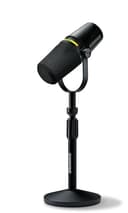 Shure MV7+ The mic that fixes bad rooms, in its current form. The same forgiving dynamic capsule that made the original MV7 the default podcast mic, now with USB-C, onboard digital processing and a real-time denoiser. Shure has discontinued the original MV7, so this is the MV7 you buy new today. | Best dynamic | $319.00 · View on Amazon Price as of October 5, 2026. #ad How we’re funded |
| 2 | 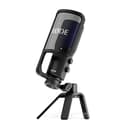 RODE NT-USB+ A studio-grade USB condenser that skips the complexity. Plug it into a computer, hear yourself through the built-in headphone jack with zero latency, and record clean, detailed voice with no interface to buy. Condensers pick up room sound, so it wants a quiet, treated space — get that right and it sounds superb. | Best condenser | |
| 3 | 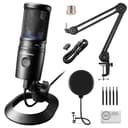 Audio-Technica AT2020USB-X The quiet, no-nonsense USB condenser for people who just want clean sound. The AT2020 is a studio staple, and the USB-X version adds a headphone jack, on-mic mute and mix control without the hype or the RGB. It sounds excellent in a treated room and gets out of your way. | Best value condenser | $185.90 · View on Amazon Price as of October 5, 2026. #ad How we’re funded |
Which of these to buy
If you are recording voice in a room you cannot treat — a spare bedroom, an office, anywhere with a computer fan in it — buy the Shure MV7+. It is a cardioid dynamic with onboard DSP and a real-time denoiser, and critically it carries both USB-C and XLR, so it is plug-and-play today and still useful the day you buy an audio interface. That combination is why it leads our USB microphone roundup too.
If your room is genuinely quiet — carpet, soft furnishings, no fan noise, no traffic — a condenser will reward you with more detail and air than any dynamic. The RODE NT-USB+ is the pick for voiceover and detailed vocal work, with a built-in headphone output for latency-free monitoring. The Audio-Technica AT2020USB-X is the no-frills version of the same idea at a friendlier price, with a headphone mix control.
One thing no microphone fixes: placement. Whichever type you buy, get it close, get it off the desk on a boom or a shock mount so keyboard thumps do not travel up the stand, and speak slightly across it rather than straight into it to control the plosives. Our how to choose a microphone guide covers the whole decision including on-camera and wireless options.
Frequently asked questions
What is the difference between a dynamic and a condenser microphone?
A dynamic microphone uses a coil attached to a moving diaphragm and needs no power, which makes it less sensitive and more tolerant of loud sound. A condenser uses an electrically charged thin diaphragm and requires power, which makes it far more sensitive and more detailed. In practice the dynamic ignores your room and the condenser records all of it.
Which is better for podcasting, dynamic or condenser?
A dynamic, in almost every real-world room. Podcasting usually happens in a spare room or an office with hard walls, a computer fan and traffic outside, and a dynamic microphone used close up hears your voice and very little else. A condenser sounds better in a treated studio and worse in a normal house.
Do condenser microphones pick up more background noise?
Yes, substantially. They are more sensitive by design, so the keyboard, the fan, the room echo and the neighbour's dog all arrive alongside your voice. This is not a flaw — it is why they are used in studios, where there is nothing else to hear. In an untreated room it is the single biggest reason people are unhappy with an expensive microphone.
Does a dynamic microphone sound worse than a condenser?
No, it sounds different. A condenser captures more high-frequency detail and more air, which is why it is preferred for music and detailed voiceover in a quiet space. A dynamic sounds warmer and closer, which is the familiar radio and podcast voice. In a noisy room, the dynamic will produce the better finished recording by a wide margin.
Do I need phantom power for a condenser microphone?
An XLR condenser needs 48V phantom power from an audio interface or mixer. A USB condenser does not — it draws power over the USB connection, which is one of the main reasons USB microphones are the easier route for creators. Dynamic microphones need no power at all, though some USB models have onboard processing that does.
Which microphone type should I buy if I cannot treat my room?
A dynamic, used close to your mouth. Proximity is the free fix: a dynamic at a hand's width captures your voice loudly and the room quietly, so the ratio between them does the work that acoustic panels would otherwise do. It is the most reliable way to get a clean recording in a space you cannot change.
Can one microphone do both?
A hybrid USB and XLR dynamic comes closest for voice work. It gives you the dynamic's room rejection, plug-and-play USB convenience today, and an XLR output so the same microphone still works if you add an audio interface later. That is the Shure MV7+ pattern and it is why it is our default recommendation for voice.
Sources
- Shure — Official microphone specifications — Shure's official mic spec pages (accessed July 18, 2026)
- RODE — Official microphone specifications — RODE's official mic spec pages (accessed July 18, 2026)
Keep reading
Best USB Microphones
The desk mics worth owning, dynamic and condenser both.
See USB micsXLR vs USB Microphones
The other half of the decision: how it connects.
Compare themHow to Choose a Microphone
Every type, matched to how you actually record.
Read the guideBest Microphones for YouTube
On-camera, desk and wireless, ranked for video.
See YouTube mics