Lavalier vs Shotgun Mic
A lav goes with the subject. A shotgun stays with the camera. Which one wins for interviews, talking-head video and run-and-gun filming — and when to use both.
For interviews, buy a lavalier. For filming yourself, buy a shotgun. If the shoot matters and you can afford it, record both. The two microphones solve the same problem — getting a voice loud and the room quiet — by opposite strategies, and which strategy fits depends almost entirely on whether the microphone can travel with your subject.
The physics in one paragraph
Sound falls off fast with distance. Halve the distance from a voice to a microphone and the voice arrives dramatically louder, while the room noise — which is coming from everywhere — barely changes. So the ratio between voice and room improves enormously as you get closer. That single fact explains why a tiny cheap microphone six inches from a mouth routinely beats an expensive one three feet away, and it is the reason a camera’s built-in mic sounds so bad: it is as far from your subject as the camera is.
The lavalier: solve distance by eliminating it
A lavalieris a very small microphone clipped to the subject’s clothing, usually omnidirectional, usually about a hand’s width below the chin. It is almost always omnidirectional precisely because it is so close — at that distance it does not need to be directional, and an omni pattern is far more forgiving of the subject turning their head.
Its great virtue is consistency. The microphone moves with the person, so the distance never changes, so the level never changes. A subject who leans forward, turns to a second camera, gestures, stands up — all of it sounds identical. For interviews, where you cannot ask someone to stop moving and cannot re-record, that reliability is worth more than any improvement in tone.
Its weaknesses are all practical. Clothing rustle is the classic one: a lav under a jacket or behind a stiff collar picks up fabric noise and loses high frequencies, which is why a lav that sounds muffled is nearly always a placement problem rather than a microphone problem. Wireless systems add batteries to charge and a link to drop. And the microphone is visible, which some productions mind.
The shotgun: solve distance by aiming
A shotgunis a long, highly directional microphone — typically supercardioid — that is very sensitive to what is in front of it and markedly less sensitive to the sides and rear. The length is not for reach, despite the name; it is an interference tube that creates the narrow pattern.
Its great virtue is natural sound. A shotgun placed just out of frame above a subject records a voice the way we hear voices — with a little of the space around it, with the chest resonance that a chest-mounted lav exaggerates. Properly boomed dialogue sounds like film, and lav dialogue sounds like television. It is also invisible in frame, and nothing is attached to your subject.
Its weakness is that rejection is not proximity. A shotgun three feet away in a reverberant room still hears that room, because directionality reduces off-axis sound without removing it, and reflections arrive from the front too. So a shotgun needs to be close, which needs a boom, which usually needs a second pair of hands. On an on-camera mount it works beautifully at arm’s length for a vlog and poorly across a room.
Which wins, by situation
Sit-down interview, one or two people: lavalier. Consistency beats tone, and a two-transmitter kit covers both chairs. Filming yourself at arm’s length: on-camera shotgun. No batteries to charge, nothing to clip on, and at that distance it sounds great. Run-and-gun and documentary: lav on your subject, shotgun on the camera for atmosphere and backup. Scripted dialogue, controlled set:boomed shotgun, with lavs hidden as backup — which is exactly what professional productions do. Streaming at a desk:neither, really — a desk mic on a boom arm is the better tool, and the USB microphone roundup covers those.
Why professionals record both
On any shoot where re-recording is impossible, two independent tracks is not indulgence, it is insurance. The lav is the dependable primary. The shotgun is the better-sounding alternative when nothing goes wrong, and the safety net when something does — a rustle at exactly the wrong moment, a transmitter that drops out, a clip knocked loose by a gesture.
You mix them rather than choosing in advance: use the shotgun where it is clean, cut to the lav where it is not. If you are building a kit over time, buy the lav system first, because it is the one that will save a shoot. More on assembling the whole thing in best mic for filmmaking on a budget.
How this is funded:we earn a commission if you buy through our links, at no extra cost to you. It never changes which product we recommend, and we’ll tell you plainly when to skip one. Full disclosure.
Quick picks
Ranked on published specs and buyer fit. Select a row to jump to the full write-up. We have not tested these products — here is exactly what we do instead.
| # | Product | Best for | Price |
|---|---|---|---|
| 1 | 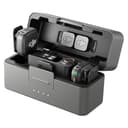 DJI Mic 3 (2 TX + RX + Charging Case) DJI's current wireless flagship, and the kit to buy if you are starting from scratch. It keeps the 32-bit float safety net and the charging case that made the Mic 2 popular, then shrinks the transmitter to 16 grams, stretches battery life to a full working day, and adds timecode for multi-camera edits. Less visible on a collar, harder to run flat. | Best lavalier system | |
| 2 | 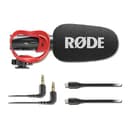 RODE VideoMic GO II The best on-camera mic for most creators, and the one to buy if you buy one. It plugs into a camera by 3.5mm or straight into a computer or phone over USB, needs no battery, and sounds dramatically better than any built-in mic. Directional enough to reject room noise, simple enough to forget about. | Best on-camera shotgun | |
| 3 | 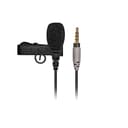 RODE smartLav+ The cheapest way to get broadcast-style lavalier sound, if you don't mind a cable. It is a proper wired lav that plugs into a phone's headphone jack (or an adapter), so a single presenter gets clean, close, consistent audio for very little. Wired means no batteries and no dropouts. | Best budget lavalier | $56.90 · View on Amazon Price as of October 5, 2026. #ad How we’re funded |
| 4 | 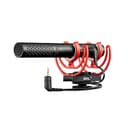 RODE VideoMic NTG The shotgun that is also a USB microphone, which is exactly what a streamer wants. It carries the acoustic design of RODE's NTG5 broadcast shotgun, then adds a USB output so it can go straight into a computer, a variable gain dial, a high-pass filter, a -20dB pad, a high-frequency boost and a safety channel. The 3.5mm jack auto-senses whether it is plugged into a camera or a phone, and doubles as a headphone output when you are on USB. | Best shotgun for a boom | $239.00 · View on Amazon Price as of October 5, 2026. #ad How we’re funded |
Which of these to buy
For interviews and anything where people move, buy a wireless lav system. The DJI Mic 3 is the current recommendation: two transmitters with a charging case, 32-bit float and 24-bit recording with timecode, and range up to 400m line of sight. Two transmitters means two people, which is the entire reason interview kits are sold in pairs. The full comparison is in our wireless microphone roundup.
For a seated presenter on a budget, the RODE smartLav+ is an omnidirectional wired lav on a TRRS connector that plugs straight into a phone. Nothing to charge, nothing to pair, and it sounds genuinely good. Its limit is the cable, which is also the thing that makes it reliable.
For filming yourself, a shotgun on the camera is the simpler setup and there is no battery to forget. The RODE VideoMic GO II is the default upgrade over a built-in mic: supercardioid, powered by the camera or over USB-C, with no battery at all. If you want a shotgun that will also live on a boom arm for streaming, the RODE VideoMic NTG adds variable gain, a high-pass filter, a pad and a ten-year warranty. Both appear in our shotgun microphone roundup.
Frequently asked questions
Is a lavalier or a shotgun mic better for interviews?
A lavalier, for consistency. Clipped to the subject's chest it stays the same distance from their mouth however much they move, so the level never drifts and the room noise stays low. A shotgun on a boom sounds more natural and open, but it has to be aimed and held close, which needs a second person or a very controlled setup.
What is the difference between a lavalier and a shotgun microphone?
A lavalier is a tiny microphone worn on the subject, usually omnidirectional, which works by being extremely close to the mouth. A shotgun is a long directional microphone that stays with the camera or on a boom and works by rejecting everything outside a narrow angle in front of it. One solves distance by eliminating it; the other by aiming.
Do shotgun mics pick up less background noise?
Within their aiming angle, yes — a supercardioid pattern rejects a great deal of sound from the sides and rear. But rejection is no substitute for proximity. A shotgun three feet away in a noisy room will usually sound worse than a lav on the subject's chest, because the lav's enormous proximity advantage beats the shotgun's directionality.
Can I use a shotgun mic on top of my camera?
Yes, and it is the standard upgrade over a camera's built-in mic. It works well when the subject is close — arm's length for a selfie-style vlog is ideal. It degrades quickly with distance, so an on-camera shotgun filming someone across a room will sound echoey and thin no matter how good the microphone is.
Why do lavaliers sound muffled sometimes?
Usually placement. Under clothing, behind a thick collar, or too low on the chest and the high frequencies get absorbed and the voice goes dull. Clip it on the outside of the top layer, roughly a hand's width below the chin, centred and facing up, and clear of anything that will brush against it.
Should I record both a lav and a shotgun?
If you can, yes, and it is standard practice on professional shoots. The lav is your reliable primary track and the shotgun gives you a more natural, open-sounding alternative plus a backup if something goes wrong — a rustle, a dead battery, a clip knocked loose. Audio has no second take once your subject has left.
Is a wireless lav better than a wired one?
It is more flexible, not better sounding. A wired lav is cheaper, has nothing to charge and nothing to drop out, and is ideal for a seated presenter near the recorder. Wireless is what you need the moment the subject stands up, moves around, or sits further from the camera than a cable reaches.
Sources
- DJI — Official product specifications — DJI official spec pages for Osmo, Mic and drones (accessed July 18, 2026)
- RODE — Official microphone specifications — RODE's official mic spec pages (accessed July 18, 2026)
Keep reading
Best Wireless Microphones
Clip-on systems for interviews and moving subjects.
See wireless micsBest Shotgun Microphones
On-camera and boom-mounted directional mics.
See shotgun micsHow to Choose a Microphone
Every type, matched to how you actually record.
Read the guideBest Mic for Filmmaking on a Budget
Building a usable sound kit without a sound budget.
See the picks